

 Online Reporter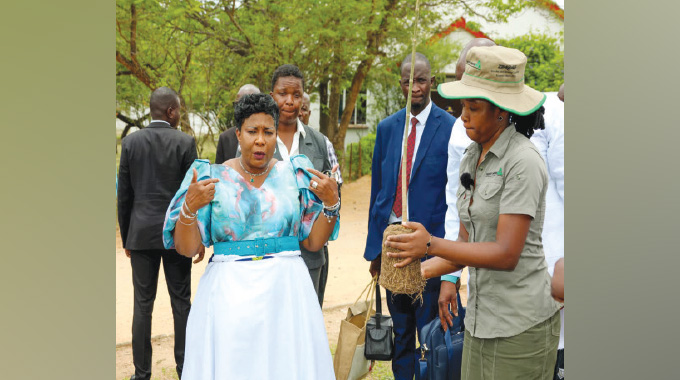
Blessings Chidakwa, Senior Reporter
ENVIRONMENT Patron, First Lady Dr Auxillia Mnangagwa, has called for cleanliness to be embraced as a lifestyle, praising schools across Zimbabwe for leading the way in sustainable waste management and circular economy innovation.
Dr Mnangagwa made the remarks yesterday at John Tallach High School in Umguza District, Matabeleland North province, where she viewed fruits of her work artefacts produced from recycled waste materials under her “Turn Waste into Money” initiative.
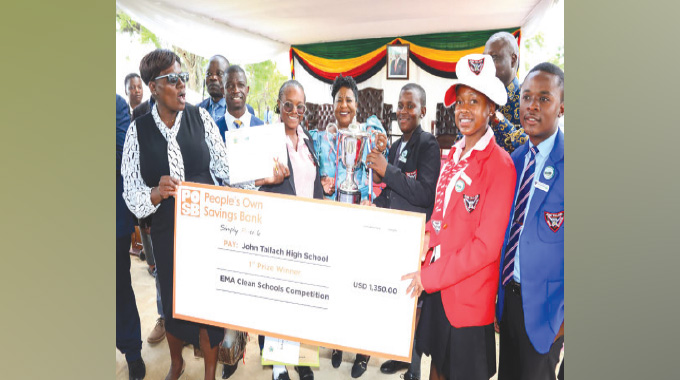
John Tallach High School emerged the national winner in the Clean Schools Competition, sponsored by stationery manufacturer, Eversharp, in partnership with the Environmental Management Agency (EMA), POSB and the Ministry of Primary and Secondary Education.
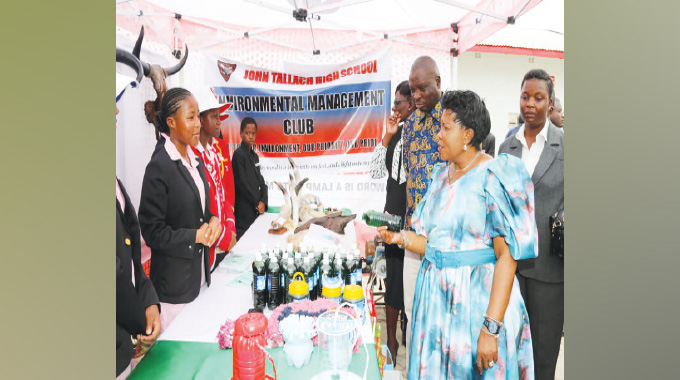
The First Lady toured various school projects, including horticulture, waste separation, recycling, poultry production, rabbit keeping, detergent-making, craftwork, sewing, and water harvesting.
Learners also produced a magazine focusing on environmental issues, which Dr Mnangagwa purchased along with some of the school’s farm produce.
The learners explained to her the steps they are taking to protect the environment while generating income from repurposed waste. The First Lady was particularly impressed by the range of recycled artefacts on display.
“I am impressed that it is the children themselves who are doing these projects. When you participate in such programmes, you must think about how they will benefit you in the future. If you are not gifted academically, you may discover something practical that you are good at and can build on.
“Learners, you mean a lot to us and to your school, because you carry its name. Whatever you learn at school, you should also be able to take home and apply in your families and communities,” she said.
Dr Mnangagwa also added: “Drugs have become a serious menace, but initiatives like these help you stay away from them. Encourage your peers to do the same.”
The Environment Patron then planted a Mukashu tree (Rauvolfia caffra) at the school, highlighting the benefits of trees and encouraging communities to take advantage of the rainy season for planting. She later presented prizes and certificates to winning schools.
Addressing the gathering, Dr Mnangagwa emphasised the broader impact of the Clean Schools Competition, saying it serves as a catalyst for embedding the principles of zero waste and circular economy within the education system.
“The Clean Schools Competition transcends the concept of mere tidiness; it should be a lifestyle. A lifestyle approach is very critical as it enables all of us to walk the talk.
“By integrating cleanliness and waste management into the curriculum and daily routines, our schools ensure that the programme is not a monthly observance, but a way of life.”
As Environment Patron and Global Zero Waste Ambassador, she expressed excitement that the competition directly advances the national zero waste agenda, positioning schools as centres of excellence for their communities.
“Through this initiative, our learners have become innovators, developing practical and sustainable solutions from recycling projects to creative reuse initiatives that transform waste into valuable resources all of which were commendably showcased during the adjudication process and exhibitions here today,” she said.
Dr Mnangagwa said there is an intrinsic connection between this initiative and the national vision under the National Clean-Up Programme.
“This programme, launched in 2018 by His Excellency, the President of the Republic of Zimbabwe, Dr ED Mnangagwa, established a consistent, nationwide call to action for a cleaner and healthier Zimbabwe.
“Our schools have proudly taken a leading role in this national movement, and I am proud of this initiative. Indeed, our learners and educators continue to be among the most committed participants in the National Clean-Up Programme.”
The First Lady described the competition as a flagship initiative instilling environmental action among young people.
“The dedication and innovation demonstrated in this competition through consistent advocacy and the adoption of tenets of sustainable waste management remain key pillars in ensuring the long-term success of this national vision.
“Our schools are the engine driving this national transformation, influencing families and communities to value a clean environment as a matter of both public and environmental health and national dignity.”
Dr Mnangagwa also commended rural schools, highlighting Hande High School from Buhera and Guga Primary School from Lupane for their innovative contributions.
“As service centres expand and populations grow, waste management challenges are no longer confined to urban settings. Their efforts embody the truth that environmental excellence transcends geographical boundaries. Well done.
“It remains my earnest desire to see more winning initiatives coming from the rural space. Hence my encouragement for schools in rural areas to remain shining beacons in the waste management discourse.”
The First Lady praised learners for their innovation and dedication, which serve as an inspiration for all.
“You remain the environmental champions and change-makers today and the custodians of a sustainable Zimbabwe tomorrow. We remain the authors of our destiny. Together, we are building a cleaner, greener, and prosperous Zimbabwe.”
Mother Zimbabwe held an interactive session with learners, speaking candidly against drug abuse, premature sexual relationships, and other social vices among youths. She also inquired about the dangers of engaging in love affairs at a young age.
The First Lady asked the learners what a girlfriend is, receiving energetic and thoughtful responses. One learner from Plumtree High School made the crowd laugh, saying, “It is that girl you are always thinking about.” He urged fellow learners never to engage in sex before turning 18, saying, “Let’s stop raping each other.” Another learner described a girlfriend as “your lover, a person whom you date.”
First Lady Dr Auxillia Mnangagwa addressed the learners: “Please stop engaging in love affairs at your age. Focus on your studies and define your future so that you can choose the profession you want to pursue.
“I graduated with a doctorate last year. Imagine attaining a PhD at my age! I did it for you to emulate, showing that education never ends, and that determination, courage, and hard work can help you achieve your goals.
“Ask yourself why you should fail when I could achieve a PhD at this age. With holidays approaching, let us return to school and avoid cases of learners eloping. Look after yourself, protect yourself, and respect yourself, so that we hear more stories of success.”
The First Lady presented prizes and certificates to the winning schools, with both primary and high schools receiving cash prizes, medals, hampers, and other awards for their outstanding performance in the competition.
John Tallach High School claimed first prize in the high schools category, while Louis Mountbatten Primary School from Harare Province took first place in the primary schools category.
Over 2 900 schools participated this year as compared to the previous year, which had 1 041 participants.
Minister of State for Matabeleland North Provincial Affairs and Devolution, Richard Moyo, hailed the competition as a demonstration of environmental stewardship as a culture.
“Today we are not only celebrating a competition, we are celebrating a movement of young people, teachers, communities, and institutions who are choosing to protect nature and sustain our environment for generations to come.
“The creativity and commitment displayed by participating schools give us hope and confidence that Zimbabwe is in safe hands,” he said.
EMA director-general Dr Aaron Chigona said the schools competition was paying off since its launch in 2022, with the ambitious vision to cultivate sustainable waste management practices in schools, enhance environmental awareness, and inspire innovation among learners.
“The changes on the ground are visible across the country. Schools are now characterised by clean, labelled waste separation points, board and leader signage, well-maintained grounds, and vibrant environmental clubs that co-ordinate clean-up campaigns within the schools and the surroundings.
“Schools have become successful entrepreneurship centres because we have realised that they are real products that are being sold, and these learners are able to convert that money into real business practices,” he said.
John Tallach school head Mr Bonakele Ncube said the school’s Environment Club, patrons, teachers, ancillary staff, and learners’ dedication turned their motto, “Our Environment, Our Priority, Our Pride” into a living reality.
“Being ranked position one nationally is a testament to your hard work and teamwork. We ensure Vision 2030 is attained, as cleanliness is healthy for a productive economy that cares for its natural resources.”
Sponsors POSB and Eversharp echoed their support.
Mr David Mukwacha of POSB said: “As POSB we are proud to stand alongside these champions who are transforming society one project at a time. They are children and young people who are making a real difference in our communities.
“We believe in supporting communities and building a sustainable future in line with the United Nations Sustainable Development Goals.”
Mr Julian Mbono from Eversharp added that the competition promotes environmental responsibility and fosters a lasting commitment to sustainability among students and communities.
“The Clean Schools Competition is a powerful tool for driving behavioural change and promoting a shift in mindset regarding environmental responsibility among students and the broader community.
“Its goal is to foster a lasting community commitment to environmental stewardship in clean schools, encouraging students to actively participate in sustainable waste management practices,” he said.
The EMA Clean Schools Competition continues to encourage schools to implement creative approaches to waste management, nurturing critical thinking, problem-solving, and environmental stewardship among Zimbabwean learners.


