Emmanuel Kafe
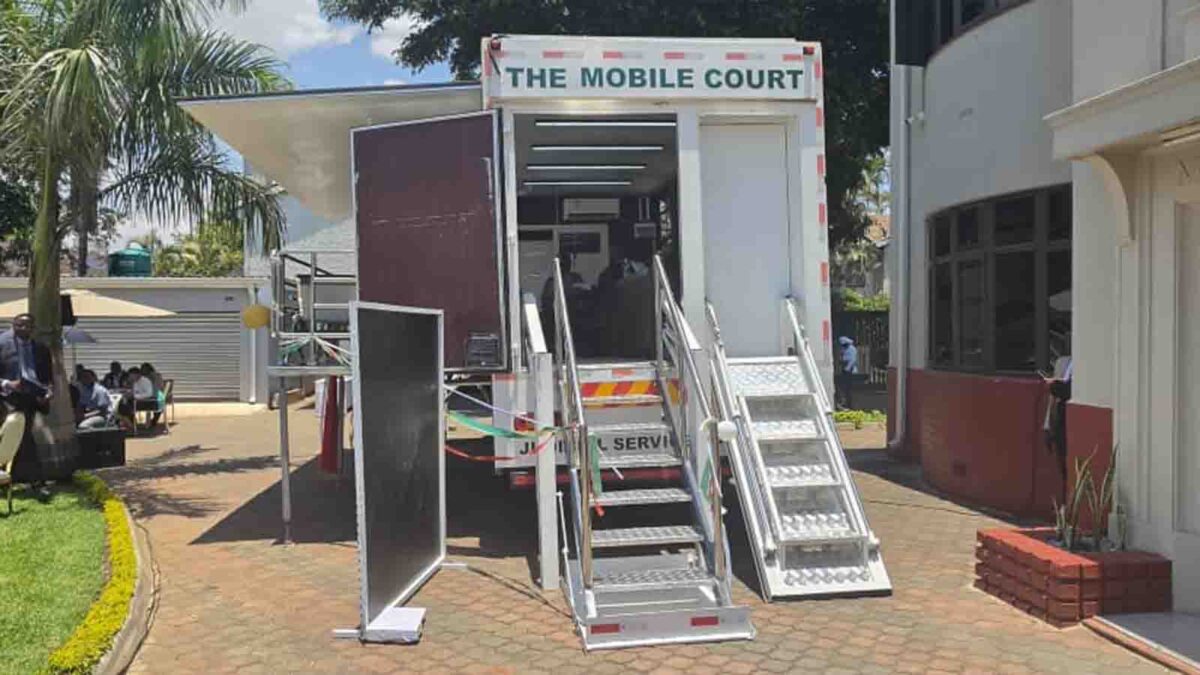
THE Judicial Service Commission has commissioned Zimbabwe’s first mobile court, bringing judicial services directly to communities to ease pressure on conventional stations and reduce the financial burden of accessing justice.
Commissioned by Chief Justice Elizabeth Gwaunza in Harare on Thursday, the mobile court will initially serve Glen Norah, Glen View, Budiriro, and Southlea Park, with each area’s police station receiving a weekly visit on a rotational basis. The initiative is projected to significantly reduce the caseload at Mbare Magistrates’ Court while minimizing transport costs, missed appearances, and administrative delays.
Speaking at the ceremony, Chief Justice Gwaunza stated that the development addresses systemic barriers that frequently prevent ordinary citizens from accessing legal recourse.
“For many people, access to a court still involves travelling considerable distances, paying transport costs and taking time away from work, family responsibilities or the pursuit of a livelihood,” Chief Justice Gwaunza said. “These burdens can be particularly difficult for people with limited means, older persons and persons with disabilities.”
She emphasized that bringing courts closer to residential areas is a fundamental constitutional obligation rather than merely an administrative convenience.
“A court that people cannot reach cannot fully serve them. The mobile court takes the court to the people, rather than requiring the people always to come to the court,” she added.
The facility is expected to enhance operational efficiency by reducing the time police spend transporting accused persons and dockets to Mbare, allowing conventional magistrates to concentrate on outstanding matters. The pilot programme forms part of the Judicial Service Commission’s 2026–2030 Strategic Plan, which targets the establishment of a mobile court in every province by 2030.
Prosecutor-General Justice Loyce Matanda-Moyo described the development as a homegrown solution that will strengthen public confidence in the judiciary by allowing communities to witness criminal proceedings firsthand.
“This initiative is a game changer: a deliberate institutional response that brings justice to the people and tailors solutions for communities so that the law is seen in motion,” Justice Matanda-Moyo said. “Mobile courts will allow communities an opportunity to witness justice in motion within a stone’s throw of their homes.”
Justice Matanda-Moyo noted that the arrangement will particularly benefit women, children, elderly citizens, and persons with disabilities. However, she cautioned that faster case disposal must not compromise the statutory rights of accused persons or the fairness of proceedings.
“The quality of justice at the mobile courts must never be sacrificed for numerical performance,” she stated, adding: “This is not just a new vehicle on our roads; it is a new vehicle for justice!”
Chief Justice Gwaunza concluded that the pilot project will be closely monitored, with operational feedback guiding its eventual expansion nationwide. She stressed that speed must remain secondary to core legal standards.
“A court that moves quickly, but unfairly, does not serve justice,” she said.