Online Reporter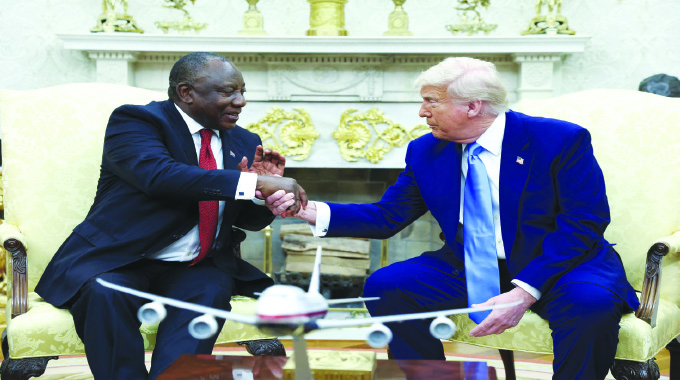
Lawson Mabhena
IN February 2020, when I returned from covering the 33rd Ordinary Session of the Assembly of Heads of State and Government of the African Union, I wrote that President Cyril Ramaphosa of South Africa had made a strong impression in Addis Ababa, Ethiopia.
Ramaphosa took up the role of chair of the AU and addressed foreign interference in African affairs with significant vigour. This marked a notable departure from the “quiet diplomacy” approach previously endorsed by former president Thabo Mbeki, who is regarded as one of Africa’s best statesmen.
I noted that the key moment in Ramaphosa’s acceptance speech, after succeeding President Abdel Fattah El-Sisi of Egypt, was when he compared the US-sponsored peace proposal for the Palestinian-Israeli conflict to the Bantustan policy of the Apartheid regime.
The Bantustans, or homelands, were designated areas created by the racist Apartheid government of South Africa, where the black majority were effectively “dumped” to keep them removed from urban areas and excluded from the political system.
I emphasised in the article that US President Donald Trump’s controversial Middle East peace plan, which on one hand called for a two-state solution but on the other awarded the entire Jerusalem to Israel, was like a Bantustan because it served to alienate the Palestinian people from their culture, heritage and religion. And their exclusion from the drafting of the 80-page plan announced by Trump at the White House, together with Israeli Prime Minister Benjamin Netanyahu, was apartheid in nature.
When Trump returned to the White House in January, this time as the 47th president of the United States, Ramaphosa was no longer the AU chair. But the resolve of the African leader had not changed since Trump was the 45th president.
Last year, South Africa filed a case with the International Court of Justice (ICJ), accusing Israel of committing genocide against Palestinians in Gaza. The ICJ, which is the principal judicial organ of the United Nations, was established after World War II to resolve disputes between nations and provide advisory opinions on legal issues.
South Africa claimed that Israel’s actions in response to Hamas attacks violated the 1948 Genocide Convention, further arguing that statements made by Israeli officials, including Prime Minister Netanyahu, were potential indicators of “genocidal intent.”
The US did not approach this bold action lightly, and earlier this month, Donald Trump made a provocative statement, claiming that the media is intentionally ignoring what he describes as a “genocide” happening in South Africa, specifically targeting white farmers. Trump’s remarks coincided with a significant moment as the first flight carrying white South African “refugees” was set to arrive at Dulles Airport.
US-South Africa relations hit an all-time low. Ramaphosa opted to take the high road and met with Trump at the White House on Wednesday to “reset” the growing tensions in their bilateral relationship.
Unsurprisingly, Trump resorted to theatrics, drawing on his experience as a prominent figure in World Wrestling Entertainment (WWE) and his role in the reality series The Apprentice to enhance the performance.
He maintained his usual confrontational tone and relied on discredited sources to catch his guest off guard, a tactic he had previously used against Canadian Prime Minister Justin Trudeau and Ukrainian President Volodymyr Zelensky.
Ramaphosa remained calm and composed. This was his opportunity to demonstrate to the world that the allegations of genocide against white farmers in South Africa were nothing more than nonsense.
And he did not blow the chance. He seized the opportunity with both hands.
Watching the meeting live on Wednesday, I realised that the Ramaphosa I saw taking over the reins at the AU has been true to his word of challenging foreign interference in African affairs head-on.
“World leaders have a huge new problem: Trump’s Oval Office smackdowns,” read a CNN headline after the meeting, obviously borrowing from the famous “WWE Smackdown” live televised wrestling shows.
“Foreign leaders now enter the hallowed lair of the US president — who runs press conferences like they’re WWE cage matches — at their peril,” the article reads.
The Guardian was not nice to the US president either, with the headline: “Trump ambushes South African president with video and false claims of anti-white racism.”
“Ramaphosa keeps cool during Trump’s choreographed onslaught,” the BBC said.
Reads the BBC story in part: “Three months into Donald Trump’s second term, foreign leaders should be aware that a coveted trip to the Oval Office comes with the risk of a very public dressing down, often straying into attempts at provocation and humiliation.”
Following the attempts by Trump to “provoke” and “humiliate” Ramaphosa on Wednesday, two distinct truths came out: No amount of evidence will make Trump take back his false allegations of genocide in South Africa, and no amount of bullying will scare Ramaphosa.
In his own wrestling ring, Trump threw all the multimedia lies at Ramaphosa, in an uncoordinated manner like late wrestler “Rowdy” Roddy Piper. Like Ric Flair, “The Dirtiest Player in the Game”, Trump bends the rules, uses underhanded tricks, and creates dramatic confrontations to secure victory.
Still, like all WWE villains, he eventually met his match.
Ramaphosa knew what was coming before he stepped between the ropes. He pushed back, and President Donald Trump got a smack-down.