Chronicle Editor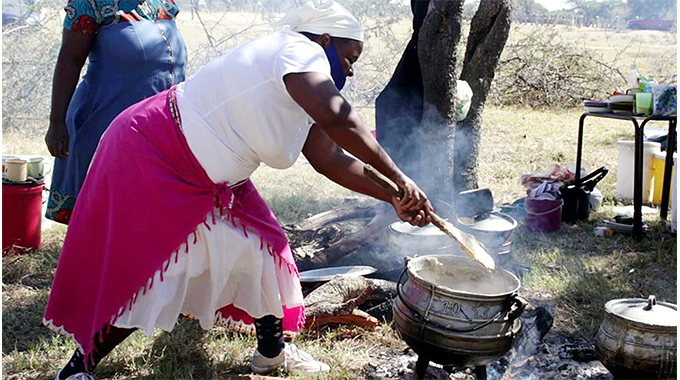
Kamangeni Phiri
The setting was rural, far divorced from that of the world’s best chefs but the food was top notch. An aroma of various stewed meats and foods emanated from the clay pots and three-legged pots on fires. Food stalls displaying all kinds of traditional foods and crops were in a neat raw not far from the fireplaces.
The talk, in a melting pot of indigenous languages and accents from across Zimbabwe’s rural southern region, was on the benefits of eating traditional meals.
“This is it,” says a smiling Ms Joyce Nyikadzino, 35, opening her many pots to the fair visitors, “I have prepared finger millet isitshwala, road runner chicken, dried cow pea leaves mixed with peanut butter, cooked pumpkins and a lot more.”
More women were equally busy hosting visitors at their respective stalls. They had on display roasted groundnuts, stewed turkey meat, preserved seeds for small grains, pumpkins and bottle gourds, among other crops.
The women were participating in a Seed and Food Fair held at Kombo Clinic in Insiza district last month where they were sharing recipes and displaying their proficiency in preparing African dishes.
Ms Nyikadzino first mastered the art of preparing traditional dishes as grew up in Bindura under the stewardship of her grandmother. “Sadly, my family and I no longer eat such meals a lot because small grains are not widely grown these days,” says Ms Nyikadzino.
The food fair, held under the theme, “We grow small grains to live a healthy life,” brought together farmers from diverse ethnic backgrounds in Ward 22.
Ms Nyikadzino is among the many farmers who were resettled in the Lochard area, Ward 22, Insiza district in Matabeleland South.
The mother of two is today an expert cook of African cuisines after she was trained by the Zimbabwe Project Trust (Zimpro), a local non-governmental organisation working in partnership with the Government.
The NGO, which seeks to uplift the lives of rural people in Matabeleland South, is encouraging communities to grow small grains and other nutritional traditional crops.
Zimpro’s monitoring and evaluation officer, Ms Sibonile Ndlovu, said the traditional food and crops programme was introduced as a way of reviving farmers’ interest in growing small grains.

“A lot of traditional foods had gone extinct or are not known in some parts of the area. We saw a slow uptake of small grains and decided to come together with the ministry of Lands, Agriculture, Fisheries, Water and Rural Resettlement to host this seed and food fair. We want people to see how the small grains can best be used,” she says.
Zimpro’s initiative comes at a time when a growing number of people in the world are suffering from non-communicable diseases like diabetes and high blood pressure, which are mostly attributable to dietary habits.
Despite the slow uptake of the small grains in the district, a local elderly farmer, Mr Makim Moyo, never misses a traditional meal.
The farmer from Village Two in the Lochard area who turned 70 last month, says traditional meals and crops were helping to keep him in good health.
“It is good that most farmers in our area are now reverting to our old ways of growing small grains. I love these grains because they are body building foods that help to keep away diseases,” says Mr Moyo.
Insiza farmers received training in preparing traditional meals under Zimpro’s Insiza Improved Income and Natural Based Resilient Livelihoods Project.
Ms Ndlovu said the training helped farmers appreciate the nutritional value of the different types of crops they grow.
She said farmers were also taught how to select and preserve seed from their yields. The seed preservation programme ran under the banner, “Preserving seed for ourselves and the next generations.”
“We want to promote the local seed but we are certainly not saying people should stop buying the certified seed. As Zimpro, we just want to promote the Open Pollinated Varieties (OPV) so that people use that grain as seed,” said Ms Ndlovu.
The resettled farmers originally came from various parts of the country. They came from Plumtree, Mbembesi, Gutu, Mberengwa, Mwenezi, Tsholotsho and even as far as Bindura.
“There are different ethnic groups in this ward. We have the Xhosa, Shona and Kalanga, among others. Each ethnic group is bringing in its own specific type of food that is synonymous with its respective culture. We are trying to bring these people together so that they learn how different kinds of food can be prepared using the same type of grain,” says Ms Ndlovu.
She hopes local farmers will move away from growing maize in favour of the small grains after benefitting from the knowledge obtained at the seend and food fair.
Insiza district emerged as one of the province’s top cereal producing areas in the previous farming season.
Matabeleland South’s acting provincial agritex officer, Mr Mkhunjulelo Ndlovu, lamented farmers’ reluctance to grow more legumes, oils and small grains that promote healthy lifestyles.
“Insiza district is doing very well in cereal production but there is still a gap when it comes to the aspect of nutrition. Our farmers need to grow a lot of legumes, oils and small grains,” he says.
Mr Ndlovu believes the challenges associated with the processing and harvesting of small grains discourage farmers to grow the crops.
He wants industry and tertiary institutions to come in and reduce the work intensity by mechanising the processing and harvesting of traditional crops.
“The processing of maize is very simple and easy. We have combined harvesters for this crop but when it comes to small grains, the harvesting and processing (threshing), demands a lot of muscle power. There is also a challenge of birds that eat the small grains thereby reducing the yields,” says Mr Ndlovu.

Insiza District is located in natural region 4 and 5 characterised by low rainfall which rarely exceeds 450mm and is poorly distributed.
Lupane State University (LSU) food science lecturer, Mr Makhosi Mahlangu, says it is important to grow indigenous crops as they are suitable to local weather conditions.
“They also promote healthy lifestyles unlike some imported varieties,” he says.
Mr Mahlangu said indigenous knowledge was vital as research has proved that tempering with genetics and ecosystems in agriculture sometimes causes hunger in communities.
Small grains work very well in these arid areas, he says.
“If you import genetics you change ecosystems. Once you change ecosystems you affect the dynamics of nature and you can end up having hunger in some areas because most of the commercial varieties do not perform well, specifically, small grains,” he says.
Mr Mahlangu warned people against eating a lot of foods processed from maize like cornflakes and isitshwala that cause an increase in sugar levels.
LSU has plans of partnering with rural communities to modernise traditional dishes through value addition.
“There is very little processing that is coming out from the village so the best way is to go back there and create our future industries according to the Government’s thrust,” says Mr Mahlangu.

Renowned historian and traditionalist, Mr Pathisa Nyathi, urged farmers to embrace traditional ways of farming to enhance production.
“We need to master the art of selecting and preserving seed so that it’s not destroyed by insects. Our elders would use firewood ash to preserve seed. This seed from our harvest is very good. Let’s use it,” he says.
Mr Nyathi said Africans need to stop viewing everything from the West as superior to their own.

“Food is part of culture. If we discard our traditional meals we are discarding our culture. Let’s grow and eat traditional grains like our forefathers used to do because it is good for our bodies,” he says.



 Online Reporter