

 Online Reporter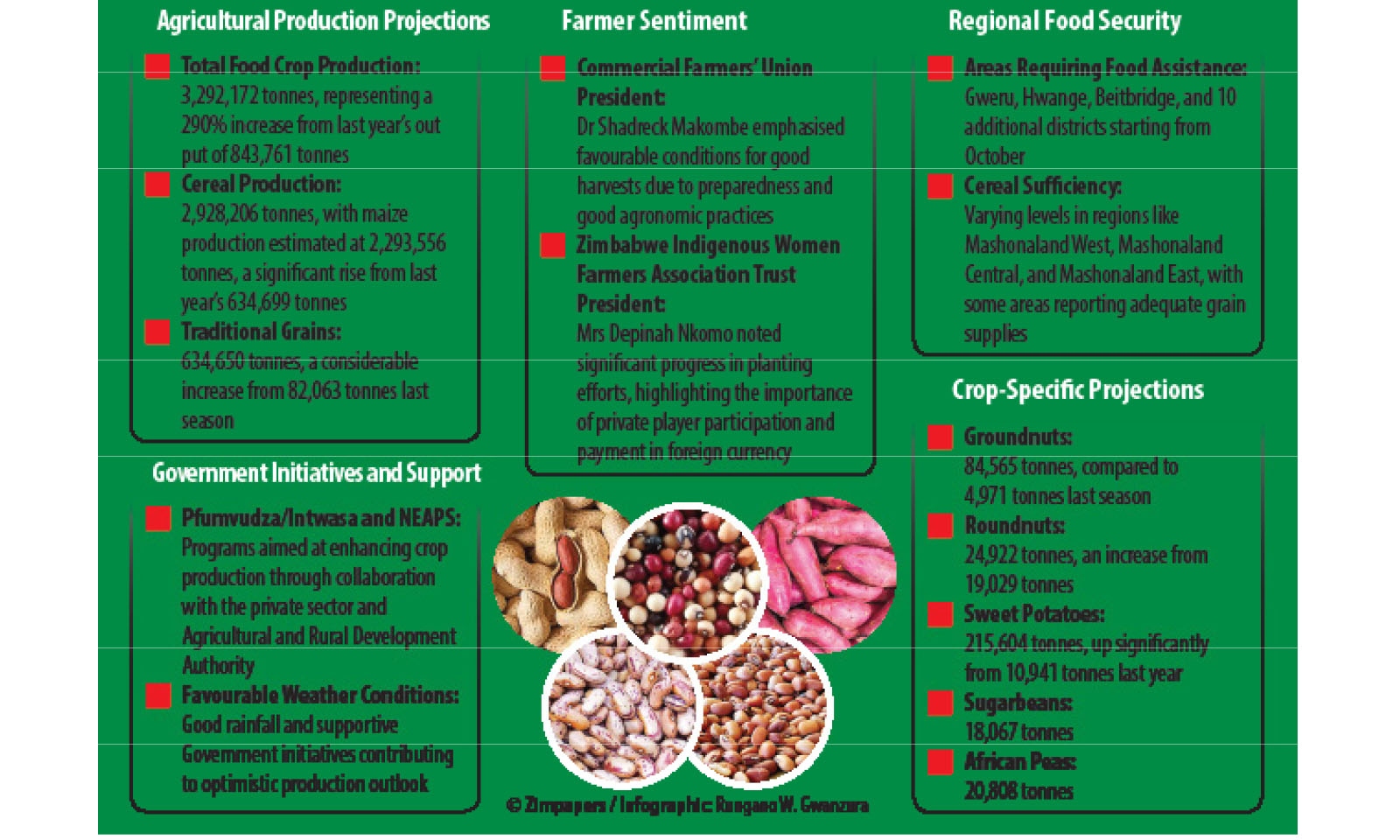
Precious Manomano
Herald Reporter
ZIMBABWE’S food production has increased 290 percent to 3 292 172 tonnes of food crops, compared to 843 761 tonnes last season, latest projections show.
The surge in production is largely attributed to various Government initiatives aimed at enhancing food security and fostering resilience in the farming sector.
The Crop, Livestock, and Fisheries Assessment (CLAFA-2) indicates that total cereal production is projected to reach 2 928 206 tonnes.
Notably, maize production is estimated at 2 293 556 tonnes, a significant rise from last year’s 634 699 tonnes.
Furthermore, traditional grains, which include sorghum, pearl millet and finger millet, are expected to yield 634 650 tonnes, a considerable increase from 82 063 tonnes last season.
The Government’s strategic focus on agro-ecological practices has led to a desirable trend of increased production in these grains.
In addition to cereals, other crops are also set to thrive.
Groundnuts are expected to produce 84 565 tonnes compared to just 4 971 tonnes last season. Similarly, roundnuts are projected to yield 24 922 tonnes, an increase from 19 029 tonnes, while sweet potatoes are anticipated to reach 215 604 tonnes, up significantly from 10 941 tonnes last year. Sugarbeans and African peas are also showing growth, with expected yields of 18 067 tonnes and 20 808 tonnes, respectively.
Despite the overall positive outlook for national food production, challenges remain in certain regions. Areas such as Gweru, Hwange, and Beitbridge will continue to require food assistance, alongside an additional 10 districts starting from October. This highlights the importance of targeted support to ensure that vulnerable populations are not left behind.
Regions like Mashonaland West, Mashonaland Central, and Mashonaland East show varying levels of cereal sufficiency, with most areas reporting adequate grain supplies. However, specific districts, including Chegutu, Makonde, and Rushinga, will need assistance after 10 to 12 months or even 7 to 9 months, respectively. Similar patterns of sufficiency and need can be observed in Manicaland, Midlands, Masvingo, and Matabeleland, where some areas are self-sufficient while others remain at risk.
Farmers across the country have expressed optimism for this year’s production, bolstered by good rainfall and supportive Government initiatives.
Commercial Farmers’ Union president Dr Shadreck Makombe said favourable conditions had set the stage for a good harvest.
“Farmers were well prepared and well informed for this season. We have also received good rains. There is no doubt that this season we will make it. Farmers were practicing good agronomic practices which are crucial in farming,” he said.
Echoing this sentiment, Zimbabwe Indigenous Women Farmers Association Trust president Mrs Depinah Nkomo noted the significant progress in planting efforts.
“The future of maize is promising, thanks to private player participation, which is critical in boosting farming. The future is bright if farmers continue to be paid in foreign currency. We are optimistic that next year we can achieve our targets, if private players partner with the Government in farming,” she said.
Government has rolled out several initiatives to bolster agricultural productivity. Programmes such as Pfumvudza/Intwasa and the National Enhanced Agriculture Productivity Scheme (NEAPS) aim to enhance crop production through effective collaboration with the private sector and the Agricultural and Rural Development Authority.
These initiatives are set to create a more resilient agricultural framework that not only addresses immediate food security needs, but also lays the groundwork for sustainable farming practices in the long run.
While Zimbabwe faces challenges regarding food security in certain regions, the overall outlook for the agricultural sector is promising, thanks in large part to government efforts and favourable weather conditions.
The collaborative approach involving farmers, private players, and Governmental support is crucial for ensuring that the country can achieve food self-sufficiency and secure a brighter future for its agricultural landscape.



