admin
admin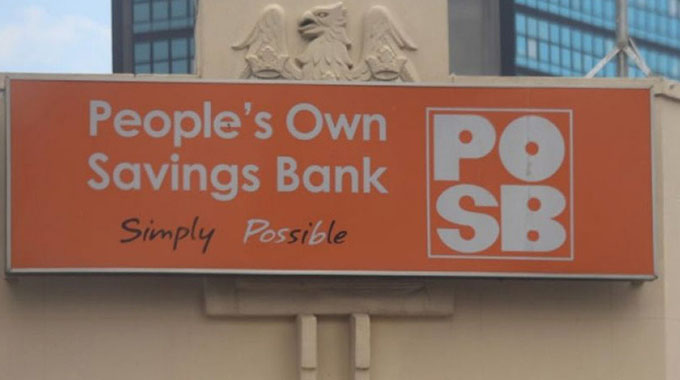
Tawanda Musarurwa
The introduction of the foreign currency auction system has given impetus to the partial privatization of the Peoples Own Savings Bank (POSB), chief executive officer Admore Kandlela has said.
Last month, the country’s monetary authorities moved to the official foreign currency rate from a peg of 25 to the United States dollar to an auction system.
Last week’s forex auction saw the official rate adjusting to 76,7 to the US dollar, weakening 6,2 percent from the prior rate of 72,1.
Mr Kandlela told the bank’s shareholders that an agreement had been reached with transaction advisors, KPMG.
And that the crawling exchange rate has made it easier to facilitate transactions.
“POSB is one of those entities that are earmarked for privatization. We started this privatization process on the 23rd of October 2018 and we had hoped by a certain date we would have completed.
“I’m glad to say as of the 9th of June we had a meeting. And on the 16th of July that’s when we finally signed this contract with KPMG,” said the chief executive.
“But core to this was obviously the unstable exchange rate. When we got into an agreement there was a fixed exchange rate system where the exchange rate was at 25.
“Obviously for any business to have done any contract signing which is US dollar-denominated but you pay it at the fixed exchange rate was a bit of a challenge.”
The partial privatization of POSB is part of a broader Government decision to privatize a number of parastatals so that they can meaningfully contribute towards the revival of Zimbabwe’s economic fortunes.
Kandlela added that the contract with KPMG should be completed next week.
“Now when we moved over to the auction rate, which is now moving, we can now sign the contract.
“This coming Tuesday we are going to have a meeting and then we see how we go forward,” he said.
The state-owned banking entity is one of the few consistently profitable parastatals.
But an inflationary operating environment complicated financial performance in FY2019.
“In the year just ended we are quite aware that the economy was actually hard hit by inflation, and you find in our financials that in historic terms we made a profit of $78,1 million.
“But in inflation-adjusted terms we made a loss of $265 million,” said Kandlela.
“The net operating income, over the years, we find that we actually reached $349 million at the end of the year. This was due to effective yields on financial assets, which were below inflation.”
During the period under review, POSB’s total assets declined from $1,7 billion to $678 million as a result of inflation, down 68 percent.
Total deposits decreased by 71 percent from $1,5 billion to $337 million.
But liquidity ratio was improved.
“In terms of liquidity ratio, the banks were quite liquid and this is merely a reflection that there wasn’t much lending to be done and also most of the assets were on monetary terms, reflecting that we may not have had other assets on terms of physical assets,” said the CEO.
“More significant was the capital adequacy. The capital base of the bank, as at December 2019, was $275 million, but we are giving to give you something else when we update you on the current position.”
POSB has over the past few years taken a proactive approach to enhance its digital banking systems, whose importance has been highlighted by the Covid-19 pandemic.
“As we go forward we find that we need more of the digital banking infrastructure, so the future strategy will see an increased digital aspect.
“Currently the bank has 80 percent of its customers on the digital platforms and the usage of these platforms is about 53,9 percent,” said Kandlela.


 Online Reporter