admin
admin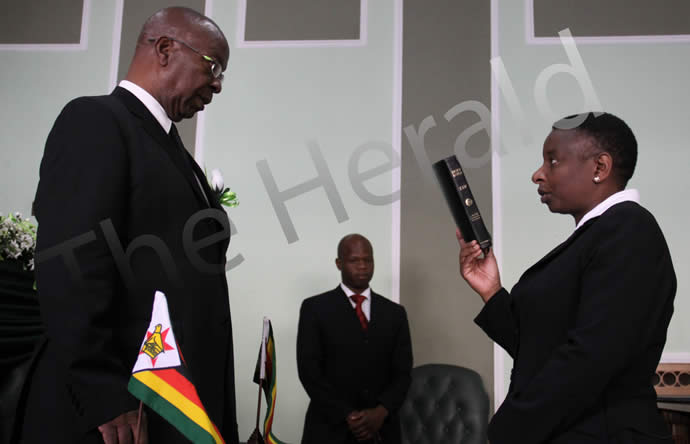
in a bid to meet the increased number of judicial officers created by the new Constitutional Court of Zimbabwe. The four — Mrs Fatima Maxwell, Ms Evangelista Kabasa, Mr Rogers Manyangadze and Mr Lawrence Murasi — took the judicial oath and the oath of loyalty to
serve as presidents of the Labour Court before the Chief Justice at the Supreme Court.
The quartet was appointed to the bench in terms of the provisions of the Constitution of Zimbabwe and the Labour Act, which provides for President Mugabe to make such appointments after consultation with the Judicial Service Commission.
Before her appointment Mrs Maxwell was the director-civil division in the Attorney General’s Office while Ms Kabasa was working for Legal Resources Centre as legal programmes director.
Mr Manyangadze is joining the bench from the Ministry of Industry and Commerce where he worked as a legal adviser while Mr Murasi was the director legal adviser in the AG’s office.
The swearing in was witnessed by judges of the Constitutional Court and Supreme Court, high-ranking judicial officers and relatives.
Speaking after the swearing in ceremony, Chief Justice Chidyausiku said the appointment of judges to the Labour Court, High Court, Supreme Court and Constitutional Court was necessitated by the need to fill in vacancies created when judges move up the ladder.
“The main reason for appointing new judges… is to try and meet the increased number of the judicial officers created by the Constitutional Court, because of that we have had to move a number of High Court judges to the Supreme Court,” said Justice Chidyausiku.
“We are also moving some of the presidents of the Labour Court to the High Court so that the numbers of judges provided for in the new constitution are met.
“Secondly we are always experiencing an increase in the number of cases coming for the courts and there is a need to constantly increase the number of judges at the courts . . . to cope with the increased volume of work.”
The Chief Justice also said the judiciary was gender sensitive hence more women were being appointed to the bench.
“Women lawyers are becoming more visible and we have responded by appointing them to judicial positions,” said Justice Chidyausiku citing five female judges who were appointed to the High Court on Monday.
“This is a welcome development and as more women come into the legal profession they will be welcome to the bench as well.”
Chief Justice Chidyausiku reiterated that efforts were under way to re-align the labour laws to enable the Labour Court to enforce its own judgments without registering awards at the High Court or magistrates’ courts.
The process of registering an award with the High Court creates hurdles for most litigants thereby causing unnecessary delays.
The bureaucratic process sees a person seeking to stop execution of orders moving from the arbitrator to the Labour Court to the High Court and back to the Labour Court.


 Online Reporter