Online Reporter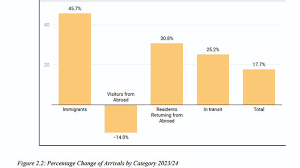
Nqobile Bhebhe
Bulawayo Bureau
Zimbabwe recorded 1,5 million arrivals in the fourth quarter of 2024, with 70 percent of the traffic being returning residents from abroad, illustrating the country’s strong ties with its Diaspora.
The number of visitors showed a slight decline compared to the same period in 2023, but the increase in returning residents offered a contrasting picture of growth.
Visitors are crucial for the country’s economy as they may help boost the economy, create jobs, generate foreign exchange, and attract investment, ultimately contributing to economic development and improving the quality of life.
This is particularly the case for countries such as Zimbabwe, which has a thriving tourism sector that creates significant employment in hotels, restaurants, transportation, attractions, and related industries.
Arrivals bring in foreign currency, which is essential for the country’s economy, allowing it to import goods and services and build up reserves.
Generally, a thriving tourism sector can attract foreign direct investment (FDI) as businesses see opportunities to expand and invest in the industry.
According to the Zimbabwe National Statistical Agency’s latest migration figures, in the period under review, the country recorded 472 745 visitors from abroad, a decrease of about five percent compared to 496 645 visitors during the same period in 2023.
The drop in foreign arrivals, while notable, was overshadowed by the surge in the number of residents returning home.
A total of 1 109 320 residents returned from abroad during this period, up from 847 889 in the fourth quarter of 2023 — an increase of 30,8 percent, the report shows.
An interesting aspect of the arrivals was the mode of travel used by the visitors.
While the number of business arrivals has decreased, the travel patterns of foreign visitors show a strong preference for road transport over air travel.
In the period under review, 77,9 percent of visitors to Zimbabwe chose road transport, constituting 368 478 arrivals. This marks an increase from the 327 688 road arrivals recorded during the same period in 2023.
The road network’s prominence as the primary entry point to Zimbabwe is driven by the country’s strategic location within the Southern African region, with several neighbouring countries using road access to enter Zimbabwe.
The bulk of arrivals by road came through Beitbridge, the country’s busiest border post, which accounted for 103 838 arrivals.
Other key road entry points included Victoria Falls (54 369) and Chirundu (45 651), further highlighting the vital role these border posts play in Zimbabwe’s regional connectivity.
In contrast, air arrivals saw a marked decrease, with 104 267 visitors flying into the country, representing only 22 percent of total arrivals, reflecting a sharp 38 percent decrease from 168 794 visitors in the fourth quarter of 2023.
Among those who arrived by air, Robert Gabriel Mugabe International Airport was the busiest port of entry, handling 52 percent of air arrivals, followed by Victoria Falls Airport (34 percent) and Joshua Mqabuko Nkomo International Airport (13 percent).
Economic analyst Mr Gilbert Khuzwayo said the preference for road transport can be seen as a reflection of both practical and economic factors.
“Road travel is often more affordable and flexible than air travel, especially for visitors coming from neighbouring countries like South Africa, Zambia, and Mozambique.
“For these visitors, overland travel offers a more convenient and cost-effective means of reaching Zimbabwe.
Additionally, the region’s economic dynamics, such as the ease of cross-border trade, might encourage road-based entry for business and leisure visitors alike,” he said.
According to ZimStat, visitors in the fourth quarter of 2024 entered the country for various reasons, with holidays remaining the most common purpose.
Approximately 47,4 percent of visitors in this period came for leisure purposes, slightly down from 49,7 percent in 2023.
However, the country saw growth in other categories of arrivals, such as in-transit visitors.
There was a noticeable increase in in-transit visitors, who numbered 145 483, up 25 percent from 116 204 in the same quarter of 2023, indicating that the country is increasingly being used as a transit point for travellers heading to other destinations in the region or beyond.
On the other hand, business-related arrivals dropped significantly.
The number of visitors coming for business purposes fell by 26 percent from 118 258 in the fourth quarter of 2023 to 87 536 in 2024.
When it comes to visitors arriving for shopping, the country saw a sharp decrease of around 38 percent.
There were 13,496 visitors in the quarter ending December 2024 who came for shopping, down from a figure of 21,904 visitors recorded for the same quarter in 2023. This represents a decrease of around 38 percent,” Zimstat said.
Holiday tourism, while still accounting for a significant portion of the visitors, also experienced a marginal decrease of one percent.
From 226 851 holidaymakers in the fourth quarter of 2023, the number dropped to 223 852 in 2024.