


 Sundaymail Editor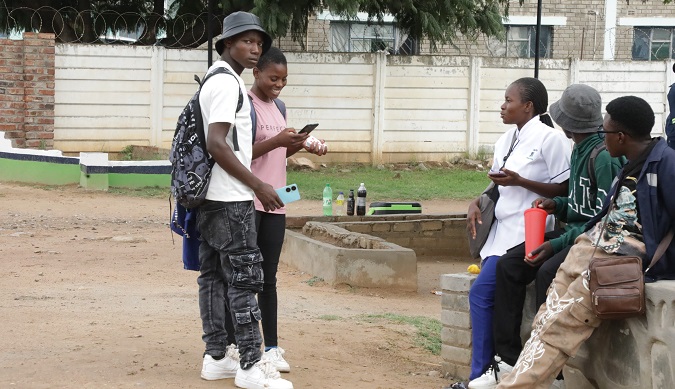
Theseus Shambare
THE relentless march of innovation has woven the internet into the fabric of daily life, making connectivity a fundamental necessity, not a luxury.
From the bustling streets of Harare to the quiet corners of rural townships, the pursuit of internet access has become a defining characteristic for all generations.
In Epworth, a dormitory settlement on the outskirts of Harare, the newly established Magistrates’ Court stands as a beacon — not only of justice, but also “free Wi-Fi”.
A stroll past the courthouse reveals a scene that speaks volumes. Men and women of all ages are huddled under the shade of musasa trees, their faces illuminated by the glow of smartphones.

Vendor stalls nearby are populated not by eager customers, but individuals glued to their devices, their attention captured by the endless stream of online content.
Social media, including WhatsApp, Facebook, TikTok and Instagram, dominates everyday life in the country. The younger generation is largely made up of digital natives, while the adults are more often digital immigrants.
“The court has Wi-Fi, that is why you see people here. Whenever I have an assignment that requires research, I come here and do it,” a young high school learner explained, his eyes never leaving his phone.
His fingers danced across the screen, navigating a labyrinth of online research for a school assignment, a desperate attempt to bridge the gap between his reality and the world beyond.
His family’s single room, a patchwork of corrugated iron and faded fabric, holds no space for the luxury of internet data.
Mobile data, when it works, is a cruel tease, a slow, agonising crawl that drains his meagre savings.
“It is like being trapped. The world is moving and we are stuck. Everyone else is learning, connecting, building . . . and we are just watching,” he said.
The Wi-Fi, intended for court administration, has become a lifeline for those who cannot afford mobile data.
“Police officers usually disperse us and warn us about ‘internet theft’,” added the learner.
This scene is not unique to Epworth.
At Queensdale shops, the perimeter wall of a liquor outlet serves as a makeshift internet café.
“Besides being expensive, mobile data is sometimes slow, especially when downloading large files. So, I come here to download and then go,” said Michael, who is in his early 30s.
The phenomenon extends beyond urban centres.
Across the dusty plains, in the rural township of Nenguwo in Mashonaland East, a different scene plays out.
Kuda Chibvongodze, her face etched with worry lines, stared at the crowd gathered outside her grocery store.
The powerful Wi-Fi router, a symbol of progress in her corner of the world, has become a magnet for the digitally disenfranchised.
“They come like moths to a flame. I understand their need, but it is overwhelming. My business suffers and I feel like I am losing control,” she sighed, her voice laced with a mixture of frustration and resignation.
The password, which is supposed to be a closely guarded secret, always spreads through the township like wildfire.
QR codes, those black-and-white squares of instant access, have further eroded her control, turning her network into a public square.
“It is not just the downloads. It is the sense of being left behind. They see the world online, the opportunities, the connections and they want to be a part of it,” said Chibvongodze, her gaze drifting towards a group of teenagers huddled under the shade of a nearby tree.
Legality
This practice, known as “Wi-Fi squatting” or “Wi-Fi piggybacking”, raises questions about legality and ethics.
“It is a form of theft,” said Jeff Phiri, a web developer in Harare.
“Accessing someone’s Wi-Fi without permission can have serious consequences.”
He recommended securing networks with strong passwords, encryption, firewalls and guest networks.
“To prevent unauthorised access via QR code, use secure QR code generators, set expiration dates, implement two-factor authentication and utilise QR code encryption or dynamic QR codes that can be edited or disabled remotely,” he advised.
Phiri noted that despite the legal and ethical concerns, the reality remains that internet access has become a basic commodity.
“From learning to job seeking, to work, the internet is essential,” Phiri acknowledged.
The United Nations Sustainable Development Goals recognise the transformative power of digital technologies, aiming to significantly increase access to information and communications technology, and strive to provide universal and affordable access to the internet in least developed countries by 2030.
Hope
Government announcements regarding the Presidential Internet Scheme have offered hope.
The scheme aims to extend internet access to marginalised areas, benefitting schools, clinics, community centres and farmers.
The Digitruck and Digital Skills Ambassador Programme, mobile training labs and community-based ambassadors are designed to promote digital literacy and equip citizens with essential digital skills.
These initiatives recognise the crucial role of digital connectivity in the modern world, especially for a generation that has grown up immersed in it.
“The Government views internet access as a right, not a privilege. While we crack down on data theft through robust regulation and enforcement, we are equally focused on making connectivity accessible to all. Together with stakeholders, we will build a secure, inclusive digital Zimbabwe,” said Information Communication Technology, Postal and Courier Services Minister Tatenda Mavetera.
The Minister said they appreciate the critical role of affordable, reliable internet connectivity in driving socio-economic development, education and digital inclusion.
“We are acutely aware of the challenges posed by rising incidents of data/internet theft — a term encompassing unauthorised access, illegal reselling of data bundles and cybercrime — which undermine trust in digital services and harm consumers,” she said.
She outlined strategies to address these issues while expanding internet access for households.
“Our priority is to ensure every Zimbabwean household has access to affordable internet.
”Key initiatives include the National Broadband Plan: accelerating the rollout of fibre-optic networks, 4G/5G infrastructure and satellite services, prioritising underserved rural and peri-urban areas.
“Collaborating with telecoms, for example TelOne, Econet, NetOne, to subsidise last-mile connectivity and reduce data costs, especially for rural schools and establishing subsidised Wi-Fi hotspots,” explained Minister Mavetera.
She emphasised the need to combat data theft and cybercrime.
“Under the Connect Zimbabwe initiative, we are deploying solar-powered base stations and satellite technology to bridge the urban-rural divide, targeting 80 percent of household coverage by 2026,” said the Minister.
However, concerns have arisen about the challenges associated with unregulated internet access.
A child online safety survey conducted last year by the Postal and Telecommunications Regulatory Authority of Zimbabwe (Potraz), in partnership with the Research Council of Zimbabwe (RCZ) and the Ministry of Primary and Secondary Education, found that 44 percent of children, aged 8 to 18, were exposed to adult content, including pornography, either intentionally or unintentionally.
“We used to restrict our children’s internet time by limiting the data we gave them. However, they now have unlimited access to data through ‘poaching’ Wi-Fi facilities at a nearby college,” lamented Edna Musarurwa.



 Online Reporter