admin
admin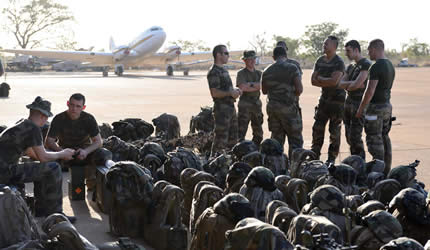
new threat as the four-day-old offensive continued to grow.
Early, an intelligence agent confirmed that shots rang out near the Diabaly military camp in what is still nominally government-held territory and that soon after, jets were overhead, followed by explosions. The agent insisted on anonymity because he is not authorised to speak publicly on the matter.
A Malian commander in the nearby town of Niono said the bombardments did not stop the Islamist fighters and that they occupied Alatona, and yesterday, they succeeded in reaching the north-south road which connects Diabaly to Segou, the administrative capital of central Mali.
By sweeping in from the west the al-Qaeda-linked insurgents are now only 400km from Mali’s capital, Bamako. Before France sent its forces in on Friday to stop a rebel advance, the closest known spot the Islamists were to the capital was 680km away, though they might have infiltrated closer than that.
Fighter jets late on Sunday dropped bombs in the central rice-growing region of Alatona after a rebel convoy was spotted 40km southeast of Diabaly, until recently the site of a major US-funded Millenium Challenger Corporation project. The rebels, said a Malian commander in the nearby town of Niono, were trying to reach Diabaly, home to an important Malian military base.
The commander, a major, insisted on anonymity because he was not authorised to speak to the press.
French Defence Minister Jean-Yves Le Drian yesterday insisted that the situation in Mali “is evolving favourably”.
However, he acknowledged challenges in the west.
“There is still a difficult spot in the west, where we’re dealing with extremely well-armed groups and where the operations are ongoing at this time,” said Le Drian. He did not name Diabaly, but military officials in Mali say it is near Diabaly that the fiercest fighting is now occurring.
The international medical humanitarian organisation Doctors Without Borders, known by its initials in French as MSF, said that 12 people wounded in the conflict were being treated by an MSF team at a regional hospital in Timbuktu, a roughly seven-hour journey from the conflict zone.
“We are worried about the people living close to the combat zones, and we call on all the parties to the conflict to respect the safety of civilians and to leave medical facilities untouched,” said Rosa Crestani, MSF emergency response coordinator.
Mali’s north, an area the size of France itself, was occupied by al-Qaeda-linked rebels nine months ago, following a coup in the capital. For nearly as long, the international community has debated what to do.
In December, the United Nations Security Council adopted a resolution calling for a military intervention, but only after an exhaustive list of pre-emptive measures were fulfilled, starting with training the Malian military, which was supposed to take the lead in the offensive.
All of that changed in a matter of hours last week, when French intelligence services spotted two rebel convoys heading south, one on the mostly east-west axis of Douentza to the garrison towns of Mopti and Sevare, and a second heading from a locality north of Diabaly toward Segou, the administrative capital of Central Mali.
Had either Segou or Mopti fallen, many feared that the Islamists could advance toward the capital.
French President Francois Hollande deployed 550 French troops to Mali and authorized the airstrikes which began Friday, initially concentrated in the north. The French are using Mirage jets stationed in Chad, which are able to carry 250kg bombs. They are also using Gazelle helicopter gunships and the Rafale jet, based in France. — Sapa.



 Online Reporter