admin
admin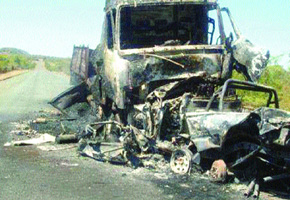
With the daily increase in the number of vehicles on our roads and the presence of multiple users such as cyclists, pedestrians, and donkey carts, this menace needs urgent attention. The effects and victims of accidents are cross-cutting.
This year alone has seen a number of gruesome accidents taking place. For instance in April, 21 people perished in a bus accident close to Ngundu along the Masvingo-Beitbridge Road. There were also accidents some weeks back that claimed at least 22 lives within two days. The first happened in Fort Rixon where 13 people died, 12 of them on the spot, including an infant while another died on admission to hospital when a kombi they were travelling in plunged four metres into a stream.
Nine people also died; seven on the spot and two on admission at the hospital while 18 others were injured, when a bus they were travelling in rammed into a stationary 30 tonne haulage truck, near Connemara Open Prison Complex along the Gweru-Kwekwe Road. As we are just past the halfway mark of the year it shows that we have a long way to go considering the number of fatal accidents that have occurred in the country so far.
Some people blame drivers for the many road accidents ignoring the vehicles themselves. Some vehicles on our roads are not roadworthy but they, surprisingly, are licensed to use roads. Road conditions in the country also have a hand in the fatal accidents as many of them are riddled with potholes.
The UN estimates that every year about two million deaths take place the world over due to road carnage with 3 500 people dying everyday. About 70 percent of these accidents occur in developing countries.
In Zimbabwe, road accidents account for 1 700 deaths a year, an unacceptable high death rate considering the country’s small vehicle population. South Africa, Africa’s largest economy, has an average of 14 000 deaths from road accidents every year from a population of 10 million cars.
An official at the Vehicle Inspection Department (VID) in Bulawayo, Mr Exevier Dzimba, said some cars that are not roadworthy usually find a way back on the roads even after their owners are instructed not to drive them.
“Our mandate is to check if vehicles are roadworthy and if they are not we remove them from the road,” he said.
“When we give the vehicle back to the owner we instruct them to take it to the garage so that it can be fixed and in some cases we remove permits so that it cannot be used on the road but some dubious people disobey the law and drive the vehicles.
“It becomes difficult for us to track down some unroadworthy vehicles because some of them travel at night when our patrols are limited and in some cases they run away and it becomes difficult to chase them as that can cause much harm to the public,” he said.
Mr Dzimba encouraged the Government to put in place stiffer penalties as the country is losing too many lives on the road.
“For the country to do away with road accidents stiffer penalties should be put in place so that those that break the law are an example to the public,” he said.
Police, VID and Traffic Safety Council of Zimbabwe should work together and come up with ways of removing unroadworthy vehicles from the roads because they are taking too many lives.
Acting National Traffic spokesperson Assistant Inspector Blessmore Chakanza said there has been an increase of road accidents this year compared to last year.
“From January to May this year we have recorded a total of 13 979 accidents where 789 people lost their lives which is higher compared to last year where 12 115 accidents were recorded in the same period and 730 people lost their lives,” he said.
“Most road accidents in the country are caused by speeding, tyre bursts, inattention and misjudgement. Speeding is the major cause of death on the country’s highways. Tyre bursts also contribute to accidents.
“Inattention and misjudgement also contribute to road accidents especially in city centres as drivers in most cases will not be concentrating on what is happening on the road,” he said.
He also said police have increased their patrols on the highways as a way to curb accidents.
“We have speed traps throughout the highway as a way to do away with overspeeding. Road blocks are still there where they check for overloading and in cases where passengers are overloaded they will be dropped off at the roadblock and the driver made to pay a fine for overloading,” he said.
Asst Insp Chakanza urged the public to report any suspicions to the police and also be selective when boarding public transport.
In light of the rising deaths from road accidents, transport ministers met in South Africa where they launched the Sadc Decade for Road Safety.
The initiative seeks to reduce deaths from road accidents by 50 percent by 2015.
But with the recent increase of road accidents in the country, rampant lawlessness by some road users and police corruption, questions arise whether the campaign will achieve its desired goals or is doomed to be one of those initiatives that are launched but achieve nothing at the end.
Professional Drivers’ Association of Zimbabwe chairman, Mr Albert Sibanda, urged drivers to be disciplined and police to shun corruption.
“Our drivers lack discipline as they do not follow road signs and instructions.
“Law enforcement agencies are corrupt as they leave drivers to escape unpunished and they cannot instil discipline to the drivers.
“The Government and law enforcement agencies should come up with a way to teach road offenders and not sympathise with them to prove to people that road offenders will not be accepted in Zimbabwe,” he said.


 Online Reporter