Online Reporter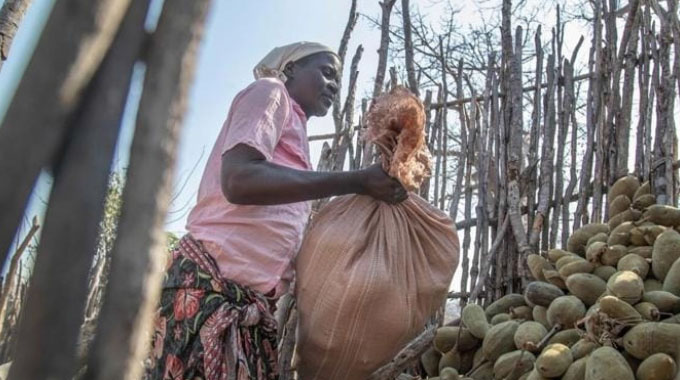
Theseus Shambare, Features Writer
In Binga, a semi-arid district battered by drought, community seed banks and climate-smart farming are giving families hope beyond the wild baobab that once kept them alive.
The corn crib at the Saba homestead tells a story long before any interview begins.
Where maize should hang in neat, golden rows, there is only baobab fruit — stacked high, pale and powder-dry, spilling through the wooden slats like marbles frozen in time.
For years, this wild fruit was never just a snack, it was a survival strategy.
Its powdered pulp, mixed with wild okra or masau, became emergency porridge during seasons when the sky withheld rain and granaries emptied too early.
“We survived on this,” said Ms Vivian Saba, 34, gently tapping one of the pods.
“During some years, it was all we had.”
Her voice is matter-of-fact, not dramatic.
In Binga — a harsh agro-ecological region classed as semi-arid and prone to prolonged dry spells — hunger is not a metaphor, but a memory carried in the body.
But the baobab, as resilient as it is, has reached the limits of what it can do for a district buckling under climate change.
Cycling droughts, sustained temperatures far above national averages and erratic rainfall — trends confirmed by the 2023 ZimVAC report and the Intergovernmental Panel on Climate Change (IPCC) Sixth Assessment Report (2022) for southern Africa — have pushed families into a corner where wild foods alone cannot guarantee survival, yet meteorological forecasts for the 2025-26 summer cropping season suggest a normal to above-normal rainfall pattern for Binga, offering farmers a cautious but welcome opportunity to plant, provided they adopt improved practices and climate-smart interventions.
Even traditional grains such as pearl millet, sorghum and groundnuts, which were supposed to be Binga’s farming backbone, now struggle to survive, often failing to germinate or losing viability in the heat.
This pattern is backed by peer-reviewed research — for example, a 2025 study in Discover Agriculture by Bright Chisadza, Onalenna Gwate and others found that in semi‑arid Zimbabwe, 80 percent of farmers now favour drought‑resistant crops like millet and sorghum but with strict in‑field rainwater management (mulching and intercropping) to boost yields.
Walking through a cracked field, elderly farmer Mr Moses Ncube shakes his head, recalling a season when rains stopped after just two weeks, leaving his millet stunted and the soil as hard as concrete.
“We planted, we prayed, and we watched it all die,” he said, his voice carrying the weight of decades of drought.
At some homesteads, children missed school during hunger months because walking to class on empty stomachs became too taxing, with district statistics and a 2025 ZimLAC assessment showing that nearly 3 099 students attend school irregularly due to food insecurity and as many as 18 secondary schools recorded zero percent pass rates in Ordinary Level examinations, a situation highlighted in Unicef Zimbabwe’s 2024 report linking child nutrition to learning outcomes.
The memory of these struggles lingers in the corners of the homestead, where the smell of dry earth mixes with the sweet tang of powdered baobab, a silent reminder of what survival once demanded.
A few metres from the corn crib, a new structure rises — small, brick-walled, zinc-roofed.
Inside it sits Binga’s newest defence against climate shocks: a community seed bank supported by the Zimbabwe Red Cross Society and Finnish Red Cross, promising a lifeline for families long battered by uncertainty.
For the first time in years, villagers say they can plan a farming season with something more than hope.
Climate change, scientists explain, is not just the odd drought or heatwave, but a long-term shift in weather patterns caused by rising greenhouse gases that makes once-predictable seasons unpredictable.
In Binga’s agro-ecological zone, this translates to delayed rains, mid-season dry spells and new threats to traditional farming practices, with the first rainfall in some years arriving as late as mid-December instead of November, shortening the planting window and threatening yields, a trend documented in the Zimbabwe National Climate Policy (2023) and confirmed by local meteorological studies.
According to the 2025 Zimbabwe Livelihoods Assessment Committee report, prolonged dry spells affect more than 62 percent of Binga households, and rising temperatures have eroded the viability of even the hardiest small grains.
At a nearby homestead, a young mother, Ms Patience Dube bends over a half-planted field, her hands coated in red clay, recalling the year her sorghum failed and she walked 10 kilometres to fetch maize for her children’s porridge.
“It was hunger you could feel in your chest,” she said softly, glancing at her youngest, who skips stones in the dust.
It is against this backdrop that the seed bank emerges not as charity, but as a lifeline built by the community for the community, a model supported by the Food and Agriculture Organisation and Consultative Group on International Agricultural Research showing that community-managed seed banks significantly improve household food security in drought-prone regions. Under the Zimbabwe Red Cross and Finnish Red Cross programme, farmers were trained in Pfumvudza/Intwasa, a climate-smart agricultural technique that emphasises conservation farming, intercropping, mulching, moisture retention, and precision planting to maximise yields even under erratic rainfall, with effectiveness documented in studies from the Zimbabwe Open University and AGRITEX.
Communities moulded bricks, carried water for construction and kept meticulous records, making the seed bank a product of their own labour and ownership.
The project’s Livelihoods Officer, Mr Nelson Nkuli said the facility stores over a tonne of seed, including millet, sorghum and groundnuts, and that open-pollinated varieties allow farmers to control their own seed supply over multiple seasons.
“This is about building resilience, not dependency,” Mr Nkuli said, standing beside neatly stacked, fumigated sacks that smell of fresh earth and grain.
The community seed bank provides a secure, fumigated, and well-managed store where seeds retain quality and viability, enabling entire villages to plan their planting seasons, ensure food security, reduce reliance on unpredictable rains and collectively preserve traditional and drought-resilient crops for the long term, creating a shared resource that benefits young and old, male and female and even the most vulnerable members of the community.
Resilience, however, extends beyond seeds; a three-kilometre water pipeline now draws life from the Zambezi and Mlibizi Rivers, supplying homesteads and small gardens that once depended entirely on erratic rains.
Women have started raising poultry, children are learning to cultivate vegetables alongside small grains and households are slowly diversifying their livelihoods to cushion against climate shocks.
Grinding mills powered by the initiative have eased women’s labour and generated income, while disability-friendly toilets ensure that the elderly and persons with disabilities are included in the gains.
Walking through a field of newly germinated millet, Mankobole Satellite Primary School head Mr Henry Sianchali noted how children come to class with lunch tins full for the first time in years.
“Education is finally catching up with farming. Hunger no longer chases them away,” he said.
The germination rates this season have surprised many, turning fear into a quiet sense of promise after decades of uncertainty.
Some voices caution that transformation is far from complete, citing the need for expanded capacity to reach more wards and sustained funding to maintain water pipelines as climate projections in IPCC and ZimVAC reports show warming temperatures, longer dry spells and more erratic rainfall in the years ahead.
Back at the Saba homestead, Vivian stands by the corn crib, her hand resting on a baobab pod, a tangible reminder of past hardship.
“We still keep the baobab,” she said, “because it reminds us of where we came from.”
She turns towards the seed bank, its new bricks radiant in the late afternoon light.
“But now it’s just a backup — not our only plan.”
She lifts a sack of millet gently from the seed bank and holds it like a promise, knowing that for the first time in years, Binga families are farming with certainty, not just praying for rain.


 Bongani Ndlovu