

 Temba Dube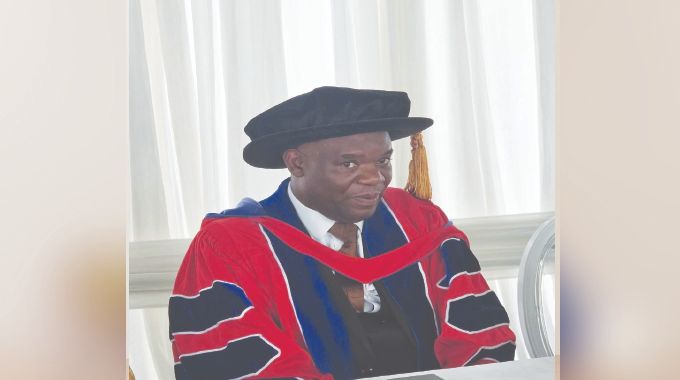
Patrick Chitumba [email protected]
BAREFOOT, hungry and covered in dust, young Leon Marongedza would walk up to 20 kilometres to school in rural Uzumba-Maramba-Pfungwe, often sitting on the floor to learn when he finally arrived.
Decades later, the boy who studied under trees and endured the hardships of a rural classroom has become Chief Superintendent Dr Marongedza — a senior police officer, holder of a PhD and multiple other qualifications, and an advocate for giving disadvantaged children the educational opportunities he once lacked.
Now, the Gweru Urban District Police Officer is turning his own story into a mission to help others, supporting rural schools with water, furniture, internet connectivity, books and learning materials while paying school fees for 10 disadvantaged pupils.
For Dr Marongedza, education has come full circle – the challenges he once experienced as a child became the subject of his doctoral research, and the knowledge he gained is now being channelled back into the communities that shaped him.
“This was not merely an academic exercise, it was deeply personal. In many ways, every page of this thesis took me back to my childhood experiences,” he said.
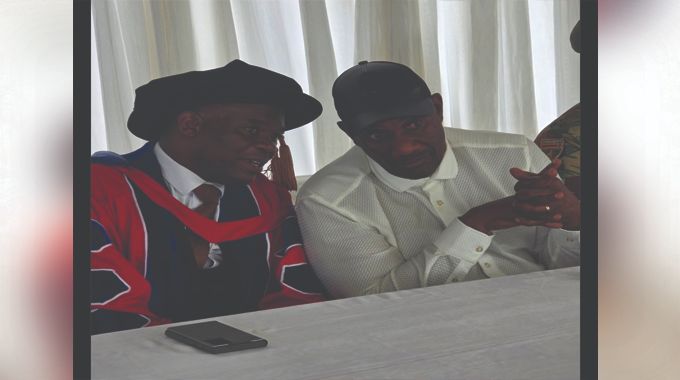
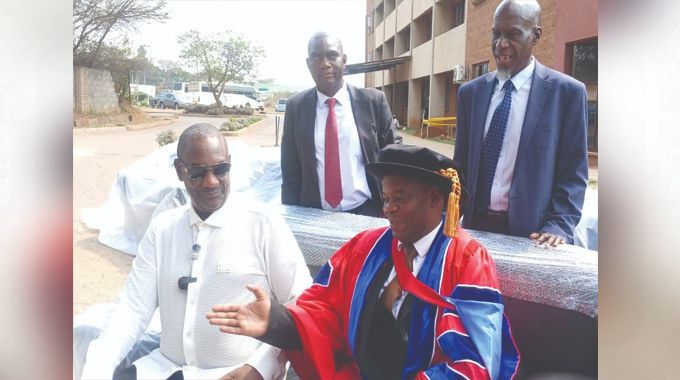
His journey was celebrated at an appreciation party hosted by Midlands Minister of State for Provincial Affairs and Devolution, Cde Owen Ncube, who commended the police officer for combining academic excellence with more than three decades of public service.
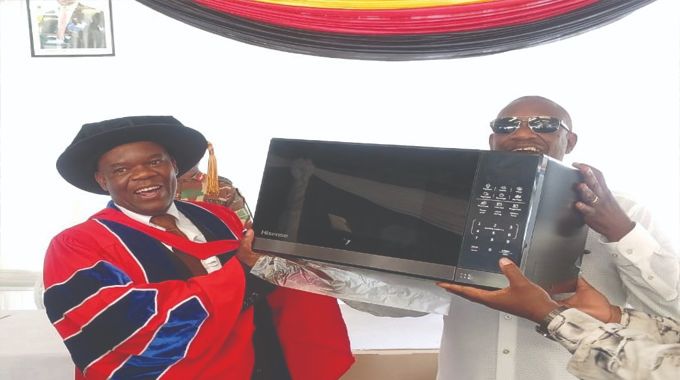
Minister Ncube presented Dr Marongedza with gifts worth US$8 000, including a television set, leather dining suite, four-plate stove, kitchenware and a fridge, as well as US$1 100 in cash. For his colleagues, however, the achievement came as little surprise.
They have long known Dr Marongedza as a bookworm — a man whose appetite for knowledge appears to be almost as strong as his commitment to policing.
Minister Ncube said Dr Marongedza’s achievements demonstrated the importance of continuous learning and human capital development, while his service provided an example of how education could be translated into practical community development.
“Today’s event is celebratory as we express our collective gratitude to DISPOL Marongedza for elevating the profile of the Midlands Province in general and the image of the Zimbabwe Republic Police in particular,” said Minister Ncube.
He said Dr Marongedza had distinguished himself through professionalism, honesty, accountability, transparency, integrity, commitment, teamwork and impartiality.
Minister Ncube said the officer’s achievements resonated with the Second Republic’s thrust on human capital development, science, technology, innovation, governance, institution building, peace and security under the National Development Strategy 2.
He commended President Mnangagwa for supporting initiatives aimed at strengthening the Zimbabwe Republic Police and improving officers’ welfare.
Since the advent of the Second Republic in 2017, Minister Ncube said, the Government had implemented various measures to strengthen the police, including improving officers’ conditions of service, providing service vehicles and food rations and installing solarised boreholes at police camps to improve water and sanitation.
He also commended Commissioner-General of Police Stephen Mutamba for rolling out training and development programmes to equip officers with contemporary policing skills under the back-to-basics model.
He further applauded the Midlands Provincial Police Command, led by Commissioner Nyabadza, for its work in combating crime and bringing notorious criminals to account.
“Performance of officers like Chief Superintendent Leon Marongedza in crime prevention, anti-smuggling, drug and substance supply reduction and disaster risk management, among several other operations, clearly exceeded expectations and deserves special recognition as they provide important lessons and benchmarks for other provinces,” he said.
Minister Ncube said Dr Marongedza’s academic record was particularly impressive, having pursued studies across several disciplines while simultaneously building a career in the police force.
Dr Marongedza holds a PhD in Development Studies from Marondera University of Agricultural Sciences and Technology, two Master of Science degrees in Strategic Management and Monitoring and Evaluation, and four Bachelor of Science degrees in Substantive Law, Procedural Law, Counselling, and Monitoring and Evaluation.
He also holds six diplomas covering areas including Project Management, International Business Management, Personnel Management, Development Studies, Security and Risk Management and Teaching Methodology.
His other qualifications include certificates in Further Education Trainers, Computers, Video Filming and Photography, as well as seven in-house training qualifications in areas such as project management, leadership, management, train-the-trainer programmes, junior command and developmental training for inspectors and sergeants.
Minister Ncube said Dr Marongedza’s professional journey was equally distinguished.
He joined the ZRP as a constable in 1994 after obtaining eight Ordinary Level passes, including English and Mathematics.
He received training at Morris Depot Training Academy in Harare in weapons handling, scene attendance, powers of arrest, exhibits management, docket compilation and court proceedings procedures.
He later served as a Crime Investigating Officer at ZRP Redcliff from 1995 to 2004, before becoming a provincial researcher and trainer under the Midlands Professional Updating Centre from 2006 to 2008.
From 2008 to 2013, he served as Superintendent for Planning and Development at Police General Headquarters before becoming Team Leader and Planner in the Inspectorate Unit from 2013 to 2018.
Minister Ncube said Dr Marongedza’s progression through the ranks demonstrated his loyalty and commitment to maintaining peace and security.
For Dr Marongedza, however, the road to the PhD began long before he put on a police uniform. He is the ninth child in a family of 10 born to the late Michael and Chestnut Marongedza, who were peasant farmers.
His early schooling in Uzumba-Maramba-Pfungwe in the 1980s was marked by hardship. Zimbabwe had recently attained independence, and the education system was battling overcrowding, inadequate infrastructure, shortages of furniture and textbooks and other challenges.
For young Marongedza, going to school meant long walks, sometimes stretching to 20 kilometres, often without shoes.
“Many of us learned under trees, sitting on the floor without desks, chairs, and adequate textbooks. We all walked long distances, sometimes 15 to 20 kilometres, to school,” he said.
“We walked barefoot through dust, and at times in the rain. We would arrive at school tired, hungry, and dusty, but determined to learn.”
Those experiences, he said, could have discouraged him, but instead built resilience and determination. Looking back, he realised that the challenges of his childhood had planted in him a deep appreciation of education. It was also those same experiences that eventually shaped his doctoral research.
His PhD thesis, titled “Institutional Constraints Affecting Learners’ Performance in Rural Schools,” examines the barriers facing learners in rural communities and proposes practical interventions aimed at improving access to quality and inclusive education.
“I remembered the lack of furniture because I had personally sat on the floor myself. I remembered the lack of clean water. I remembered the long distances I travelled to school. I remembered the absence of connectivity, libraries and internet,” he said. “Education without giving back is incomplete,” he said.
“I believe that each of us has a responsibility to contribute to the development of the communities from which we came.”
At Matsenga Primary School, Dr Marongedza facilitated the installation of a borehole, providing pupils and the surrounding community with access to water.
At St Arnold Secondary School, he donated tables and chairs sufficient to support several classrooms. At Myema Primary School, he installed Starlink internet connectivity, opening a window to the wider world for rural learners.
He has also donated books, uniforms and other learning materials to schools, while currently paying school fees for 10 pupils from financially disadvantaged families.
For Dr Marongedza, providing internet access to rural learners is particularly important in an increasingly digital world.
Dr Marongedza said Zimbabwe’s development therefore depended on sustained investment in children, teachers, schools, institutions and communities.
His academic journey has also strengthened his work as a police officer. Dr Marongedza said policing had become increasingly sophisticated, requiring officers to continuously acquire new knowledge and skills to respond to changing criminal methods, communities and justice-delivery demands.
His studies have helped deepen his understanding of community development, leadership, planning, crime analysis and the justice delivery system.
“Let us continue investing in education. Let us give our children the opportunities that many of us did not have. Let us ensure that no child’s potential is limited by the circumstances into which he or she was born,” said Dr Marongedza.


 Online Reporter