Online Reporter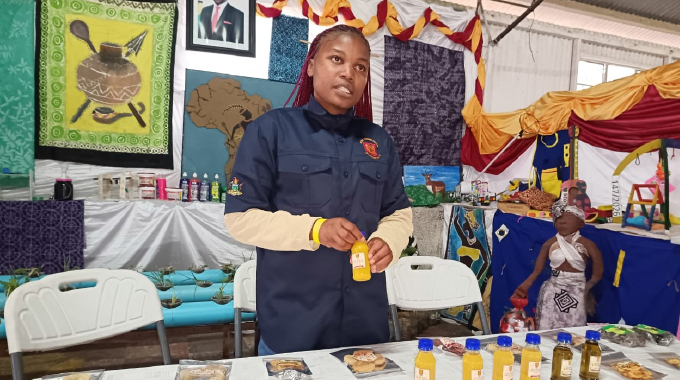
Patrick Chitumba, Midlands Bureau Chief
A SWEET potato is no longer just a crop at Mkoba Teachers College.
In the hands of student teachers, it can become a packet of crisps flavoured with madora.
An avocado can be turned into garlic and herb oil, peanuts into fudge, bananas into shelf-stable snacks, while lemons and ginger are being processed into marmalade.
Inside the college’s food laboratory, the traditional image of a student teacher sitting behind a desk preparing for examinations is giving way to something more ambitious, a future teacher learning how to produce, innovate, commercialise and create employment.
For Level 3.2 Food Technology and Design students, this is Education 5.0 in practice.
“We are putting the principles of Education 5.0 into practice by transforming locally available raw materials into innovative, nutritious and marketable products,” said Monalissa Musarurwa.
The students are involved in the entire production chain, from sourcing raw materials and processing to packaging, branding and marketing.
Their work reflects the philosophy underpinning the Second Republic’s transformation of the country’s education system, which seeks to move higher and tertiary education beyond teaching, research and community service towards innovation and industrialisation.
The National Development Strategy 1 (NDS1) formally reconfigured higher and tertiary education around Education 5.0, with the objective of producing entrepreneurs, quality goods and services rather than graduates whose main aspiration is to seek employment.
That thrust has been carried into the current NDS2 (2026-2030), which places human capital development, science, technology, innovation and digitalisation at the centre of the country’s drive towards an upper-middle-income economy by 2030.
NDS2 specifically calls for accelerated implementation of the Heritage-Based Education 5.0 model and says it should produce innovators and entrepreneurs capable of creating jobs and developing home-grown solutions.
At Mkoba, that policy is increasingly visible not in conference speeches, but in what students are making with their own hands.
At Mkoba, food waste is also being tackled through value addition. Produce that might otherwise have limited commercial value is being processed into products with longer shelf lives and potentially wider markets.
Musarurwa said the projects were therefore serving several purposes at once.
“Our work promotes innovation, entrepreneurship, skills development and industrialisation, while reducing food waste and creating opportunities for income generation,” she said.
Bubbington Nyamupanda, a Level 3.2 Agriculture student, said the practical approach was exposing students to the entire value chain.
“In the college’s food laboratory, we wash, slice, mix, cook, package and label the products ourselves,” he said.
Even the absence of sophisticated equipment has become part of the learning process.
For oil extraction, students currently rely on manual methods because the college does not yet have the necessary machinery.
“For oil extraction, we use manual methods because we do not have machines yet. But even with manual tools, we are learning the full value chain that is from sourcing raw materials to producing a finished, shelf-ready product,” said Nyamupanda.
Education 5.0 model is not simply about producing more graduates. It is about equipping graduates with skills that can be translated into production, enterprise and solutions to local problems.
The transformation extends beyond the food laboratory. In the Art and Design Department, students are turning creative skills into potential businesses through textile dyeing, egg and sand mosaics, pyrography, portrait making, graphic design and other crafts.
Tariro Felistas Chimbo, a Level 3.2 Art and Design student, said the training went beyond simply producing attractive pieces.
“Students are trained in textile dyeing, egg and sand mosaics, pyrography portrait making, graphic designing and other crafts. Beyond making the art, they learn to brand it, cost it and market it,” she said.
The students are also taking their skills beyond the college through exhibitions, school murals and community skills workshops.
Government’s current development strategy says the model should create a seamless pipeline of skilled human capital aligned with labour-market needs, while leveraging science and technology to drive home-grown solutions and industrialisation.
Mkoba Teachers College Principal Dr Rosina Mavunga said the ultimate test of the programme will be what happens when the students leave the college.
She said the graduates are expected to carry the culture of innovation into schools and teach pupils not merely to consume knowledge, but to use it to solve problems and create products.
“Instead of merely teaching learners to consume knowledge, the graduates are expected to encourage them to create, make and solve problems. This is where the Education 5.0 thrust intersects directly with the Government’s broader industrialisation and economic transformation agenda,” she said.
Dr Mavunga said the use of locally available resources demonstrated that value addition did not have to begin in a large industrial plant.
“Sweet potatoes can become crisps. Bananas can become shelf-stable snacks. Avocados can be processed into oil. Peanuts can be transformed into confectionery and the principle is simple to add value before selling,” she said.
That philosophy is consistent with the Government’s broader industrial policy, which places emphasis on value addition, import substitution, agro-processing, innovation and stronger links between industry and tertiary institutions.
The ambition at Mkoba is now to move beyond student assignments.
Dr Mavunga said the college was working towards developing some of the innovations into viable commercial ventures.
Several products are being documented for possible patenting and standardisation, while engagement with the Standards Association of Zimbabwe is being considered to prepare products for wider markets.