


 peter
peter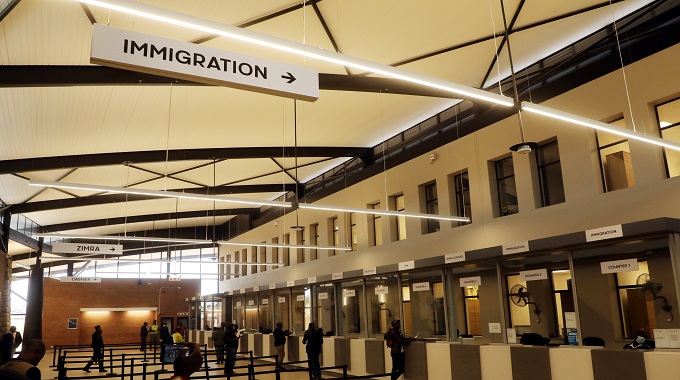
Limukani Ncube, Editor
“THE work is cut out for us. We must be linked to transit countries with efficient rail, road and pipeline systems,” said President Mnangagwa in 2018, and a few years down the line, the country is on course to transition from a land-locked country to a land-linked economy.
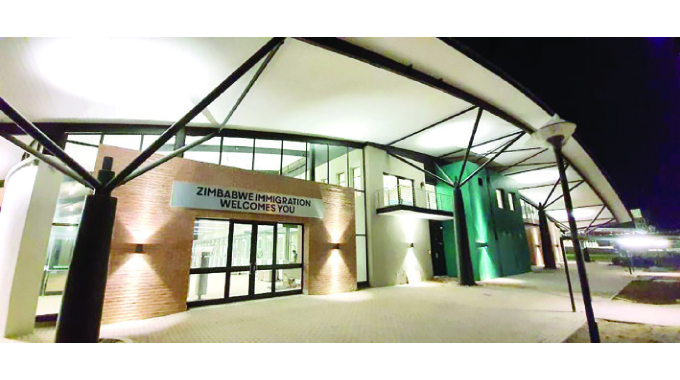
To emphasise the point that the Second Republic led by President Mnangagwa is walking the talk to develop the country, he said the recent launch of a modernised Beitbridge Border Post marked a high point in the Second Republic’s Vision of overcoming limitations of geography to make Zimbabwe a land-linked economy.
“This goal behoved that we look at improving transport infrastructures, principally those to do with road, rail and air transport, so these talk to each other, and to systems in neighbouring countries. A key component of that thrust involved addressing inefficiencies and bottlenecks at all our ports of entry, with the goal of facilitating movement of people, vehicles, goods and services between borders.
The transformation of Beitbridge thus has to be seen in that broad, sub-regional context.”
In order to become a land-linked country and economy, the World Bank says a number of initiatives have to be undertaken to improve the performance of the economy and get businesses from neighbouring countries and beyond.
“Attracting additional flows from neighbouring countries will also require establishing an efficient transit system and implementing further trade facilitation measures to reduce the costs of moving goods through (as well as into and out of). In particular, customs and other border agencies will need to modernise operational practices . . . improve co-ordination, and introduce effective risk management systems.
Once processes, procedures, and non-tariff measures are simplified, increasing the use of Information and Communication Technology (ICT) could further improve the predictability of customs and other border agency requirements and processes, as well as reduce border clearance times and increase the predictability of processes.”
The process of becoming a land-linked country also taps a lot from the railway network, according to the World Bank.
“(A country) needs to improve its infrastructure connectivity including cargo handling equipment at railway stations and have sufficient road connectivity between stations and centres of production and consumption.
The price competitiveness of the railway will depend on improvements in roads and more efficient logistics services, making it easier and cheaper to connect economic activity and consumption centres to the railway.”

Furthermore, the African Continental Free Trade Area, essentially created an immense single African market for goods and services which can facilitate the integration of land-locked countries into regional value chains and expand their trade capabilities.
The President is also on record emphasising that geographically; Zimbabwe has no waterfront. But that need not condemn it. Its economy can still be efficiently linked and integrated within the region, the continent and globally. Which is the essence of a land-linked economy.
“I personally do not believe that geography necessarily limits or condemns a country. Geography cannot be a handicap, or be allowed to sum up a country’s destiny. Otherwise, why would we talk of development? What handicaps a country is the absence of, or under-investment in infrastructures, principally communication infrastructures by which a country connects to vital transit countries and to international markets.
Whether located away from or abutting the sea, a country can easily become “locked” or “linked” depending on the availability and quality of its infrastructures. For me that is what is critical and what has challenged the archaic idea of “a land-locked” country, replacing it with the new and progressive idea of “a land-linked” country. By communication infrastructures, I am referring to a country’s road, rail, air, pipeline, inland waterway and ICT assets. I refer to how these are built and distributed spatially, and of course how they are run to interface and move goods efficiently, inside its economy, to sea for sea-borne trade, and to global markets.”
This critical realisation has informed global development debate, leading to the United Nations Vienna Programme of Action for Landlocked Developing Countries for the Decade 2014-2024.

The Programme of Action addresses infrastructural development; trade facilitation; structural transformation of economies of so-called land-locked countries; and regional integration as a strategy of land-linking these economies to those of transit countries, and to global markets.
Zimbabwe shares borders with three countries with coastlines, namely Mozambique, South Africa and Namibia, and also shares borders with two countries which are land-locked “like us”, namely Zambia and Botswana.
“If we situate ourselves in Sadc, as indeed we should, we gain two more countries on the African mainland with coastlines, namely Tanzania and Angola. We also gain four more which are landlocked, namely the DRC, Malawi, Lesotho and Swaziland.
Those with coastlines automatically become transit countries; those without coastlines, especially those to the north of us, become potential customers for a Zimbabwe whose economy and infrastructure plays sub-regional land-bridge. Our goal should thus be to make Zimbabwe a sub-regional transport and communication hub, in all modes of transport and communications: road, rail, pipeline, air and ICT. This means planning for an integrated regional transport link masterplan akin to one dubbed the Greater Mekong Sub-Region Communication Initiative in Southeast Asia which connects China, Vietnam, Cambodia, Myanmar and Thailand, with Laos as the hub.”
Last week, the President said what makes Beitbridge’s upgrade especially significant is that it combines sub-regional, national and community objectives.
“Zimbabwe’s vision is that of becoming Sadc’s transport hub. Her geography favours her to play such a role. Sitting at the heart of the North-South Trade Corridor, Zimbabwe’s Beitbridge Border Post ranks as the busiest on the African Continent. It thus needed commensurate infrastructure to live up to that coveted status. The facility I launched provides just such infrastructure, and generates enormous national pride for all of us,” he said.

He added that the country’s master-plan for Beitbridge went beyond its core function as a national border post as it integrated many other goals in that master-plan, including meeting local needs, principally roads, housing, telecommunications and water reticulation systems.
“This is to ensure no one and no community is left behind. I was able to see model housing units designed for the Town’s burgeoning army of professionals employed in various sectors in this fast-growing Town. The master-plan, too, provided for an 11 million-litre storage tank which makes Beitbridge water-secure.
All the elements of a modern town are thus either already in place or in the process of being built. I have no doubt that before long, Beitbridge will become a major city.”
Moreover, plans are already underway to modernise and improve Chirundu, Plumtree and Forbes Border Posts to ensure that infrastructures at all the ports of entry are made to purpose, and to high international standards. It also means all major roads traversing the country and linking all border posts must be made to international standards.
Apart from the ports of entry, focus has been put on the road infrastructure, with massive resources spent on roads across the country, and the dualisation of the Mutare Plumtree Highway highlights that factor. Furthermore, a lot of ground has been covered to improve airports, with improvement at Robert Gabriel Mugabe International Airport Terminal at 80 percent, and the Victoria Falls airport complete, among others, which are part of infrastructure that epitomise the transition from being a landlocked country to a land linked economy.
“Our biggest headache remains our weak railway service. Vital and cheaper, this service must begin to receive our attention so the national multimodal transport master-plan is complete, and reduces the cost of doing business. I am particularly worried that this vital transport mode lags behind at a time when the demand for its services is rising, what with the phenomenal expansion we are witnessing in the mining sector. Serious decisions will have to be made to revamp that transport sub-sector, including finding innovative ways to finance its rehabilitation and expansion,” explained the President.


 Bongani Ndlovu
 Online Reporter