Online Reporter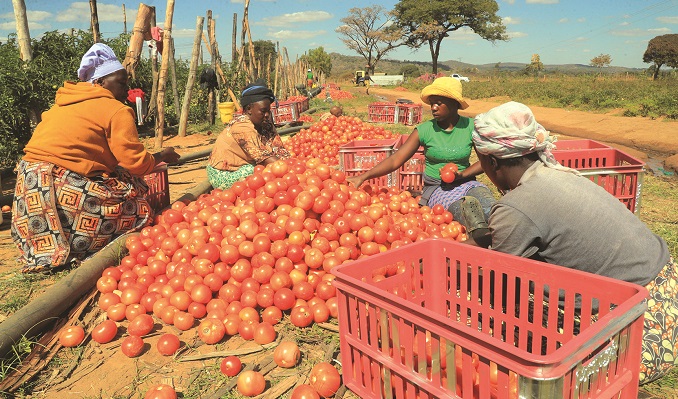
Elita Chikwati
Agriculture News Editor
AT a time when the youth seem to be seeking opportunities abroad, Oliver Msusa, a 40-year-old farmer at Saratoga Farm in Goromonzi, has found his “greener pastures” at home.
Through dedication and hard work, he has become one of the major suppliers of tomatoes to key agri-produce markets in Harare, Bulawayo and Gweru.
Besides tomatoes, the farmer also grows sugar beans, cabbages, green mealies and sweet potatoes.
Every day, he supplies an average of 2 000 crates of tomatoes to Mbare Musika from his six-hectare plot. He also rents an additional four hectares.
With the price currently averaging US$2,50 per box, this translates to roughly US$5 000 per delivery. With 200 000 tomato plants, he is expecting a total output of 80 tonnes.
Msusa has never been formally employed.
Instead, he now employs 45 permanent workers — 30 women and 15 men. He also hires casual labour, especially when harvesting is at its peak.
Msusa attended Murisa Primary School in Goromonzi, but his education was cut short when his parents separated. He was forced to drop out of school in 1994 when he was in Grade Three. He resumed his studies in 2000.
Three years later, he, however, dropped out again after securing a job in Goromonzi, at Maiden Svisva Farm, which belonged to a Mr Chidzwanda. He worked as a labourer, assisting in tomato production. Not only did he acquire the invaluable knowledge and experience in producing tomatoes; he was also inspired by the farm owner.
Taking the leap
Msusa realised he could dramatically change his fortunes if he became his own boss.
This prompted him to look for land and start growing tomatoes. He realised renting small pieces of land was not sustainable.
In 2003, he applied to the Ministry of Lands to be considered for resettlement.
“I went to apply for a farm at the provincial offices in Marondera and got a six-hectare farm in 2009. Since then, I never looked back. Farming has impacted my life. I now own three houses in Harare, cars, tractors and irrigation equipment. I have five children, and they go to decent schools,” he said.
Msusa has since outgrown his plot and now needs more land, as he has now resorted to leasing from other farms.
“I am using all the land and I think I can do more if I get a bigger farm. I wish the Government would allocate more land to farmers with potential. I am restricted to horticulture because I do not have enough space. The Government should also prioritise hardworking farmers for inputs and mechanisation programmes to boost production and ensure food security,” he said.
Msusa has two-tonne trucks to ferry his produce to markets. He also considers shelf life when selecting tomato varieties to grow.
“A good-quality crop fetches a high price on the market. I grow tomatoes throughout the year and because of the varieties I grow, I get good prices,” he said.
All-year-round production is possible for Msusa, as he relies on irrigation.
He invested in drip and sprinkler irrigation.
“There is a dam nearby, so we are not affected by low rainfall. The reliable supply of water has enabled me to grow crops throughout the year. I always have a crop on the market at any given time. In August, I will be harvesting sweet potatoes. I, however, practise crop rotation.”
By alternating crop types, farmers can manage pests and diseases, maintain soil fertility and enhance overall farm productivity.
He highlighted the importance of technology.
“I invested in irrigation and recently bought a 120-horsepower tractor with its implements. I also have a boom sprayer and always ensure I have back-up diesel engines so that my operations are not interrupted when there is no power,” he said.
Inspiring the next generation
Having inspired his younger brother — who joined him after completing an information technology (IT) degree at the University of Zimbabwe — Msusa encourages the youth to consider farming.
“Farming can be painful at first and may not appear attractive to the younger generation but it is one of the lucrative businesses, if done properly. Knowledge and expertise are required for meaningful returns,” he said.
He emphasised the importance of adding value to tomatoes as a means of increasing earnings for smallholder farmers. He acknowledged that while many farmers had innovative ideas, they often lacked the financial support needed to bring these ideas to fruition.
“We have ideas and the capacity to produce tomatoes, but we often suffer losses due to poor post-harvest handling.
“Financial institutions need to assess the potential of smallholder farmers and be willing to invest in their projects.”
If local banks provided funding to smallholder farmers, he added, agricultural production could see significant growth.
“With proper financial backing, we could pool our resources to focus on value addition. This would allow us to process our tomatoes into various products such as juice, puree, paste, sauce and dried tomatoes. Such initiatives would not only boost earnings but also drive rural industrialisation,” he said.
Msusa said value addition could create jobs and reduce rural-to-urban migration.
“By empowering smallholder farmers to process their produce, we can create employment opportunities in rural areas, strengthening local economies and supporting sustainable development,” he added.
However, with each yield, his success is drawing attention. He is expecting visitors from the Democratic Republic of Congo (DRC), who will be coming to see the performance of a tomato variety at his farm.
For him, farming is not just a livelihood; it is a path to prosperity.



 Online Reporter