Conrad Mupesa
Mashonaland West Bureau
FOR Mufaro Mapanda, the transformation of Zvamaida Primary School from a modest rural learning facility into a modern educational institution is more than a development project; it is the fulfilment of a child-hood dream shaped by years of educational deprivation.
More than five decades ago, Ms Mapanda experienced first-hand the consequences of living in a community where access to education was a privilege rather than a guarantee.
Having grown up in a remote area of Mount Darwin during the colonial era, she could not enrol in Grade One at the conventional age of six because there was no nearby school.
Instead, she started her primary education at nine, almost turning 10, finding herself in a classroom with children four years younger than her.
The experience left an enduring impression on her, ultimately shaping her determination to ensure that children in disadvantaged communities would not have to endure similar barriers.
Today, through her organisation, Hope for African Communities (HAC), Ms Mapanda has helped rewrite the educational story of Zvamaida Primary School in Chegutu, transforming what was once a collection of makeshift classrooms into a facility boasting modern classrooms, a library, a computer laboratory, solar power and improved sanitation facilities.
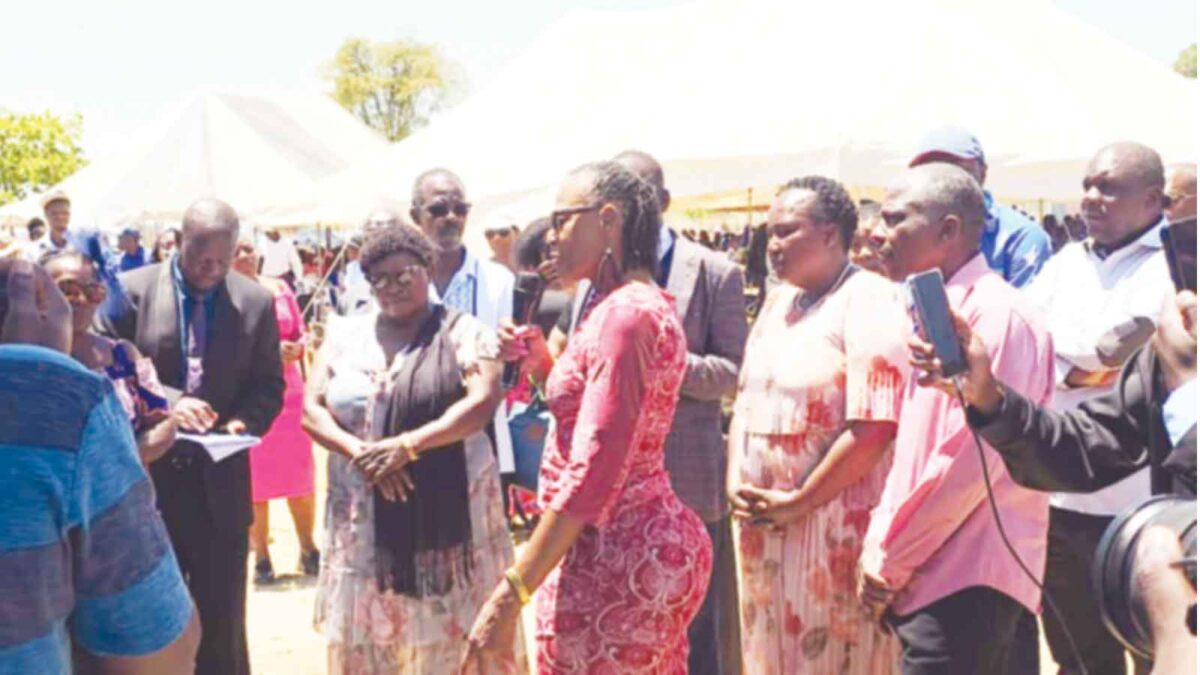
The transformation, which was officially commissioned on Saturday by Mashonaland West Minister of State for Provincial Affairs and Devolution Marian Chombo, demonstrates what partnerships between communities, development organisations and international partners can achieve.
For the children of Zvamaida primary, the development means an opportunity to learn in an environment where their dreams are no longer constrained by inadequate infrastructure.
“When I was growing up, I faced challenges in accessing education. I remember starting Grade One at the age of nine because my parents had moved from Harare to a remote area in Mount Darwin,” Ms Mapanda said.
“The experience has stayed with me throughout my life. I understand what it means for a child to face barriers to education, and I know how much access to a school can change a child’s future.
“As I look at Zvamaida today, I am reminded of my own childhood. I see the children, their dreams and their potential, and I am reminded why we must never stop investing in education.” Her vision has been realised through partnerships, including support from the Rotary Club of Basildon and other Rotary clubs, alongside the local community and Chegutu Rural District Council.
The project received US$140 000 mobilised through the Rotary Club of Basildon, while Rotarian Allison Beaumont contributed US$40 000 from her personal funds.
The contributions helped finance the construction of additional classroom blocks, a solar power system and a computer laboratory, among other facilities. Ms Beaumont’s personal contribution also supported the construction of a memorial library named after her late mother, Francis Macnab. For HAC board chairperson, Mrs Sylvia Sanyanga, the development represents what communities can achieve when they unite around a common purpose.
“Education is one of the greatest investments we can make in our communities. Children, regardless of the circumstances in which they grow up, deserve a safe and conducive environment in which to learn,” she said.
“For the children of Zvamaida, these classrooms represent more than just buildings. The library represents knowledge and discovery, the sanitation facilities restore dignity, while solar power and internet connectivity open doors to new technologies and opportunities beyond the boundaries of this community.”
School head Mr Boniface Tinago said the institution was established in 2016 following an assessment of the community’s educational needs and the signing of a memorandum of understanding between HAC and Chegutu Rural District Council in 2009.
Seeded on Downs Farm by Mr Chasauka, the school initially enrolled 200 learners but has since grown to 270, served by eight teachers.
Before its establishment, children had to walk approximately 10 kilometres to access education in Chegutu, while the flooding of Mupfure River during the rainy season often made travelling to school difficult.
The situation forced some learners to endure long journeys under challenging conditions, while others risked missing lessons.
Mr Tinago said the school had initially operated under trees and in makeshift pole-and-dagga classrooms, with parents struggling to mobilise resources to improve the learning environment.
“We are grateful for this development because it has brought dignity to our children. As parents, despite the economic challenges we face, we played our part by providing labour, bricks and stones,” said Mr Blackson Phiri, representing the community.
Mr Tinago said the improved infrastructure had created an opportunity to address the school’s historically low Grade Seven pass rate, which has remained below 30 percent since the first cohort sat its examinations in 2016.
He said the new facilities, including the library and computer laboratory, would help improve teaching and learning outcomes.
Officiating at the commissioning ceremony, Minister Chombo challenged the school and community to translate the infrastructure development into improved academic performance.
“Pass rates have to improve because we now have everything. We are going to invest in the school so that you pass,” she said.
She also encouraged the community to take advantage of the library and other facilities, including through adult education programmes, while commending HAC, the Rotary Club and other partners for supporting rural education.
The Minister said the initiative reflected the Whole-of-Government approach to development, anchored on the principle that communities must actively participate in building their future. Chegutu District Schools Inspector Mr Magarire said the development supported the country’s education aspirations under the National Development Strategy 2 and Vision 2030. He said modern learning infrastructure was critical in creating an environment where learners could acquire practical skills and use them to address national challenges. Despite the milestone, the school still faces challenges, particularly the absence of teachers’ accommodation.
Teachers currently commute daily from Chegutu town, approximately 10 kilometres away, prompting calls for parents, development partners and well-wishers to support the construction of staff houses. Chegutu Rural District Council chairperson Councillor Lynette Chirwa and Ward 28 Councillor, Tatenda Gwinji, pledged the local authority’s support, urging parents to mobilise resources towards the project and meet their obligations to sustain the school.