Online Reporter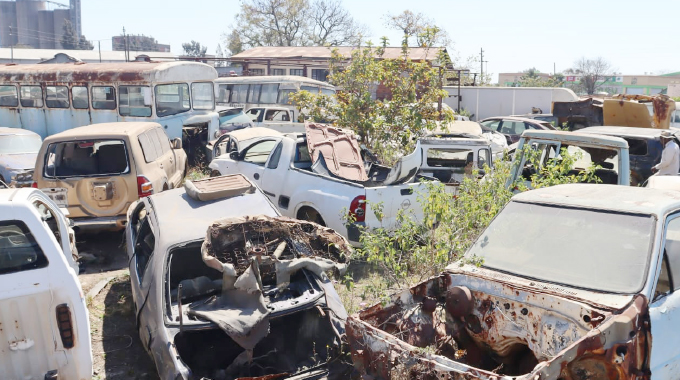
Patrick Chitumba, [email protected]
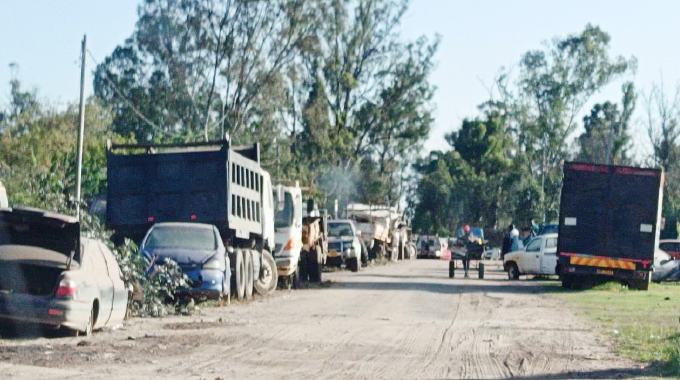
From the industrial yards and dusty streets of Gweru to the open spaces of Bulawayo’s Kelvin area, one thing is becoming impossible to ignore: Zimbabwe is drowning in old tyres and dead cars.
They line precast walls, fill empty stands and sit half-buried in storm drains. And every day, more arrive.
What was once a quiet trade of stripping a few parts has exploded into a nationwide problem.
With the rising cost of new vehicles and imported spares, a booming industry of wrecking yards, auto-dismantling yards and vehicle recyclers has sprung up.
But without proper regulation or recycling technology, the waste is piling up faster than the economy can absorb it.
In the heavy industrial site of Gweru, Mrs Lindiwe Moyo (44) points to a vacant lot opposite her offices where at least 200 car shells sit in various states of decay.
She said for over 10 years, her neighbour has been bringing vehicles there for stripping.
“We used to have free passage, but the road is slowly being swallowed by the vehicle shells,” Mrs Moyo said.
She said when it rains, water collects in the shells and they end up with mosquitoes everywhere.
She is not alone. In Gweru’s Mkoba 12 suburb, Mr Bernard Chikoromo (52) said the situation has worsened over the last two years.
“People are buying accident-damaged cars from auctions and from former vehicle owners, stripping the engines and doors, then dumping the shells in yards and along roads,” he said.
Mr Chikoromo said they have reported the matter to council, but nothing has changed.
“The roads in Mkoba 12 light industrial area are an eyesore and they are becoming dangerous. Children climb into the dumped vehicles,” he said.
According to research, the world generates about 30 million tonnes of end-of-life tyres (ELTs) every year.
Globally, around 88 percent of them are collected and recovered — a far better rate than the 14 percent recycling rate for plastic packaging.
In countries such as Italy, advanced tyre recycling in 2023 prevented 297 000 tonnes of carbon dioxide emissions and saved 274 000 tonnes of fossil and mineral resources.
The reason is technology.
Modern tyre recycling turns discarded tyres into crumb rubber for roads, playground surfaces, sports fields and construction materials.
Tyres can also be used for energy recovery in cement plants because of their high calorific value.
Vehicle recycling itself is not new. Dismantling cars for spare parts has always happened. But manufacturers in Europe, the USA and Asia are now formally involved, with regulated auto-recycling facilities that safely drain fluids, recover metals and process hazardous waste.
Zimbabwe is not there yet.
“We don’t have the technology,” said environmentalist Mr Peter Makwanya from Midlands State University.
“End-of-life tyre recycling is a pillar of sustainability and resource efficiency. But here, most ELTs end up in open dumps, burned, or buried,” he said.
A tyre, he explained, is not simple. It contains more than 200 materials — natural and synthetic rubber, carbon black, silica, steel, textiles and chemicals.
“Once they reach the end of their life cycle, ELTs can take two main paths: material recycling, where rubber, steel and fibres are recovered, or energy recovery, where they are used as fuel. Right now in
Zimbabwe, we have neither at scale, and it is high time that tertiary institutions work on that technology in line with Education 5.0, which aligns with Vision 2030,” he said.
Mr Makwanya said the business of breaking vehicles or fitting old tyres will not end as people continue to invest in vehicles and, subsequently, tyres.
“Many of us cannot afford new cars or new parts. So we buy from the wrecking yards. As alluded to earlier, we need proper disposal of the wreckages and tyres to protect our environment,” he said.
Mr Tawanda Sithole (35) runs a small auto spare parts business in Belmont, Bulawayo.
He buys accident-damaged vehicles from auctions and strips them for resale.
“There is huge demand,” he said. “A gearbox for a Toyota can cost US$1,200 new. From a wreck, I sell it for US$400. People need their cars to work,” he said.
Mr Sithole employs four young men. But he admits the waste is a problem.
“After we remove what we need, we are left with the shell. So we just push it into an open space,” he said.
Across the country, the pattern is the same. Mechanics strip vehicles in residential areas and industrial sites.
The valuable parts — engines, gearboxes, electronics — are sold. What remains — the shell, tyres, plastics, batteries — becomes waste.
Gweru City Council spokesperson Ms Vimbai Chingwaramusee said the wreckages and tyres should be dumped at the council dumpsite.
She said the practice of dumping tyres and vehicle wreckages on stands and along roads is illegal.
“All of these should be dumped at our dumpsite. We encourage all those with wreckages to do so,” she said.
But one wonders if the GCC has the capacity or state-of-the-art machinery, such as crushers, to dispose of the wreckage.
“We do separation of waste at our dumpsite, hence we are encouraging those with wreckage to dispose of them at our dumpsite,” said Ms Chingwaramusee.
Environmental Education and Publicity Manager for the Environmental Management Agency (EMA), Mrs Amkela Sidange, said her organisation has a clear regulatory position on waste management as enshrined in the Environmental Management Act [Chapter 20:27] and Statutory Instrument 6 of 2007.
“Section 70 of the Environmental Management Act prohibits the disposal of waste in a manner that causes pollution to the environment. It stipulates that every waste generator shall employ measures to minimise waste through recovery and recycling,” she said.
Mrs Sidange said disposal of waste in contravention of the provisions of Section 70 and Section 83 of the same Act is a punishable offence.
“As EMA, we call upon waste generators to adopt principles of waste minimisation, recovery, reuse and recycling to promote a circular economy,” she said.
Mrs Sidange noted that the circular economy is not just an environmental ambition but an industrial opportunity, adding that materials recovered from residual waste, including end-of-life vehicles and associated post-consumer residues, should be treated as resources rather than waste.
Residual materials, she added, should be properly managed to protect the environment while creating opportunities within the recycling sector.
“Gone are the days of waste management. Now is the era of resource management, where residual materials are raw materials for another line of production, thus instilling resource efficiency,” she said.
The Agency, she said, is calling upon local authorities to create an enabling environment for this transition by putting in place appropriate waste management infrastructure and enforcing local by-laws as the nation forges towards the attainment of a clean, safe and healthy environment for all.
Meanwhile, local authorities often issue removal directives for abandoned cars in public spaces, holding owners or property lessees responsible for removal costs.
But compliance is limited and the environmental cost is mounting. Burning tyres to extract steel rims releases toxic smoke containing dioxins and heavy metals. Oil, brake fluid and battery acid leak into the soil and groundwater. Rainwater trapped in tyres becomes a breeding ground for mosquitoes, increasing the risk of malaria and dengue. And the sheer volume is overwhelming.
Mechanics estimate that for every 10 cars stripped, 40 tyres are left behind.
Multiply that by hundreds of yards in Harare, Bulawayo, Mutare, Gweru and Masvingo, and you get mountains of rubber.
Beyond health, there is also the question of aesthetics and property value.
In the industrial area, factory owners complain that access roads are blocked by car shells.
“It looks like a war zone. Investors come to look at stands and they turn back. Who wants to build next to 200 tyres?” said Mr Chikoromo.
Globally, the shift is towards a circular economy. In Europe, car manufacturers are legally responsible for taking back vehicles at end-of-life. Tyres are shredded and used in road construction. In South Africa, there are licensed tyre recycling plants that turn rubber into tiles and mats.
Mr Makwanya said Zimbabwe needs the same approach.
“We need a policy that makes manufacturers and importers responsible. We need recycling plants.
We need designated dismantling zones with proper waste management,” he said, pointing to the opportunity.
“If we could recycle even half our ELTs, we could create jobs in construction, make cheaper road materials and reduce landfill. But first we need investment and enforcement.”
Mr Esau Mandipa of Mandipa, Makwara and Chikukwa Legal Practice and law lecturer at Midlands State University said the solution must come in three parts.
“First is regulation and enforcement. Government must designate and license auto-dismantling yards, ban dumping in open spaces and enforce removal orders. Second is investment in recycling.
The private sector must be brought in to set up tyre-shredding and rubber-processing plants, and to explore public-private partnerships for vehicle recycling facilities. Third is public awareness.
Mechanics and residents must be educated on the dangers of burning tyres and dumping oil,” he said.
As the sun set over the rows of rusting shells in Mkoba 12, a car-stripping business owner speaking on condition of anonymity said he makes a living from this business.
“I have children and I don’t want them to grow up breathing this kind of air. Government must help us do this properly,” he said.