Online Reporter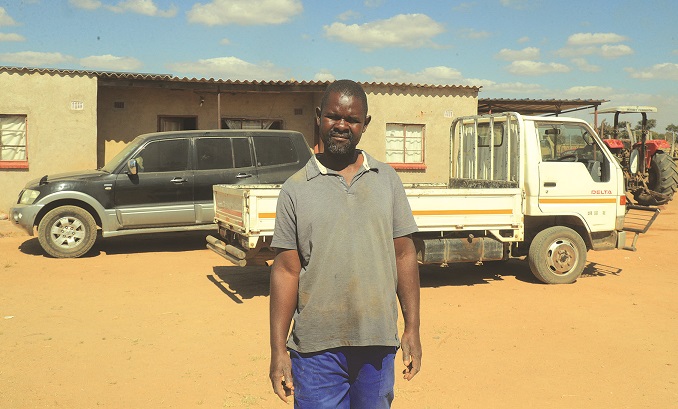
Elita Chikwati
Agriculture News Editor
HIS story is one of perseverance and determination.
Transitioning from a subsistence farmer to a successful commercial tobacco producer has been a challenging but rewarding journey for Mr Boniface Chitate of Plot 45, Munhenga Farm, in Goromonzi.
The A1 farmer now enjoys the creature comforts of his chosen field, as he now owns cars, tractors and a head of 40 Brahman cattle, among other assets. His journey, however, has been far from easy.
Mr Chitate, who is also the founder of the Apostolic Church of Christ in Zimbabwe, took a decision not to rely on offerings for sustenance but to venture into tobacco farming.
He is now one of the 134 000 local registered growers of the cash crop.
His expertise in growing the yellow leaf — once a preserve of white commercial farmers — has been improving with each passing season.
This year, Zimbabwe recorded its highest-ever tobacco output, thanks to hardworking farmers like Mr Chitate, who has become an inspiring figure within his community.
He has motivated others to embrace agriculture as a viable path to success and self-sufficiency.
Deliveries to auction floors so far have surpassed 340 million kilogrammes and much of it is produced by smallholder farmers, who account for more than 85 percent of the tobacco growers.
The long march
Resettled under the Land Reform Programme in 2002, he received six hectares of land. Early days on the farm were full of challenges. He did not have sufficient working capital and lacked decent accommodation.
Putting the six hectares under production was a daunting task, especially as he could not afford to hire tractors for tillage.
“It was difficult during the first days because we were coming from the communal areas, where we used to grow crops on a small piece of land. Farming was in my blood, but I did not have the necessary resources,” he recalls.
Armed with just a plough, a wheelbarrow and two head of cattle, he struggled yet remained determined. Together with his brother Charles, they began by growing groundnuts, sweet potatoes and maize, gradually increasing production over time.
At harvest, they managed to send a tonne of maize to the Grain Marketing Board.
As the years progressed, their yields improved.
“In 2008, we increased our production and shifted to high-value crops to maximise earnings. This change was essential not only for sustaining my livelihood but also for contributing to national food security. Observing the profitability of tobacco farming, I decided to start growing the crop in 2010, beginning with two hectares on a trial basis. I lacked the technical expertise at the outset,” he said.
“It was at this moment that I realised tobacco production was no easy task.
“It is labour-intensive and requires specialised expertise, particularly in curing. We used a scotch cart to transport the produce from the barns, which presented its own set of challenges. With no truck available and limited financial resources to hire one, we faced significant logistical difficulties.
“After the first sale, we could only afford to buy inputs for the following season. In 2011, we increased the hectarage to three. We were contracted by ZLT. We got inputs for two hectares and self-financed the other hectare. Initially, we did not have irrigation equipment and relied on rainfall, and this limited our yields,” he added.
Switching to irrigation
After doing his own research, Mr Chitate realised that those growing irrigated tobacco were getting better yields.
“We repaired the borehole at our farm and bought a pump so we could irrigate our crop,” he said.
After sowing seeds in June, they planted the irrigated crop in September and, as a man of God, prayed for success.
Their efforts were rewarded when they harvested 36 bales, with 21 of them fetching US$4,99 per kg at the market. This gave him the wherewithal to purchase a pick-up, even before selling the whole crop.
“We used the truck to carry the remaining tobacco bales,” he said.
Despite the success, he remained focused on improving his farm. His determination saw him expanding his hectarage and eventually establishing six hectares of tobacco by 2018.
He had to rent additional land for maize and soyabean, enabling him to diversify his farming operations.
“We started developing our home and last year we planted 7,5 hectares, and this was the season we got the best yields.
“I had always wanted to buy a tractor but was failing to do so. This year, I bought a tractor to replace the one we bought in 2016, which is now old. Next season, we are going to grow 10 hectares of tobacco,” he said.
Despite the progress, challenges remained.
Those he rented land from often offered virgin land that needed clearing and improvement, only to reclaim it after he had invested time and resources. Fluctuations on the market also posed another obstacle, with unfavourable prices sometimes forcing him to sell livestock to fund tobacco production.
Accessing financial support was another hurdle, owing to stringent requirements set by banks.
“I wish our Government could help by allocating us fuel and fertilisers.
“If we get affordable inputs from the Government, this would cut our production costs and increase profits,” he said.
He also expressed concern over middlemen who sometimes flood the market and force farmers to switch to other crops.
Blossoming revolution
Mr Chitate remains grateful for the Land Reform Programme, which empowered him and others in his community.
“If it was not for the Land Reform Programme, I would have continued to farm in the communal areas where the land is rocky and infertile. My forefathers laboured in vain in the communal areas where they had been settled by the colonial regime. Land reform was a springboard to better life. This is the best form of empowerment, and we will forever be grateful,” he said.
His ambitions for the future include achieving 30 tonnes of tobacco in the coming season.
He also hopes extension workers will recognise hard working farmers and recommend them to be allocated more land.
If he could secure between 50 and 100 hectares, he believes he would significantly increase production.
Mr Chitate emphasised the importance of educating the next generation on farming and steer them clear of negative influences.
“We are now educating our children to farm so they do not end up indulging in drugs and other illegal activities,” he said.
Looking ahead, he plans to diversify into poultry production, having already constructed fowl runs capable of housing 20 000 birds each. He continues to inspire those around him, proving that determination can bear success against the odds.



 Online Reporter