Chronicle Editor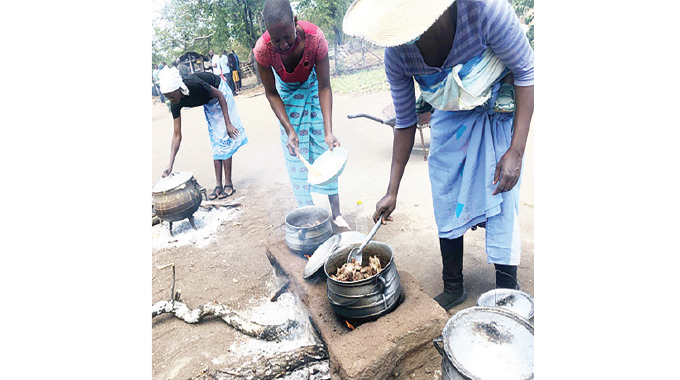
Lungelo Ndhlovu
DENISA Muhlatiwa (37), a mother of five from Tonono Village, Chiredzi District, now spends less time cooking beef trotters, sugar beans and other legumes thanks to her Tsotso stove, which cooks faster compared to the traditional open fire.
This leaves Muhlatiwa with more time to do other chores such as helping her children with school homework, instead of spending much time attending to pots, and having to push a wheelbarrow load of firewood sourced from the Save Conservancy across the Save River, about seven kilometres from her homestead.
Muhlatiwa indicated this ‘great’ relief for herself, and family came in 2018 when the whole village in Ward 7 received training in moulding and use of Tsotso stoves by the Enhancing Community Resilience and Sustainability (ECRAS) programme.
The ECARS project is implemented under a CARE led consortium, one of the three consortiums implementing partners for the Zimbabwe Resilience Building Fund (ZRBF) United Nations Development Programme (UNDP) and Government of Zimbabwe programme for the July 2016 to June 2017 year.
The consortium has been implementing the ECRAS project in Chiredzi and Mwenezi districts of Masvingo province where the common hazards for the two districts have been droughts, mid-season dry spells, diseases, crop, and livestock pests.
These hazards have resulted in poor maize harvests, poor cattle health and high cattle poverty deaths causing smallholder farmers to collect very low prices for their cattle.
According to Muhlatiwa, the training in moulding Tsotso stoves came to remedy the villagers’ heavy dependence on the use of firewood mainly for heating, cooking, lighting, and other energy needs which was contributing to deforestation in the village.
Forestry Commission figures indicate Zimbabwe loses about 330 000 hectares of forests annually because of deforestation.
“Cooking on the Tsotso stove doesn’t take time. In less than five minutes, I’m able to boil water for tea. I can cook sadza in less than 15 minutes compared to the traditional open fire,” said Muhlatiwa in an interview, tending to a pot full of ox-head placed on the Tsotso stove.
She is one of the villagers who managed to mould her own Tsotso stove which she now uses daily.
A Tsotso stove is a fuel-efficient wood-burning stove made from sheet metal.
The ECRAS project is one example of the available interventions to tackle energy poverty in Zimbabwe.
Climate experts say deforestation and the use of firewood for fuel are major contributors to Zimbabwe’s planet-heating emissions, which, however, remain low compared to developed nations.
The Government has pledged to cut the country’s energy-related emissions by 33 percent per capita from projected business-as-usual levels by 2030.
Speaking during a recent capacity building workshop for the Dissemination of Climate Change Information by media practitioners, Lawrence Mashungu, a climate change mitigation and renewable energy expert in the Climate Change Management Department in the Ministry of Environment, Climate, Tourism and Hospitality Industry said:
“We are making a lot of efforts especially with our renewable energy policy to make sure that we are 27 percent in terms of renewables by 2030.”
To support renewable energy-based projects for the achievement of SDGs in Zimbabwe, the United Nations Joint SDG Fund will mobilise resources and secure investments for clean and reliable energy in the country which has a potential to spur or complement the country’s efforts to a ‘just transition.’
“Just Transition is a concept which came out of the COP26, and the Climate Agenda where we are now shifting towards a low carbon and resource efficient economy. And, at the COP26 Summit there was a concept that is called Net Zero where we are also saying that we want to look at what we are emitting, what we are able to treat to achieve Net Zero.
So, Net Zero and Just Transition go together where we need to shift into a more sustainable way of doing things,” said Tawanda Collins Muzamwese, a climate change expert explained in an interview.
Elizabeth Paturzo, the Head of Communications for the UN Joint SDG Fund indicated the roll out of the joint programme is expected to start next month, after the completion of the design and pre-feasibility phase last year.
“The Renewable Energy Fund (REF) will be set-up for an initial period of 4 years. It is envisaged that after the first cycle of the fund, there shall be a second phase. About 40 percent of the fund will be used for small scale renewable energy projects while about 60 percent will be devoted to larger scale projects,” she said in an interview.
Commenting on how the programme seeks to tackle energy poverty and spur a green transition that creates employment and wider social benefits for the country, Paturzo said, this funding improves quality of life and creates opportunities for diversified income generating activities.
“The renewable energy projects funded by the REF will leverage local private sector financing to create opportunities for enterprise development and employment, particularly for women and youth. Additionally, underlying projects will enhance the resilience of vulnerable communities by ensuring greater and greener clean electricity access in rural areas for productive uses,” she said.
According to the United Nations, in 2020, an estimated 44 percent of Zimbabwe’s population had access to electricity. Lack of electrification, especially in rural areas has caused losses in production across key economic sectors, including agriculture and tourism.
While renewable energy has the potential to improve the low electrification rates in the country, high inflation and currency risk have deterred the long term, low interest financing that renewable energy businesses need to grow.
On the other hand, the REF is coming in at a time when Covid-19 has unleashed a blow to the global economy leading to decreased investments in renewable energy and access to clean energy.
According to Partuzo, the UN made some provisions for this project to be sustainable beyond the initial grant. She said, firstly the programme encompasses a financially and operationally sustainable model, partly through the partnership with Old Mutual Investment Group (OMIG) acting as the fund manager who will continue to operate the REF after the duration and fund provisions.
“This would create a self-perpetuating system of financing and fund pooling. It is envisaged that after the first cycle of the fund, there shall be a second phase.
“Secondly, the plan is to explore other sources of funding to sustain or expand the future iterations of the REF geared towards the financing of green infrastructure projects by establishing new partnerships with prospective co-financiers,” she said.
She added, the UN Joint Fund will contribute US$10 Million to the programme whilst the Zimbabwean government, through the Infrastructure Development Bank of Zimbabwe and local partners including OMIG, Zimnat Asset Management and CABS would chip in with a total of US$35 Million.



 Online Reporter