admin
admin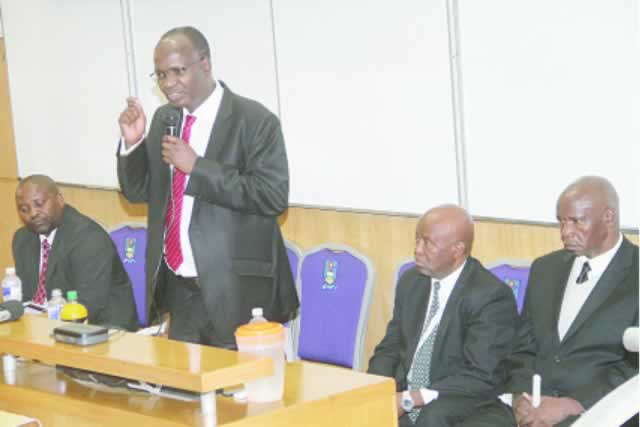

Kennedy Mavhumashava
The Government sees a bright future for the local media industry which would be characterised by diversity of opinion and respect for common national values.
The Minister of Information, Media and Broadcasting Services, Professor Jonathan Moyo said this in Bulawayo yesterday while delivering a public lecture at the National University of Science and Technology’s Department of Journalism and Media Studies.
Speaking on the topic, the “Future of the Media in Zimbabwe,” Prof Moyo said:
“It will be a media dispensation that reflects different view points but based on common national ethos driven by professional values with competing business interests.”
He said constitutional guarantees for freedom of media, the clear mandate that Zanu-PF won in the July elections and the advent of technology are some factors that would create a bright future for the local media.
He said:
“The outcome of the recent elections has created a very radically new situation in our country arising out of the magnitude of the mandate which President Mugabe got, 61 percent, what Zanu-PF got in Parliament more than two thirds majority; in fact unprecedented. It was so huge to say that ‘you said in your manifesto if you win you will resolve these things and address the aspirations of Zimbabweans and unite the Zimbabweans, there is the mandate, do it’. That mandate makes it possible for Zanu-PF to address real issues that have remained unfinished since 1980 which created an opportunity for the donors. One of the things that should fall into place is the role of the media, the purpose of the media. You cannot have national development with a divided, polarised media.”
He said the people must engage themselves regarding their national interests, adding that the Government is committed to depolarising the media to foster national development.
The minister said the Government is interested in what the media does professionally.
On another note, he said the new constitution would be instrumental in securing the future of the media in Zimbabwe in terms of Sections 61 and 62 as well as the country’s nine founding values that include the primacy of the constitution, importance of the rule of law, human rights and freedoms, recognition of equality of human beings, gender equality, diversity of the nation, good governance, respect of the liberation struggle and importance of the dignity of all humans.
“This is very good stuff that assures me that the future of the media can be bright,” he said.
New technology, said the minister was creating new opportunities, which would take the industry forward. He said if media houses allow themselves to be overtaken by new technology they risk collapse.
The other positive factor is that the economic situation dictated that investors who set up media outlets for political agendas also risked collapse.
“If you set up the media only for political reasons without a business or economic reason, you collapse. Some are retrenching right now, we will not mention their names but it’s not for anything other than a wrong strategy based on politics when they could be informed by business,” he said.
The new generation, said Prof Moyo have different values that tend to be more progressive, more tolerant and on good terms with many in society. Their values, said the minister are consistent with the founding values of the new constitution and those of the liberation struggle, thus guarantee the future of the country.
Prof Moyo said freedom of speech, not necessarily freedom of the press was fundamental, because everyone was born to exercise it while the latter is enjoyed by the elite.


 Online Reporter