Online Reporter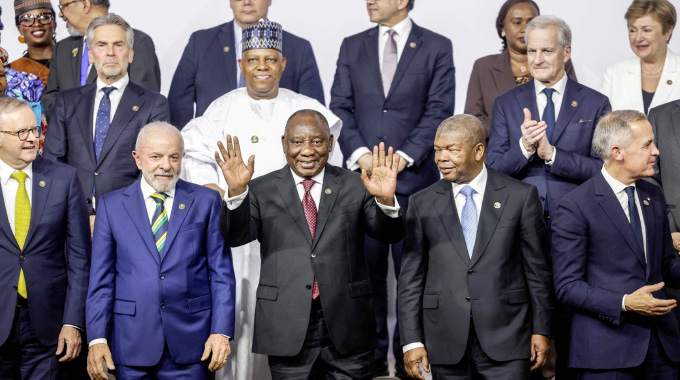
Fortune Madondo
FOR the first time in its history, a G20 summit was held in Africa, and under African presidency of the forum.
Commendably, South Africa prepared and tabulated an agenda which later formed the declaration of the summit; an agenda focused on helping developing economies of Africa and the global south adapt to the climate crisis, transition to clean energy and cut excessive debt.
Now that the concerns of Africa and the global south formed much of the G20 declaration, maybe, just maybe, Africa and the global south may push for practical policy action and interventions. The November 2025 theme: “Solidarity, Equality, Sustainability”, no doubt had with it African and global south yearnings.
“Solidarity” in the theme refers to “co-operation across diverse economies”.
“Equality” is all about “promoting fair opportunities between and within countries”.
And “sustainability” points to a “long-term development that does not compromise the future”.
This summit was unique and historical for a number of reasons. This was the first G20 summit to be held on the African continent under the presidency of an African country, (South Africa). South Africa had assumed the G20 presidency from 1 December 2024 to November 2025, becoming the first African country to chair the forum.
It was the first G20 summit in which present nations agreed to a declaration at the start of a meeting rather than on its conclusion. It was the first time in the history of the G20 summit that the next leader to take the rotating chairmanship was absent. It was the first time that the US boycotted this summit of the world’s largest economies.
What is G20?
“G20” stands for “Group of Twenty.”
The G20 brings together the countries with the largest economies in the world. It is a forum for the world’s major economies, both developed and developing, to discuss global economic and financial challenges.
The forum defines itself as the main forum for international economic co-operation. This forum annually meets to discuss economic, political and social initiatives. It was formed in 1999 as a response to the Asian financial crisis. The G20, as a forum of the largest economies in the world, meets regularly to discuss the most pressing issues facing the global economy.
Membership
The G20 consists of 19 countries and two regional bodies. The current members are: Argentina, Australia, Brazil, Canada, China, France, Germany, India, Indonesia, Italy, Japan, South Korea, Mexico, Russia, Saudi Arabia, South Africa, Turkey, the UK and the US, plus the AU and EU. The 2025, G20 Johannesburg Summit was the 20th meeting.
The G20 presidency is responsible for bringing together the G20 agenda in consultation with other members and in response to developments in the global economy. South Africa was responsible for preparing the Agenda for Johannesburg Summit 2025. South African President Cyril Ramaphosa said: “South Africa has used this presidency to place the priorities of Africa and the global south firmly at the heart of the G20 agenda.”
The UN secretary-general Antonio Guterres commented on efforts made by South Africa, of putting Africa and the global south needs at the heart of the G20 agenda: “But I think South Africa has done its part in putting those things clearly upon the table.”
A complicated global environment
The G20 Johannesburg 2025 Summit was held under a backdrop of global, political, economic and diplomatic difficulties.
The global environment was/is complicated by a number of factors. There are wars in Gaza, Ukraine and Sudan. The US and some of its allies are also undermining the international community’s efforts to address the intertwined challenges of climate, biodiversity, energy, poverty, inequality, food insecurity, debt, technology and development.
Trade wars initiated by US President Donald Trump by imposing tariffs on trading partners caused rifts therefore, getting together a diverse membership of G20 was quite a diplomatic and political feat.
It involved South Africa organising more than 130 meetings of G20 working groups, task forces and Ministerial meetings, in addition to the leaders’ summit. All this to end in a 120 paragraph Leaders Declaration covering all issues embodying and embracing the “Solidarity, Equality and Sustainability” theme that South Africa had chosen for the G20 agenda.
A closer analysis shows that South Africa prepared the agenda with the needs, concerns and yearnings of Africa and the global south in mind. Conspicuously absent was Trump who had earlier on said: “It is a total disgrace that the G20 will be held in South Africa, no US government official will attend as long as these human rights abuses continue. I look forward to hosting the 2026 G20 in Miami, Florida!”
Trump boycotted the summit over unsubstantiated allegations of “white genocide” in South Africa, accusing Pretoria of discriminating against, and even allowing the killing of white Afrikaners.
US Secretary of State Marco Rubio is also on record denouncing this year’s G20 theme for promoting what he referred to as “DEI” (diversity, equity and inclusion) initiatives.
Many observers have pointed out that US absence weakened any meaningful consensus, with many questioning whether South Africa would manage to reach its aims without the presence of one of the world’s wealthiest nations?
However, Professor Richard Calland, from the Cambridge Institute for Sustainability Leadership, thought it was possible.
“I think that people who are serious-minded in their analysis will not attach much weight to the US’ absence,” Prof Calland said.
“Ironically, the absence of President Trump may create more space for real consensus, because people won’t be constantly looking over their shoulder at him and trying to anticipate or navigate his conduct and his positioning.”
Prof Calland added that the absence of the US may have enabled middle powers to step up and push for the reforms they want, and in this case, South Africa pushed the concerns of Africa and the global south, enabling the leaders to make a declaration, though not binding.
The US had also told the South Africans that they should not issue a joint declaration at the Summit’s close, and that if they issued something it should only be called a “Chair’s statement”.
However, President Ramaphosa had said ahead of the event: “We will not be bullied!” He went ahead and announced at the meeting’s opening that consensus had been reached and a joint statement was issued without the input of the US.
This did not go well with Trump as it contained the kind of “DEI” language disliked by the Trump administration, stressing the threat of climate change, the importance of achieving “gender equality” and the debt burden faced by poorer countries. All for the purpose of boosting food security.
The G20 leaders called for lasting peace in Sudan, the Democratic Republic of Congo, the Occupied Palestinian Territory and Ukraine. G20 leaders reaffirmed their commitment to multilateralism and the principles of the UN Charter. However, there is not much take away for Africa because:
These G20 declarations are non-binding and do not include specific, legally binding financial commitments from member States for projects in Africa and the global south.
While the G20 declarations are not binding, White House spokesperson Anna Kelly criticised the move, accusing Ramaphosa of “. . . refusing to facilitate a smooth transition of the G20 presidency.” She further stated that Trump looked forward to “. . . restoring legitimacy . . .” to the group next year, probably when the G20 summit is held in Florida.
Meanwhile, President Ramaphosa was upbeat, saying South Africa had used the Summit to put “ . . . the global south at the heart of the agenda . . .” and, “. . . prioritised the issues that matter most to developing economies . . .”
The 120 paragraph Leaders’ Declaration issues included: debt and access to affordable, sustainable finance, financing for a just energy transition, critical minerals, a second phase for the Compact with Africa (The first phase was launched in 2017 during Germany’s G20 presidency and provided a framework for Africa’s engagement with its development partners), illicit financial flows and inclusive growth.
The recent G20 Summit prioritised African and global south concerns. It did try to bring more visibility to the challenges faced by Africa and the global south. The G20 members committed to working towards a fairer international financial system and addressed the unmanageable debt burden of low and middle-income countries.
G20 Leaders pledged to work on climate resilience, scale up adaptation, and increase financing for climate-related projects. The Summit declaration endorsed “Ubuntu approaches” to nutrition and price stability, supporting smallholder farmers and acknowledging volatile food prices.
The G20 Summit did not guarantee or offer guarantees that the discussion would result in a fundamental shift in the existing global economy for the benefit of Africa and the global south.
Commentators criticised the Summit language towards climate change as weak and lacking concrete targets for reducing emissions. So it’s very difficult to fathom how Africa and the global south would benefit from tackling climate change issues.
Consensus did suffer at this Summit. The US boycotted the Summit, and Argentina did not subscribe to the declaration.
Without consensus, it seems nothing much positive is going to come the way of Africa and the global south . . . it’s more likely business as usual — unfair, unequal and unsustainable economic systems. The G20 2025 Summit in Johannesburg did not achieve concrete, legally binding commitments from all G20 member States for Africa, but it did result in a declaration with a flavour and a focus on African and the global south concerns.
Nonetheless, the South Africa G20 Summit did signal a shift towards greater inclusion of developing nations’ interests. Whether this will reflect in tangible policies, actions and interventions, Africa and the global south awaits. —The Patriot