admin
admin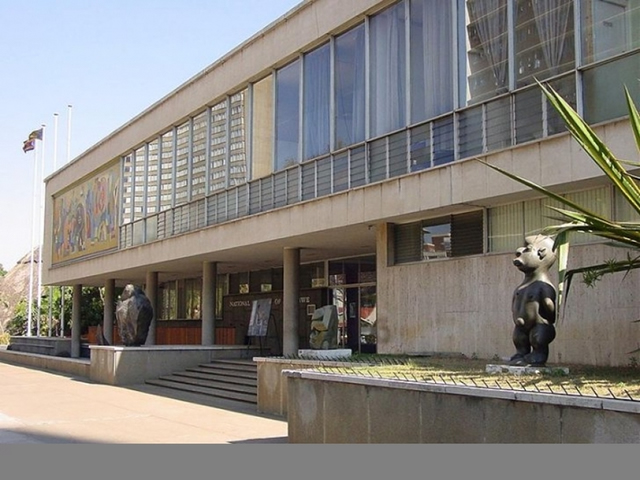
At The Gallery
With the commercial appeal of Biennales being highly attractive, there is great need to evaluate the format of Exhibitions and Art Fairs. In a year after the Venice Biennale and the second ever International Conference on African Cultures; which featured a fringe Art Fair component, the dynamics of the annual exhibition comes under intense inspection.
First and foremost, the definition of an annual exhibition is crucial to understand the dynamics between it and other forms of exhibition. Noteworthy is the fact that most annual exhibitions are open, that is to say, they may draw participation from artists of all techniques.
Annual exhibitions do not focus on a single medium and can traverse the visual art and performative art border, with new media techniques such as installations and digital graphics being included in such shows.
At times, annual exhibitions can be guided by a Call for Participation that is conceived by a curator. The curator usually comes up with a theme that the artists respond to.
The curatorial theme in previous National Gallery of Zimbabwe’s annual art exhibitions in recent years have changed, for example; Mharidzo in 2016 and Form and Colour in 2017. Artists responded to these themes with works across various technique and media, which showed the viewer the means artists were able to manipulate the different types of media they could manipulate. There is usually no limit to the number of media an artist uses to create their body of work, which is testament to the openness of the annual exhibition concept.
With regards to biennial or biennales; these exhibitions are set on a much grander scale, with a much more meticulous level of planning.
Biennales are more often curated as opposed to annual exhibitions. They take place on a global scale and with that, the openness aspect of these events is reasonably and justifiably minimal as the expression to show the best artworks is the underlying mode of the biennale.
Biennales are competitively geared and more focused on the lucrative elements of art. It is thus natural to have big name galleries and, correspondingly, big name artists, appearing at these Biennales.
One may consider biennales to be largely organised and well-coordinated; take the metaphor of a court where order is principle, while an art fair is organised to the fish-bone layout in many cases and is chaotic, confusing and overtly crowded.
Perhaps this description of the difference between an art fair and a biennale can fully describe the relative amount of planning that exists between the annual and biennale; the middle-ground being the former, which is all about wheeling and dealing, constituted of numerous shows and being somewhat disorganised.
From that, it is crucial to understand that annual exhibitions are not mostly focused on commerce and work to expose and develop talent.
The openness of annual exhibitions flows through the galleries and museums that stage them are largely free to the public, or, are of a light penny to access. This is the case because public institutions have to produce these exhibitions in line with their mission and mandate.
The cognisance of up and coming or maturing artists is a key proponent of the annual exhibition concept, as compared to the earlier mentioned big gallery- big name dynamic aforementioned.
With the case of the Zimbabwe Annual Art Exhibition, the mission of the National Gallery of Zimbabwe is to “promote talent, creativity and contemporary dialogue, through collection, preservation, exhibitions, education, research, engagement, and inspiration towards a broader appreciation of the visual arts and heritage”.
With that in consideration, the critical point between talent promotion, engagement with viewers and exhibition is crucial to the existence of the annual exhibition concept.
The annual exhibition platform thus serves as an important tool to connect with the viewing public as it is not steep in relations to pricing; wherein the biennale concept would be inversely ostentatious to a relatively non-consumptive market.
In a situation where more is to be benefited from the missionary-oriented promotion and exposition of talent and creativity, the annual exhibition is the best format of exhibition in Zimbabwe.
The annual exhibition, throughout the course of its history, was instrumental to the activating of artist’s careers. The platform’s openness and transparency is unmatched, as artists and their artworks became household names ingrained in Zimbabwe’s artistic and cultural history.
Sylvester Mubayi, Nicholas Mukomberanwa and Henry Munyaradzi were part of a group of artists, in colonial times, who benefited from this platform against the conservative wave of Rhodesia, who overlooked talent while holding race as the most important aspect of art production. In independent Zimbabwe, one may cite the likes of the late Charles Kamangwana, Chikonzero Chazunguza and Gareth Nyandoro as beneficiaries of the clout which the annual exhibition holds in exposition of talent.
The Zimbabwe Annual Art Exhibition thus has an important role to play on the Zimbabwean art scene as it offers a measurement of innovation in technique, the ever evolving media and the constant unearthing of new names in art circles.
This process is spurred to be competitive on a regional and global stage as there is always an exposure of artists who work from multitudinous perspectives that are relevant to the zeitgeist of a particular period, that is, a caption of the contemporaneity of the day.
It is the ultimate strengthening of the art industry as a whole which is the long-term focus of the Zimbabwe Annual Art Exhibition.
With the growth modalities of the annual exhibition platform being in all ways bounteous, the theme for this year’s edition of the show is blood relatives.
In the curatorial theme as according to the Call for Participation for this exhibition, “the Zimbabwean cultural ecology we inhabit is evolving in the face of a wired world which offers indefinite globalisation of infinite localities.
“Today everything is interconnected and mobility and the search for greener pastures across the borders have separated families and the family unit as we know it has suffered” the observation stated.
A question was posed as a critique of contemporaneity in conclusion, that being: “Are our family-tree based relationships still as important as they used to be in the not so distant past?” With that open ended question, for an open exhibition in place, this year’s Zimbabwe Annual Art Exhibition looks to have captivating interpretations to its call.


 Online Reporter