Chronicle Editor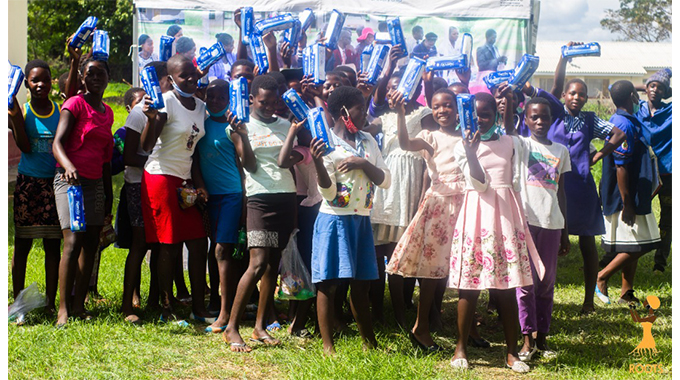
Hazel Marimbiza
While many are looking at the rising cost of commodities on the supermarket shelves and the declining purchasing power of their earnings, very few have stopped to ponder about the challenges being faced by school girls due to shortages of sanitary wear.
With the socio-economic situation taking a toll on Zimbabweans, for many girls in the rural areas the situation is dire as they cannot afford to buy sanitary pads during their monthly period.
A Plumtree resident, Emelda Maphosa, said she relies on unhygienic material to try to stem the bleeding.
This forces her to skip school lessons, lest she exposes herself to ridicule from friends.
“The situation is unbearable, my parents cannot afford to buy sanitary pads and I sometimes skip lessons for fear of being mocked by friends. I make use of worn out cloths as well as leaves and newspapers to contain the flow,” she said.
The economic hardship is affecting most students. For most girls, the menstruation period per month is four to five days. Without proper sanitary wear, girls are forced to skip school until their period is over.
The United Nations Education, Scientific and Cultural Organization (Unesco) says one in 10 girls in Africa will miss school during their period and eventually drop out; while World Bank statistics show girls are absent about four days every month, harming their education.
In Zimbabwe specifically, a study by the Dutch Development Agency reveals that 72 percent of girls in rural primary schools who menstruate do not use sanitary pads.
The subject of menstrual hygiene management (MHM) is an extremely important one but one which has not been thoroughly conveyed especially to young girls.
MHM is of uttermost importance to every woman and girls should be moulded into the most responsible and ready women when the implications of womanhood approach.
During MHM it is important for women and adolescent girls to use clean menstrual management materials to absorb or collect blood.
These materials should be often changed in privacy for the duration of the menstruation period. It is also essential to use soap and water for washing the body as required, and to have access to facilities to dispose used menstrual management materials.
However, girls, mostly in low income settings have low awareness on hygienic practices and lack appropriate materials for MHM practices.
Menstruation is often surrounded by silence, shame and social taboos. These often result in mobility restrictions and many girls avoiding going to school during menstruation. Rights advocates say the solution is simple: Give school-age girls free sanitary pads.
Kenya and South Africa already make it easier for impoverished and marginalised communities to access sanitary pads. Kenyan president Uhuru Kenyatta pledged to supply free pads to girls in school.
Sanitary pads have been tax-free there for more than 10 years. In South Africa, the department of education for the province of KwaZulu-Natal gives 3 000 schools free pads every month, with each girl in Grades Four to 12 getting a pack of 12.
Various civic organisations and Government bodies are now trying to do the same in Zimbabwe, devising initiatives to ensure that reaching puberty doesn’t condemn girls to missing school or dropping out altogether.
The Rozaria Memorial Trust, based in Murewa, in rural Mashonaland East province, provides five schools with sanitary pads and education in menstrual hygiene. It also helps children pay for their school fees and uniforms.
The Real Open Opportunities for Transformation Support (ROOTS), a grassroots organisation that has been combating child marriages and gender-based violence in Zimbabwe, has embarked on a campaign to ensure the sustainable provision of sanitary pads for girls in rural areas.
ROOTS has stepped in to help give pads to school girls in areas such as Mazowe, Bindura, Chivi, Zaka, Lupane and Harare. ROOTS programs officer Ms Sandra Muzama said girls need pads in order to further their education.
“Having seen the period poverty that is inherent in our communities we saw the need to provide sanitary wear to bridge this gap. In our findings period poverty is a catalyst for girls failing to attain a good education as some will stay at home when on their period to avoid embarrassment in the event that they soil themselves. Also adolescents and young people engage in transactional sex for money to buy essentials such as pads. The sex is usually unprotected as they have limited negotiation power because of their vulnerability,” said Ms Muzama.
She added: “When these girls fall pregnant, due to the existing cultural norms, they are then forced into marriage.”
Talia Women’s Network (TWN) has also stepped in by donating CHAYIL Reusable Cloth Pads to disadvantaged girls and women. Women across the nation of Zimbabwe have benefited — Harare, Mashonaland Central, Mashonaland East, Hwange, Chipinge, and Chimanimani.
Mrs Saliwe Mutetwa-Zakariya, director at TWN said giving girls free sanitary wear will enable them to attend school.
“Two of the major reasons why girls miss school are lack of appropriate menstrual hygiene products and dysmenorrhoea (painful periods).
Our pads have benefited the schoolgirls by providing them with a safe, hygienic and environmentally friendly solution to help them manage their monthly periods. Girls resort to using rags, tissue paper and other unhygienic materials when they do not have access to pads. With the CHAYIL Reusable Cloth Pads, girls don’t have to worry much and these can be used for up to 18 months with proper care,” said Mrs Zakariya.
In a bid to tackle period problems, TWN has come up with ways to alleviate the stress girls or women may face during this time.
“In addition to providing the pads, we also have a Menstrual Health & Hygiene curriculum, which talks about many things related to periods such as breaking the myths and taboos and more importantly how to identify and deal with irregular periods and period pain. So I would like to believe that our intervention has made girls love their periods and given them more knowledge and understanding on the subject of menstrual health, in addition to supplying the products. Culturally, we don’t talk openly about menstruation and periods, so we create a platform for open discussion and sharing for the girls.
“Our goal is to eradicate period poverty and supply pads to vulnerable women and girls. So where there is a need, resources permitting — you will find us there. We work with private sector partners such as Stanbic Bank, Mimosa Mining Company, MMCZ and OK Zimbabwe and sometimes they also help us identify vulnerable women and girls according to their CSR priorities,” said Mrs Zakariya.
While these organisations’ efforts are appraisable, keeping girls in school also requires also requires Government to assist in giving pads.
Last year in December, Government told our sister paper, The Sunday Mail, that learners in rural schools will start receiving free sanitary wear this year under a Government programme that is meant to assist children from disadvantaged families who are losing out on valuable learning time after failing to attend classes during their menstrual cycles.
Ministry of Primary and Secondary Education director of communications and advocacy, Mr Taungana Ndoro, said the programme will commence once Treasury releases funds for procurement and distribution of the sanitary wear.
“We intend to roll out the programme for the whole year based on the budget and we expect to alleviate the challenge of sanitary wear within the education sector. Our strategy of distribution is based on the equity principle, where we start with rural primary and secondary schools,” he said.



 Online Reporter