admin
admin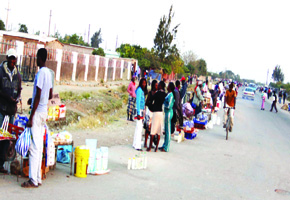
 Opinion Martin Stobart
RECENTLY, certain quarters in the formal sector of the economy complained, as they have always done, that the country is saturated with foreign goods, the consequence of which is the stifling of job creation. Yes, this is a time-worn camp we have heard umpteen times before.
Since when have the formal sector created jobs in this country and I am talking about the post-independence period? Come off it, please, if the majority of Zimbabweans (more than 80 percent) pinned their hopes on the formal sector to create employment opportunities this country would have slid into an economic abyss of incalculable proportions. There can be no doubt about that.
If the formal sector created employment, as it claims, why is it that the formal sector accounts for 80 percent of the working class in the country?
In fact, it’s a misnomer to categorise the business sector as formal and informal. We are merely playing with words. The facts on the ground reveal that the informal sector creates by far more jobs than the so- called formal sector.
The nomenclatural sectorisation of the country’s economy has lost its essence, having been overtaken by events. The authorities should desist from assigning pejorative titles to the majority of Zimbabweans who create employment for themselves and others.
The authorities should appreciate the efforts made by the informal sector towards socio-economic stability in the country. We realise that in countries where the majority sit back and look to the State to fend and provide for them, there has always been socio-economic instability, boiling into political violence.
When this happens foreign superpowers slot themselves in with tantalising regime change packages to seduce the gullible and ambitious pseudo-politicians. The informal sector is pivotal to the indigenisation of Zimbabwe’s economy. This writer is all for the indigenisation of the economy as embarked upon by the government.
And yet a closer analytical scrutiny of what is left of the foreign-owned businesses that are targeted for indigenisation is so miniscule that it is nothing to write home about and in terms of employment creation for the majority of Zimbabweans.
Let us admit it, comrades and all out there, indigenisation per se will not and cannot, translate into meaningful job creation opportunities.
It is important and imperative for Zimbabwe to encourage and facilitate the existence of a parallel or dual economy. The argument that traders and entrepreneurs in the informal sector do not pay personal and corporate taxes is neither here nor there.
While this is true, the sector makes up by being responsible for the bulk of the disposable income in circulation. And this income generates billions of dollars for the exchequer by way of VAT. The biggest by far of economic growth is consumption (in its broad and varied form).
It is not as if informal traders are the biggest smugglers of goods. The formal sector traders do it in a big way, containers, by truck loads and so forth. And in fact by other devious ways such as under-invoicing and or invoice inflating and by tax invasion and or tax avoidance.
If informal traders and other entrepreneurs do not pay taxes, it is not by avoidance or evasion. They are not even aware that they are supposed to pay tax in the first place. The other thing is that it will be an exercise in futility for Zimra to assess the taxability of each and every informal trader or entrepreneur.
I think it is self-evident that more than 95 percent of them fall well before the taxable threshold, so that Zimra may rebate some of them. One other point to make here is that not even the gainfully employed are also found in the informal sector.
The informal sector entrepreneurs are fending for themselves in all ways and manner conceivable. They pay for their health needs in addition to a myriad of other basic needs. They pay for the education of their dependents.
Recently, the government sent tonnes upon tonnes of goods to the Tokwe-Murkosi dam flood victims. The goods were seized by Zimra at the country’s borders. I would call it a timely donation by the informal sector entrepreneurs. The formal sector is organised in its
operations and is therefore able to attract and even court the attention of the government by calculated overtures.
Its relation and interaction with government is also bolstered by the law of the land through various statutes (company law). The formal sector, can in some rare cases, arm-twist (some would say blackmail) the state to accede to its demands. A case in point is the importation of certain foods including fruits and vegetables.
These are basic consumables we should have access to for the good of our health. This is done on the self-serving and criminal contention that the banning of these goods and produce will capacitate the local companies to produce optimally and thereby create employment.
This contention is a dummy. It is fake and criminal, I would say. This is the kind of legerdemain often employed by the formal business sector so that it continues to hold majority as a captive consumer buyer.
The owners of these formal businesses are denying us our right of choice as to the goods and produce we must buy and eat. The local businesses gripe has always been that imported goods are cheaper, of course they are and that is what we want and this is the reason why we import them in the first place. What’s objectionable about that and why? We cannot just buy locally made goods even if they are poor quality and extortionately expensive.
By criminalising the informal sector the, government is biting the hand that feeds it and thereby playing into the hands of the capitalists. This writer is well aware that the mention of the term “capitalist” is construed as hate speech by some I understand them without of course sharing their interpretation. Suffice it to say that capital is not the same as capitalist or capitalism in the same way that the term race is not necessarily the same as racist or racism. And yet it is a universally proven fact or truism that capitalists and their religion of capitalism can never create employment for the majority, at least in a developing country such as Zimbabwe.
The informal economy, in most countries of the developing world, of which Zimbabwe is one, is a response and perhaps even a recognition by its entrepreneurs and practitioners that unless they create employment opportunities for themselves and by their own effort and initiative, they will continue to wallow in perpetual impoverishment until doomsday (if ever such a day will materialise).
Actually, the facts on the ground are that a huge segment of the formal sector, particularly the distributive or retail sector, operates pretty much as part of the informal sector. The formal sector has become a luxury if not liability to this segment. In other words, the formal sector economy is now exclusive domains for a particular class of business players especially those with foreign connections and interests (in share holdings).
These companies want government to protect them by banning exports so that they can exploit local consumers by charging exorbitant prices. They complain that imports are cheap. That is a very silly statement to make. They do not want the informal businesses to import. Only they must export and import. What brazenness! Let the formal economy do with cheap zhing zhongs. They satisfy its needs.
Aren’t we in a global village?
Coming as news “flash” as I was penning off this article, is the announcement that the government is currently working on the modalities of taxing the informal sector operators. I touched on this possibility above in this contribution. The good part of this envisaged exercise is that Zimra will spearhead it while the Ministry of Local Government will provide logistics. Perhaps the exercise is very noble in that it will start the beginning of “integrating” the country’s economy.
However, it will all depend on how wide and finely knit the Zimra tax nets will be. Time has now come when the Ministry of Local Government ceased to treat the informal sector traders as disease carriers and the “people’s market” as the epicentre of communicable and transmittable diseases and treat them as infections of disposable income into the economy especially when the economy is going through straightened circumstances, as presently is the case.
It is hoped that Zimra will consult sufficiently and widely only with the relevant ministry officials but with the traders themselves. It is common cause that the ministry has criminalised the traders for a long time by disrupting their operations without offering optional means. That time is now over. It belonged to the colonial era.
The formal sector has failed to create employment for 34 years now and what reason is there to make one believe it will create employment this time around? When times are hard, it has always been the informal sector to the rescue. When times are good, which they have never been, the informal sector is criminalised.



 Online Reporter