


 Online Reporter
“I have been a victim seven times already. I came here in 2009, but the fires started in 2015. Each time, I feel like I am back to square one.” — Patrick Munemo
Trust Freddy
Check Point Desk
THE morning after a devastating fire on Saturday night, the Glen View 8 home industry complex reverberated with the relentless sound of hacksaws, hammers and drills.
Traders rallied to rebuild their livelihoods, even as the scale of their losses became painfully clear.
Hundreds of small and medium enterprise (SME) traders lost goods valued at over US$100 000 in the mysterious blaze, marking the 14th fire incident to hit the complex, with cumulative losses estimated at over US$3 million.
The aftermath is stark, with remnants of dreams and hard work scattered among the smouldering debris.
An army of skilled artisans, armed with claw hammers, planers, nails and an assortment of specialised tools, tirelessly worked round the clock to carve life out of wood.
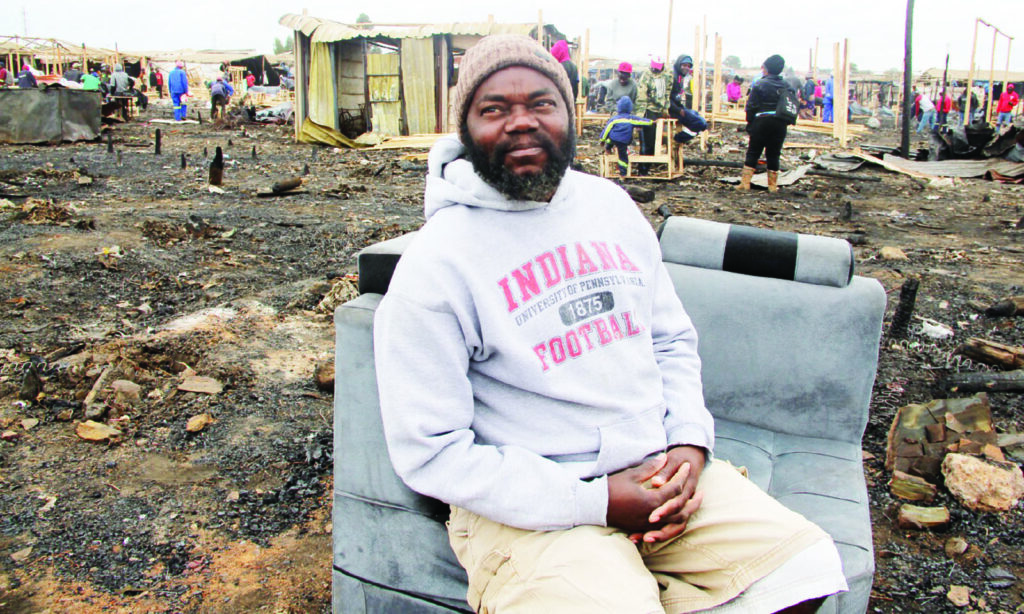
Yet, amidst the fervour, a solitary figure, Patrick Munemo (48), remained seated on a surviving corner couch, his face buried deep in his hands, fingers nervously twisting through his cotton-tufted hair.
“I had 17 sets of L-shaped sofas, but this corner is the only thing that survived,” Munemo recounted.
“The rest were reduced to ashes. We are talking of over US$5 000.”
He is the portrait of heartbreak.
Others around him hustle and bustle in an effort to rebuild their shattered livelihoods after yet another catastrophic fire — the ninth since 2015.
“I do not know what to do next. I am not even sure if all my sets were burnt or if some were looted. Out of all 17 sets, we should have been seeing a pile of burnt springs here. I am literally confused. Anyway, . . . only God knows,” he added.
A cycle of loss and frustration
While this is believed to be the complex’s 14th fire incident, in previous events, Munemo had managed to salvage his property.
The city’s fire department used at least 300 000 litres of water to contain the latest blaze.
For Munemo, the recurring nightmare of fire has become a bitter reality.
“I have been a victim seven times already,” he laments.
“I came here in 2009, but the fires started in 2015. Each time, I feel like I am back to square one.”
Each incident has chipped away at his resolve, making his dreams of establishing a stable business feel increasingly distant.
“I thought I was finally saving enough to get a stand of my own. Every time I come close, it goes up in smoke,” he laments.
The spectre that the fires could be caused by arsonists continues to fuel fear and mistrust among the community.
“We work so hard just to have it all taken away,” he added, shaking his head in disbelief.
“How can we protect ourselves when we do not even know what caused the last inferno?”
This cycle extends beyond him; it envelops the entire community.
“Even insurance companies tried to partner with us, but they fled, knowing the risks are too high. There is a 100 percent probability of fire here. Nothing is regulated and it is risky working in these conditions, yet we have nowhere else to go,” he continued.
The same sentiments resonate throughout the complex, where other informal traders have faced similar tragedies.
Some whisper suspicions of foul play, suggesting that amidst the chaos, looters may have struck, destroying evidence of their crimes.
“Anything is possible here. Without strict regulations, it is easy for someone to take advantage of the situation,” added Munemo.
Troublesome touts
While the affected traders try to rebuild, just outside, hundreds of young men, colloquially known as magombiro (touts), swarm around passing motorists, aggressively touting an assortment of goods and services.
Any vehicle that tries to slow down is fair game, immediately chased and motorists are coaxed towards the furniture sections that hold an array of sofas, wardrobes, kitchen units, beds and headboards.
The touts charge what they want for furniture that is not theirs.
After getting the cash, they hand over to the carpenters what they think is the fair price and pocket the difference.
“We are being compelled to sell our sofas at US$250, a full $100 less than our intended price of US$350. At one point, we demonstrated as carpenters, but we were simply told that we must also share because these youths also call their enterprise as middlemen “employment”.
Despite his reservations, Munemo is somewhat optimistic about the Government’s plan to relocate them and construct a well-regulated facility, which would hopefully eliminate the touting issue.
“We might finally start generating decent income. The current setup is unworkable, with touts pocketing most of the profits . . . ” he lamented.
Just a stone’s throw from where Munemo’s workspace once stood, Trymore Mukwada is also grieving over his loss of 19 sets of sofas.
However, his situation is different, as he can see that all his sofas were completely burnt.
“I had 19 sets of sofas; that is about US$4 750 that has gone up in flames. I have no other option but to rebuild with the little savings I had.”
For Mukwada, this is the eighth time he has been affected by fire.
“While we appreciate the Government’s initiative to build proper structures, we are concerned about the potential consequences, particularly the risk of some traders losing their livelihoods,” he said.
“Again, the identified temporary locations may prove inadequate to accommodate the more than 1 000 traders who call this area their workplace.”
A 2014 study by University of Zimbabwe’s Professor Godfrey Muponda found that more than 8 000 people work for small furniture manufacturing businesses across the country’s six largest cities.
The study also revealed that Harare had the largest number of furniture makers, with several of them working out of makeshift sites.
The Glen View Furniture Complex was set up by the Government in 2000.
But the authorities say many carpenters there arrived shortly after “Operation Murambatsvina”, a clean-up campaign carried out in May 2005.
Between 2006 and 2009, the city council gave 1 920 SMEs free workstations at the complex, according to a 2012 study in the International Journal of Marketing and Technology.
Since then, others have moved in — some with authorisation from the local authority and others with permission from people they believed to be council workers.
Adding to the challenges, there are no functional ablution facilities at the complex, forcing the majority to resort to open defecation, while others have made arrangements with nearby homeowners to use their facilities.
Just behind the complex’s precast wall, an open space is used by both men and women for this purpose.
“We just go to that open space; the toilets were never renovated because we are not paying any cent to the council,” a trader who requested anonymity said.
Future plans
Harare City Council SMEs committee chairperson Councillor Denford Ngadziore said: “The affected traders include those manufacturing wardrobes, kitchen units, sofas and other carpentry products. Preliminary investigations suggest the blaze was unintentionally started by security guards on duty, who were warming themselves by a fire that later spread around 5am.
“As the SMEs committee, we will take a keen interest in the ongoing investigations. It is our strong position that those on duty must be held accountable and prosecuted for the negligence that resulted in this costly disaster.”
Harare Mayor Councillor Jacob Mafume said the council will work with the Government in the construction of the new structure, with improvements to floors, electricity and toilets.
“We are deeply hurt by what happened here and our wish is to end the sorrows of the people who work here. We are going to unite.
“This is being done to work hard on the new structure to be constructed similar to the Mbare Musika,” he said.
“At this place, a nice building will be constructed. We are going to create a good market. The one we created in Mbare is going to be smaller than what you will see here, with the help of the Government. We will also consider a complex structure with floors, electricity as well as toilets.”
President Mnangagwa has ordered the urgent reconstruction of the Glen View Area 8 complex.
The directive comes as the Government is undertaking the Mbare Traders’ Market Phase Two project. This follows the destruction of Mbare Musika by a fire last year.
The two projects will now run concurrently under a national programme to modernise informal trading spaces.
Local Government and Public Works Minister Daniel Garwe said the recurring fire outbreaks have paved the way for immediate intervention through the Department of Civil Protection.
“Over US$2 million to US$3 million was lost. All their products were also lost. The President declared the Mbare Market inferno a national disaster when it was gutted by fire last year and then said, ‘Can you also look at Glen View Area 8, because year in, year out, it is gutted by fire.’”
The Government is now fast-tracking redevelopment plans, with work expected to start in September 2025, and run concurrently with Phase 2 of the Mbare Market reconstruction.
Minister Garwe hopes the completed Glen View complex, including the unaffected areas, will be commissioned by the first quarter of 2026.



