admin
admin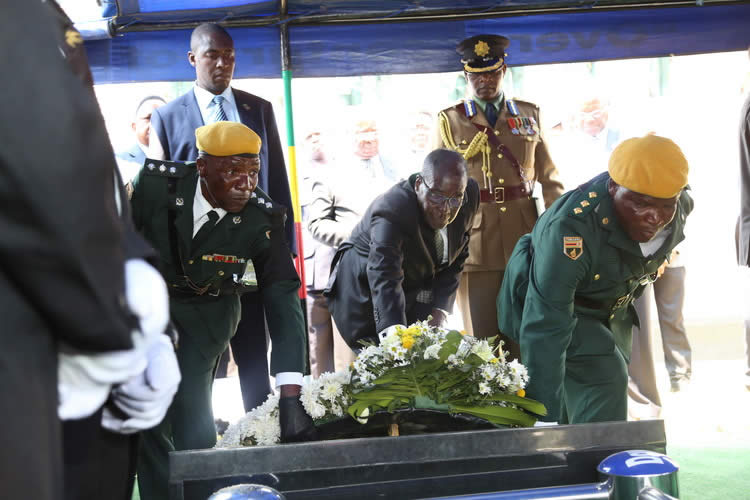
Address by His Excellency, the President of the Republic of Zimbabwe, Cde Mugabe, at the burial of Zanu-PF Politburo member and former Cabinet minister Dr Sikhanyiso Ndlovu at the National Heroes Acre, Harare on September 19, 2015
***
It is a very sad day indeed for our nation as we gather here at the Heroes Acre, to bury a veteran nationalist and a leading educationist, Dr Sikhanyiso Duke Ndlovu. He passed on on Tuesday, after a sudden but fatal health complication. On behalf of the party, Zanu-PF, Government and our entire nation, I express my deepest condolences to the Ndlovu family, principally to Mama Ndlovu and the children, who have lost their dear one.
That broad, unreserved, spontaneous and infectious smile, is gone forever.
We grieve at his departure, moan that he will no longer be with us.
But there is a way in which he continues to speak to us as in real life, a way in which he will continue to be with us, indeed lead us, as before.
As he departs this Earth, he leaves us an illustrious life well lived, an ex-ample of how commitment to a noble cause beats mortality, imparts durability beyond the transiency of ordinary life.
Dr Ndlovu’s deeds, in the nationalist struggle, his scars, both visible and invisible, his complete dedication to a protracted struggle, shall live for ever.
He was a veteran nationalist who joined his elders when he was young. As he was moved by the love for his country, itself then shackled by colonial chains, the love for his people, then subdued and prostrated by colonial rule.
All these enkindled the fiery nationalism in him, making him do things, take decisions, accept and suffer adversities that far outstripped his age, and even his times.
He was among the pioneers of Gonakudzingwa, that notorious open prison, right in the middle of Gonarezhou which made him and revolutionary patriots of his time, all of them companions of beasts of the wild, cut away from human contact. Gonakudzingwa was built for the incarceration of nationalists from Zapu.
Those of us from Zanu were herded into an equivalent open prison at Sikombela, right in the middle of nowhere, in Gokwe. Each incarceration inflicted a wound to both body and soul, but also marked some step forward in our bid for freedom.
Sikhanyiso was one of us, fellow denizen in those dungeons.
All these prisons and detention centres were calculated to break the back of African resistance, to break its leadership in order to make the African people submit to colonial rule, by making them quiescent.
Much worse, marriages were broken when wives, having endured loneliness for longer than was bearable, succumbed.
And we also had nationalists whose lives disintegrated under intense pressures.
It was not easy to be a “widowed” wife of a man who only lived within the confines of prisons and detention centres.
Sikhanyiso went through all this, braved all this, to emerge tried and tested, as unalloyed metal gone through a crucible.
It is this amazing sense of commitment, this indomitable courage, this unbroken spirit in the face of intense pressure, which gives us something indestructible, something immortal which far outlives Dr Ndlovu’s transient life.
A total commitment to a people’s cause which imparts timeless lessons to all of us the living, enabling Dr Ndlovu to exhort and urge us on from his grave.
Yes, he went to America to pursue higher education. He finished his doctoral studies, itself a clear indication that he was a case of a fighter with brains. Those of us who joined the ranks of nationalists in the ‘50s and ‘60s, will tell you how difficult it was to enlist the support of African intellectuals.
Reared on the staple of a white-designed, an oppressor-designed curriculum, fed and fumed with illusions of being “better Africans”, of being educated Africans, this pioneering class of native intellectuals preferred multi-racial tea parties and “sundowners”, patronised liberal white company, revelled in bow-ties, coattails and affected English, to the rough rigour of political agitation.
Comrade Sikhanyiso was not one of them. He went to source higher knowledge for the struggle, not for personal prospect.
Once done, he flew back to Zambia to help other comrades in the struggle for a free, majority-governed Zimbabwe.
He was in charge of educating cadres and refugees, all in anticipation of a free Zimbabwe. What foresight!
We had such men and women who knew the Patriotic Front was not just about guns and bullets, was not just about the armed struggle, men and women who peered beyond the struggle to inventory skills needs of a free Zimbabwe.
At Independence, we turned to educationists like Dr Ndlovu to show the way.
I never called him Dr Ndlovu; I just called him “Doc” right through, and even amongst other doctors, he knew whom I meant. It was just him.
Doc, Doc and Doc forever.
They (the educationists we turned to) did, which is why today we stand as a shining beacon in broad-based, inclusive education on the continent.
The real challenge is now to give that education a qualitative leap so it speaks directly to the needs of our economy.
Yes, we have many graduates, but we have few skilled graduates, who have found exposure and gathered experience in the service of industrial trades that power our economy.
That is our challenge as we move into the future.
Dr Ndlovu did much more than write, comment, or prescribe.
He set examples by way of his chain of colleges which he called Zimbabwe Distance Education College.
Alongside People’s College, at Independence, ZDECO became synonymous with resumption of education for adults whose chances had been ruined by the war.
We have many ZDECO graduates, who now stand tall in professional circles, thanks to Dr Ndlovu.
How then does he depart from us, he who sired so many living testimonials?
I made him minister in my Government in many ministries, principally those of education and information. He excelled, distinguishing himself as a man of ideas. It showed in Government, in the party, and indeed in the Press where he distinguished himself as a fierce but conscious columnist.
The bedrock of his ideas, values, was the African struggle. And here is one big lesson to the current generation of educationists.
There is no education which is value-free. All human education derives from or has to be steeped in values, experience and aspirations of a people, if it is to avoid being irrelevant.
It must confirm our being Africans, and challenge the denial of our being by contrary theories.
This is what Ndlovu strongly believed.
Today we say goodbye to Dr Ndlovu, our hero. We say goodbye to him in a free Zimbabwe, a liberated soil which now embraces him for his final rest.
We say goodbye to him as a free and emancipated people.
He goes to rest, a happy and fulfilled fighter for freedom. He leaves behind a free people, a literate and numerate people. An educated nation transforming its socio-economy for greater welfare and security. A free Zimbabwe whose coming into being gave him so many visible and invisible scars.
Go well. Go well son of the Great Elephant.
Go well. Go well, Son of the Soil.
Qhawe lamaQhawe.
Rest in eternal peace our veteran nationalist, teacher of a people.
I thank you.


 Online Reporter