admin
admin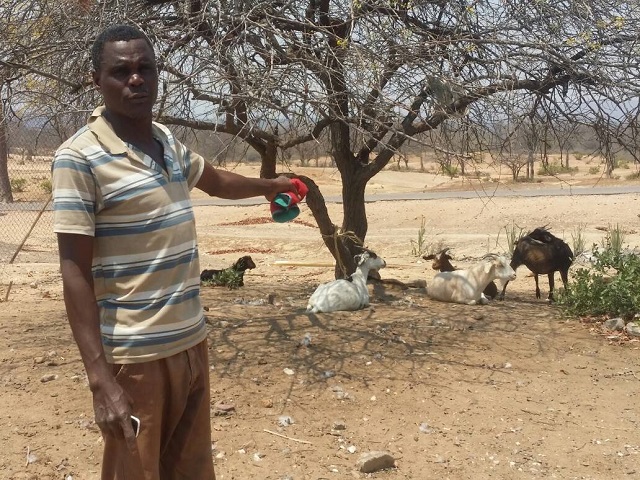

Ngqwele Dube, Features Correspondent
MR Robert Sitilo (42) of Siachilaba, Ward 10 in Binga’s dream of increasing his goat herd and making significant gains out of it seemed a far off reality.
Despite his efforts in trying to make ends meet from goat-rearing, the natural geography of the area and his lack of adequate resources seemed to have conspired spiritedly to deny him the comfort that he yearns for as the region’s dry and hot weather has stunted the growth of his herd, leading to his goats fetching lower prices on the market.
To pay school fees for his two daughters he needs to sell between 13 and 18 goats a year, one of the factors that puts a ceiling on his aim of increasing his herd.
However, the implementation of the Integrated Food, Nutrition and Income Security Programme (FNI) in 2014 changed Mr Sitilo’s fortunes.
His herd has increased threefold since the Goat Value Chain project kicked off and he has been selling between six and eight goats to pay his daughters’ school fees per year.
Despite being livestock-rearing communities it has been difficult for farmers in Binga and Hwange to make maximum gains from their livestock but with the knowledge and support they are getting now, life has been made a little more easier.
To alleviate the plight of the farmers, FNI brought in a cross-breeding programme for the goat farmers. They brought 32 boer he-goats to 32 wards in the two districts.
The boer goat, found in Matabeleland South is bigger, has a fast growth rate and excellent carcass qualities coupled with a high resistance to diseases and adapts well to hot, dry semi-deserts, merits that have made it one of the most popular breeds in the world.
This led to an improved carcass weight with the positive impact of increasing the prices of the goats.
Mr Sitilo said the carcass weight has improved to above 30kgs.
“One adult Tonga goat was being bought for $15 while a cross-breed is fetching $45 on the market, marking a significant price hike. The impact on our lives is immense as increased income means there are a lot of changes we can implement,” he said.
“My herd increased from the 20 goats when I joined the scheme in 2014 to 70 which I currently have.”
The programme, which is funded by the European Union, brought together a consortium of Netherlands Development Organisation (SNV) and Catholic Agency for Overseas Development (Cafod) with Caritas (Binga) and Environment Africa (Hwange) being implementing partners.
The project which is funded to the tune on $4,5 million also incorporated the resuscitation of irrigation schemes in the two districts of Hwange and Binga.
Farmers said the improved weight led to their goats fetching higher prices on the market.
Ms Marias Munkombwe of Siachilaba also said increased income from goats had a net positive effect on other aspects of their lives.
She said she had been able to pay school fees for each of her children after selling fewer goats.
“For each term I would have to sell three goats to pay for one child but now I only sell one. As a woman I also want to have a presentable kitchen, when visitors arrive I want to be seen with better utensils and pots and with increased income I can now buy more quality pots and pans for my kitchen, even the children can be clothed better,” she said.
Mr Neckson Kazwela said the project had a positive impact on their diet as they were now able to buy various foodstuffs to complement what they grow.
“Before the introduction of the boer goat income from the goats was low and sometimes we could not even afford cooking oil and would continuously eat okra but that is now a thing of the past, we are eating a wholesome diet with all the nutritional requirements,” he said.
FNI project manager Mr Minenhle Ngwenya said they have also provided training on the keeping of livestock and also trained para-vets, who work closely with veterinarians in the livestock department.
Farmers are also trained in business oriented farming, contract management and marketing so that they can exploit any opportunities which arise in their value chains.
Mr Sitilo revealed that the training coupled with qualities of the boer goat has seen them registering near-zero deaths of kids during birth.
“Previously we would lose kids during birth when it is very hot but this is a thing of the past because of the strong breed and knowledge we have gained.
“Para-vets also play a big role because they are close to us and can give us advice and assist with ease,” he said.
Siachilaba Crop and Livestock officer, Mr Lawrence Rupiya said establishment of sale pens under the programme enabled secure transactions with a scale, enabling actual live weight to be factored in the price.
He said more than 300 farmers across 16 wards in Binga benefited from the EU-funded programme.
Food security is one of the biggest challenges facing governments across the world with various strategies being adopted to mitigate hunger.
Binga and Hwange are located in farming regions five and four respectively which are characterised by low rainfall and high temperatures that impact negatively on agriculture endeavours.
FNI, which started in 2014 and comes to an end in December, rehabilitated 30 irrigation schemes across the two districts with six new ones being established.
Mr Ngwenya said the overall objective of the FNI project was to improve smallholder farmer productivity for food nutrition and income, develop and implement diversified and appropriate value chains to increase production and consumption of nutritious food.
“We aim to increase household participation in the value chain development in five areas that include fisheries, small grains, horticulture, livestock and sesame but we do it through climate smart, conservation agriculture.
“Agriculture is no longer about production but also has the business aspect hence the training of farmers in agronomy. We want farmers to be able to earn beyond the funding phase of the programme,’” he said.
Cafod country director, Verity Johnson said they have been working with Government and various stakeholders to ensure the success of the programme adding that the gains made in the livestock value chain should be retained beyond funding years.
“There are many aspects that remain in place after the programme has been folded and these should be put to full use by the farmers and maintain them in good condition.
“Knowledge gained during training and technology on market information will also continue to play a critical role in enabling farmers to maximise their effectiveness and increase income,” she said.
Irrigation schemes include the Nabusenga scheme in Binga which started in 1976 but recently suffered from worn out irrigation infrastructure that had resulted in less water getting to the fields while a new fence was erected to keep out domestic animals from entering the fields and devouring the produce.
Mr Ngwenya said Nabusenga farmers had also been facing marketing challenges but they managed to link them with contractors, signed a memorandum of understanding with Gokwe Spar which would take delivery of green mealies. An agreement was also reached with Cairns Foods over the purchasing of sugar beans and Michigan peas.
The consortium held the World Food Day commemorations in Siabuwa, Binga on Wednesday and in Lupote Village in Hwange. The day is marked every year on 16 October.



 derick.khumalo