Chronicle Editor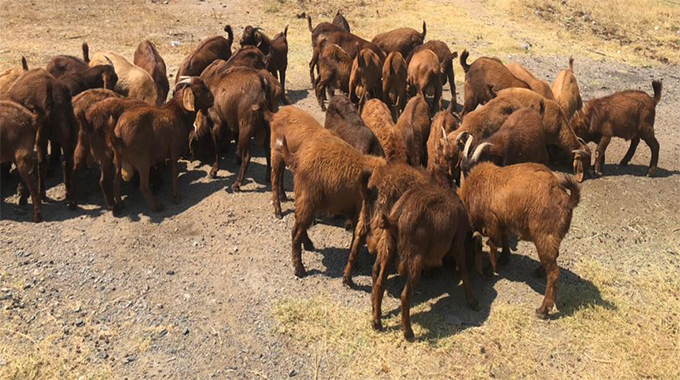
Sukulwenkosi Dube-Matutu, [email protected]
A MASSIVE goat breeding and multiplication centre located on a 100-hectare piece of land in Guyu area in Gwanda district, Matabeleland South has started taking shape.
The project, which is being funded to the tune of US$186 000, is a Government initiative under the Small Holder Irrigation Revitalisation Programme (SIRP).
The centre, which is now 75 percent complete, will house goat feeding pens, an abattoir, and a two-hectare irrigation scheme for fodder production among other facilities.
Works are expected to be completed by the end of this month. The centre is being constructed on land which housed the former Thuli Breeding Centre. The land had been lying idle for several years after the breeding centre was closed.
The centre is located near Guyu-Chelesa Irrigation Scheme which was rehabilitated under SIRP.
In an interview, Matabeleland South provincial livestock officer, Mr Hatityi Muchemwa said 36 Boer and Red Kalahari goats have been secured under the programme.
He said farmers who will be part of the project are expected to bring in one goat each once the project starts running.
“We want to improve the local breeds through cross-breeding the Boer and Red Kalahari goats. After breeding and multiplying them we will sell them to the local community,” said Mr Muchemwa.
“The project will also house a business unit where there will be pen feeding of the goats and slaughter services. The centre will have an abattoir where farmers from the community will pay for slaughter services.”
Mr Muchemwa said some of the fodder will be sold to the community. The project will also serve as a learning centre for farmers where they will be equipped with best practices in goat production.
“We plan to expand the project to incorporate other small livestock such as poultry and piggery. This project will target about 300 farmers from six wards,” said Mr Muchemwa.
He said the goats that will be brought by the farmers will act as shares and after selling the animals, farmers will withdraw profits as dividends.
Mr Muchemwa said the construction of feeding pens, kraals, dip tank, and connection of water from the Guyu Irrigation Scheme to the centre was underway. A perimeter fence has been erected.
Mr Muchemwa said the project will help to improve breeds in the district and inculcate a business mindset among farmers.
“Farmers will be equipped with knowledge that will help them to manage their goats better. They will be equipped with information on issues such as goat management, and income generation,” he said.
“This project will lead to improved breeds because as part of the project, farmers will bring in their goats for mating even if they are not registered members of the centre. There will also be bucks exchanged for improved breeds.’
Mr Muchemwa said the project will be managed by a committee while Government will provide technical and advisory services including market linkages.
In an interview, SIRP programme coordinator, Mr Walter Makotore said the small livestock production project is being implemented under the component of climate-smart agriculture and market access.
“As SIRP we have the component of irrigation rehabilitation and expansion and we also support areas around the revived schemes which is known as the greater scheme area. Under this project villagers around the Guyu-Chelesa Irrigation Scheme are benefiting from the goat breeding project,” he said.
“We have 12 goat breeding projects that are running under the SIRP programme. We also have projects of breeding indigenous chickens that are running in 21 districts in the four provinces that we are operating in.”
Mr Makotore said there is a component of fodder production focusing on crops that are appropriate for feeding small livestock.
“We also promote the growing of traditional grains and under this component, we have distributed crop packs to farmers as the SIRP programme seeks to empower farmers holistically,” he said.
SIRP is a Government-led programme funded by the International Fund for Agricultural Development (IFAD).
It is being implemented in Matabeleland South, the Midlands, Manicaland, and Masvingo provinces.
@DubeMatutu



 Online Reporter