malvernmugadzikwa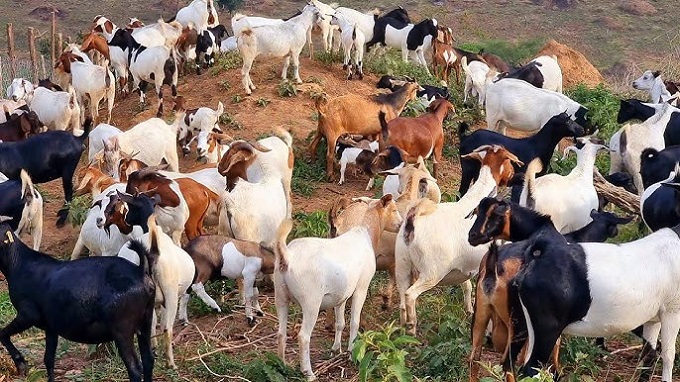
Word from the Market with Simon Pande
THE El Niño phenomenon experienced in Zimbabwe during the 2023/2024 agricultural season has been a wake-up call for local communities to explore strategies to mitigate its adverse effects.
Venturing into goat farming is not only a climate change adaptation strategy, but also a lucrative business due to the animals’ performance in harsh environments.
The goat value chain presents huge opportunities for communities in the dry areas of Zimbabwe, where the impact of climate change and variability is most felt.
Globally, goats are primarily reared for their meat, milk and leather. Plus or minus 35 percent of the world’s goat population is in Africa, with Ethiopia carrying 15 percent of the continent’s total.
Zimbabwe’s goat population stands at about 4,3 million, with 80 percent belonging to small-scale farmers, according to the Goat Breeders Association of Zimbabwe.
Goats are reared across all the country’s provinces, with Manicaland being the most populous, at just over a million.
Mashonaland Central has the least, at just below 50 000 goats.
Demand for goat meat, as well as breeding and meat goats is on the rise across the world.
The United Arab Emirates (UAE) is the targeted importer of chevon, with a deficit of between 300 000 to two million goats per annum.
Our local farmers are better positioned to take advantage of this development.
Even on the local market, the appetite for goat meat has increased. Goat meat is exported fresh, chilled or frozen. Just like in the case of other livestock, goat meat is also graded.
Here, the focus is on determining the quality of the meat at the point of off-take.
The grades are “inferior”, “standard”, “super” and “choice”.
Marketing of goats
Each market has its own requirements, and it is important for farmers to match these standards.
Live goats and/or chevon can either be consumed locally or exported to the top 10 importing countries, which are the United States, the UAE, Saudi Arabia, Qatar, Oman, Taipei, Portugal, Italy, Canada and Korea Republic, according to Trade Map.
The UAE market prefers organic super and choice grades. Meeting the grade target is dependent on the feeding regime.
To penetrate the UAE market, goat farmers will need to have the required documentation, such as Halal certification, as well as sanitary and phytosanitary certification.
Consolidation for export
The export business is a volumes game, hence organised farmer consolidation is critical to meet demand.
Woodlands Farm, a goat value chain specialist entity domiciled in Kwekwe, identified export markets for which it is seeking partnerships with farmers to satisfy.
The farm says the UAE market has a firm demand of more than eight tonnes of super and/or choice grade per week.
The consolidation for the export initiative will involve Woodlands Farm carrying out on-farm training courses and programmes to improve goat management techniques by small-scale farmers. These will then contribute significant throughput into Woodland’s export abattoir.
The Agricultural Marketing Authority (AMA) is also spearheading capacity-building workshops to empower farmers with the requisite information on market requirements.
Recently, AMA, in partnership with Woodlands Farm, held a training workshop in Kwekwe, which was oversubscribed.
The UAE market is sensitive. Recent engagements with the off-takers revealed that clients prefer rollovers to spot transactions. They are also keen on the values of trust, loyalty and honesty.
With the knowledge acquired, we expect farmers to produce goats with a larger cold dress mass, achieve twinning per parity and reach target slaughter weights at young ages.
The goat mortality rate for the year 2020 was 23 percent, rising to 36 percent for 2021.
Kid deaths contributed about 75 percent to the total goat mortality. Sixty-two percent of mortality was due to diseases and 28 percent due to predation.
This desperately calls for the nation to double down on implementing and adapting sound commercial management practices.
Due to the poor production, which makes it almost impossible to mobilise the required volumes to match weekly demand, both the local and export markets are still underserviced, which offers a great opportunity for goat farmers who decide to go commercial.
On the domestic front, chevon demand and consumption are increasing, even in rural areas. However, supply is insufficient to meet demand from both low-cost urban consumers and quality-conscious urban chain store niche markets. Domestic formal goat markets, standing at 21 percent (19 percent regulated markets and 2 percent abattoirs), are almost non-existent in Zimbabwe. Significant volumes of live goats, goat meat and products are channelled through informal markets (middlemen — 22 percent, and open markets — 55 percent).
Simon Pande is a livestock expert with AMA. Word From The Market is a column produced by AMA to promote market-driven production. Feedback: [email protected] or WhatsApp +263781706212.



 Online Reporter