

 admin
admin
Patrick Chitumba, Midlands Bureau Chief
LONG accustomed to lengthy treks for unsafe drinking water, residents of Gokwe Town can now heave a sigh of relief following the investment of over US$200 000 in six solar-powered boreholes which are now their new source of the precious liquid.
For years, the town had become notorious for water shortages, a development that is attributed to investors shunning the cotton town.
Residents in parts of Gokwe Town Council (GTC) had become accustomed to going for months with dry taps forcing them to resort to unsafe sources.
However, there are now six solar-powered boreholes that have been drilled to bring water to the people, which is a relief to schoolchildren and their parents.
These are in Sasame 1 and 2, Nyaradza, Njelele, Mapfungautsi suburbs and the other one in the industrial area.
Before the intervention, residents in these areas would walk more than four kilometres to fetch unsafe water from shallow wells they dug.
Thanks to the new boreholes, Mr Maxwell Ncube, a resident in Mapfungautsi suburb, said his children are no longer going to look for water from unprotected sources.
He said even diarrhoeal cases will be a thing of the past.
“My two children, eight and 13-years old no longer walk long distances to look for water. They now fetch at least 70 litres per day from the solar-powered borehole that’s within reach. We’re no longer worried about unsafe water in the household.”
With an improved supply of safe drinking water, Mr Ncube said his children now concentrate on their education.
“They would sometimes miss school because they would often be down with diarrhoea. My wife can now do laundry whenever she wants,” he said.
Ms Prisca Nemangwe, a small-scale farmer, said she had abandoned thoughts of having a garden at her house in Sesame 1 suburb because of the unavailability of water.
“It wasn’t possible to do any gardening because of the unavailability of water. We would seek the precious liquid from unsafe sources and the water was unclean. But now, I no longer trek that far and my garden is coming back to life. The availability of borehole water has been our salvation because we have had enough of the water shortages,” she said.
A Chronicle news crew came across pupils from St Agnes Primary School fetching water from a new solar-powered borehole on their way to school.
Walking to school in the scorching heat that characterises Gokwe Town in the summer season, the three boys namely Tatenda Sibanda, McDonald Sithole and Xavier Tonhodzayi could not contain their joy when they opened a tap and got water to drink and wash their faces.
“We used to travel long distances to get water from unprotected sources. There are boreholes in all districts and it’s a relief for us. We now concentrate on our books,” said McDonald
GTC acting town secretary Mr Alexander Nyandoro said the Zimbabwe National Water Authority (Zinwa) is managing the town’s water systems.
“As a local authority, we have come in with six solar-powered boreholes for the residents and the industry. All six boreholes have been drilled at a total cost of US$224 000. We have one borehole per ward and Gokwe Town has six wards which are Sasame 1, Nyaradza, Njelele, Industrial Area, Mapfungautsi, and Sasame 2,” said Mr Nyandoro.
Unfortunately, he said, there are always perennial breakdowns forcing the town to go for months without clean water.
“Despite the fact that the water authority is Zinwa, Gokwe Town Council is privy to its constitutional mandate to provide people with safe and clean water. At the moment, people don’t get water from Zinwa 24/7 due to a plethora of reasons including intermittent power supply which affects the pumping of water from boreholes,” said Mr Nyandoro.
He said limited access to clean water poses a threat to the country’s public health.
Mr Nyandoro said GTC is therefore complementing the efforts of Zinwa by providing the people with safe and clean water in times of need through these boreholes.
“Water and sanitation is critical to the socio-economic growth of the town and therefore the need to have constant water supply so that we protect our residents from water-borne diseases. With a reliable source of water, they’re also able to do market gardens and all sorts of other projects to improve their livelihoods,” he said.
Mr Nyandoro added that the people will not resort to using water from unprotected wells which can cause water-borne diseases such as diarrhoea.
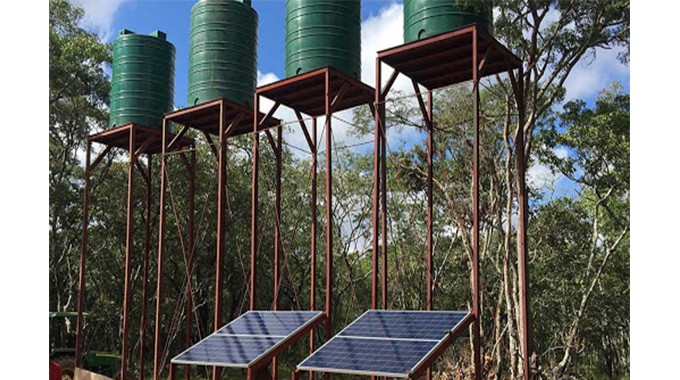
“The purpose of installing boreholes and other water supply facilities is to provide water services to our residents. The construction of the boreholes remains paramount for this town and residents should bear in mind the need to boil borehole water sufficiently to make it safe to drink,” he said.
Gokwe Ward 2 Councillor Darlington Mudondo said the town’s water crisis would’ve resulted in outbreaks of waterborne diseases as residents were now fetching water from unprotected wells.
“We were actually concerned over water shortages in some parts of Gokwe and the boreholes initiative is coming at the right time for residents and the business sector,” he said.
Zinwa spokesperson for the Sanyati Catchment area Mr Obert Muchena said Gokwe Town was facing water challenges as a result of pump breakdowns.
According to Unicef, dry regions of the country writhe from water scarcity which leaves communities to resort to unsafe water supplies for domestic use.
It is estimated that about 90 percent of rural households in Zimbabwe consume untreated water and that more than 75 percent of Zimbabwe’s population lives under water-stressed conditions in most rural areas.
The country generally receives an average rainfall of 675mm per annum of which only a minimum of 10 percent finds its way to rivers as runoff.
Gokwe, Nkayi, Lupane and Mwenezi are some of the driest districts in Zimbabwe having mean annual runoffs in the range 17–70mm.
River flows especially in Gokwe, Nkayi and Lupane are seasonal and often dry up in the period June to November every year.
The Kalahari sands predominantly found in such areas promote rapid percolation of rainwater leaving little runoff.
As a result, the main source of water for domestic purposes in these areas is groundwater with very little reliance on surface water.


 Online Reporter
 Bongani Ndlovu