Chronicle Editor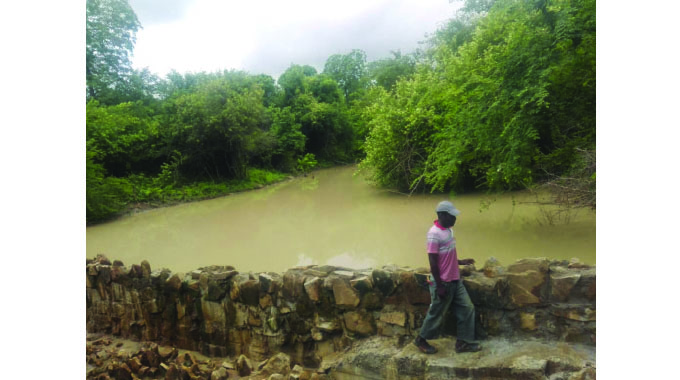
Patrick Chitumba, Midlands Bureau Chief
FOR years, Mr Freddy Mpofu (54) of Kajirivanda Village, under Chief Chireya in Gokwe North, could not afford to have a small garden to grow vegetables for his family.
He and other villagers had been accustomed to making back-breaking trips to Une River some six kilometres from their homesteads, not to fetch water at one-easy-go, but to dig the riverbed first to get the precious liquid for household chores and for their livestock.
As a result of severe water challenges in the area, youths are always migrating to Gokwe Centre and other areas to look for means of making a living and that has been the sad tale of the villagers until a plan was mooted to construct a dam using constituency development funds (CDF) advanced to the area by Government.
Through the funds, Kajirivanda villagers under the leadership of Member of Parliament for Gokwe Chireya Constituency Cde Torerayi Moyo showed unity of purpose when in 2020 they started constructing a dam that made possible the setting up gardens for fresh horticultural produce while their livestock would have access to water without walking painful distances to the river.
The CDF is used by Members of Parliament to carry out developmental projects in their constituencies.
And two years on, the villagers are now proud owners of the dam.
They no longer travel long distances to look for the precious liquid as the dam is within a comfortable walking distance.
The Kajirivanda Dam wall now stands at 1,3 metres although plans are under way to make the wall 3 metres tall so that it can hold more water. It has a depth of 5 metres.
The dam is also providing water to Kajirivanda Primary and Secondary schools in Ward 4 and when complete, will provide water to over 3 000 homesteads in the Gokwe (Chireya area).
“Gokwe is generally a dry district and the process of securing water for our daily chores and that of our livestock has always been time-consuming and difficult.
Several villagers lost their livestock to lack of water and shortage of pastures each year because it was tough to look for water and pastures to feed them,” said Mr Freddy Mpofu, who is the village head.
He said with the release of constituency development funds, they decided to put their heads together where they agreed on dam construction and today, they have water within their reach.
“So, we sat down, the MP Cde Moyo donated 100 bags of cement, food, fuel and other things towards this project on top of the CDF funds.
The dam is now there for everyone but it’s not yet complete but we can now start to put up our gardens to grow vegetables and our livestock can drink water from the dam,” said Mr Mpofu.
A villager, Mrs Anna Mwenda said the dam was a relief to the woman and the girl child especially as they were the ones who in many families took up the duty of looking for water.
“All these years, we would walk at least six kilometres to fetch water from wells dug on the river bed.
The boreholes were all dysfunctional and so, it had been a nightmare walking long distances to Une River to look for water but we had no choice.
That is a thing of the past now.
“It is a blessing that the villagers have been quick to understand that the abundance of water can mean a better lifestyle and livelihood.
This water will not only be of use for us but also for villages surrounding us,” said Mrs Mwenda.
Chief Chireya said there was never enough water for drinking or irrigation for the villagers in the newly constructed dam.
“For years, youthful villagers migrated to Gokwe Centre and other areas in search of work, eventually leading to our children dropping out of schools.
We hope that the villagers will utilise the dam to fend for their families. Once completed we want to turn this area green.
We are talking of a green revolution in this arid area.
“We want to put small canals so that we can start an irrigation scheme in our drought prone area.
Once we have the irrigation scheme, the livelihood of villagers will definitely change and we will also contribute to the socio-economic activities of the country,” said Chief Chireya.
The dam has brought relief to smallholder farmers who have lost livestock due to frequent droughts that often ravaged the communities.
The community is upbeat that they will derive maximum benefits from the water reservoir.
“Our main vision is to finish off this project in time.
This is a very arid region and the only way we can get economic emancipation is through irrigation activities.
This is our hope and we are very grateful to the legislator who has been helpful through the provision of resources.
“This is our way of escaping from poverty.
We have always been dreaming of having a dam in this area.
Our cattle used to get water 10 kilometres away and this is fast changing.
We want to thank the New Dispensation for the timely devolution intervention,” said another villager Ms Angela Mwale.
Cde Moyo said the government intervened on the project in order to uplift lives of marginalised communities in line with the National Development Strategy (NDS1).
“President Mnangagwa has made it clear that ‘nyika inovakwa nevene vayo’ (a nation is built by its people).
We made promises during our campaign period and it’s time we fulfil them.
The President has been on the forefront in spearheading development projects and we are simply following in his footsteps.
We want to ensure that our people get the support they deserve for them to be self-sustainable,” he said.
He said after getting their heads together with the villagers, he donated 100 bags of cement, goats, mealie-meal and other commodities to make the job easy for the villagers.
“Remember we had the CDF but it wasn’t enough. I had to dig deep into my coffers so that we have a tangible project — Kajirivanda Dam.
Villagers want irrigation schemes, they want the dam wall increased so that the catchment area increases and we are going to do that in support of our Government that is working on improving the livelihoods of the people,” said Cde Moyo.
The Second Republic is on a drive to ensure that people in marginalised communities are not left behind in the country’s national development trajectory through various empowerment projects.


 Online Reporter