Online Reporter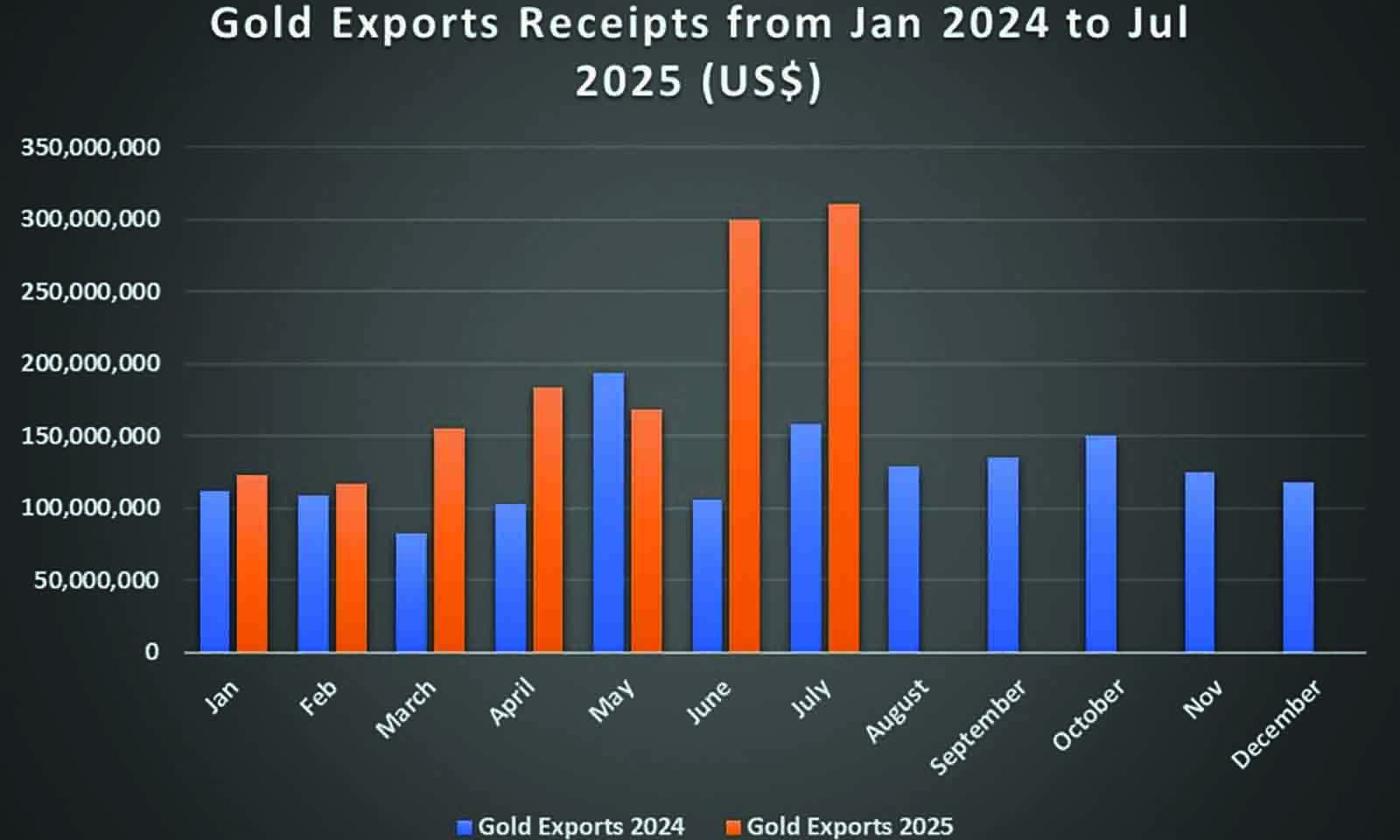
Martin Kadzere
Business Reporter
ZIMBABWE’S gold exports have registered a strong performance, surging to $1,385 billion in the first seven months of 2025 — a massive 60,5 percent increase from the $863,1 million earned over the same period last year — latest figures from the Reserve Bank of Zimbabwe (RBZ) show.
The growth means the country has already generated over 91 percent of the $1,52 billion total earned from gold exports last year.
A month-by-month analysis of the data reveals a sharp acceleration in earnings.
While January to April showed consistent gains, the performance in the mid-year months was particularly higher.
After a slight dip in May, exports shot to $300,1 million in June and reached $310,8 million in July, marking a phenomenal leap from the $105,7 million and $158,2 million recorded in the same months last year, respectively.
Analysts attribute the robust performance to a combination of factors, including increased output from both large-scale mining operations and the growing contribution of artisanal and small-scale miners.
Favourable international gold prices and Government initiatives aimed at formalising gold trade are also cited as key drivers behind the sector’s impressive growth.
The outlook for international gold prices is bullish for the near to medium term.
Market analysts, including those from JP Morgan, are forecasting that prices could average $3 675 per ounce by late 2025 and potentially hit the $4 000 per ounce mark by mid-2026. The optimistic projection is primarily fuelled by strong demand from both central banks and institutional investors.
Several key macroeconomic and geopolitical factors are expected to support this upward trajectory.
Heightened geopolitical tensions worldwide are driving a flight to safety, with gold serving as a reliable haven asset.
Additionally, persistent high inflation erodes the purchasing power of traditional currencies, pushing investors toward gold as a store of value. Furthermore, the United States’ Donald Trump-led administration, with its focus on tariffs and protectionist trade policies, could trigger market volatility that traditionally benefits gold.
However, the bullish outlook is not without its risks. The primary counteracting force comes from central banks, particularly if they continue to raise interest rates.
As they rise, gold becomes less attractive as a non-yielding asset, as investors can earn returns from bonds and other interest-bearing investments.
This could potentially curb gold’s rally and provide a ceiling for its price, creating a tug-of-war between inflationary pressures and the appeal of higher-yielding assets.
With five months remaining in the year, Zimbabwe is well on course to surpass its 2024 full-year total and solidify gold’s position as the country’s largest foreign currency earner.
During the seven months to July, gold production has been overwhelmingly driven by small-scale producers, who delivered more than twice the amount of “yellow metal” to Fidelity Printers and Refiners compared to their primary-producing counterparts.
A total of 24.31 tonnes of gold was delivered between January and July 2025, Fidelity, the sole purchaser of bullion, said.
Of this total, small-scale miners delivered 17.76 tonnes, while primary producers contributed 6.55 tonnes.
In the period from January to March, total deliveries reached 20.10 tonnes. Small-scale miners once again led the way, with 14.56 tonnes, significantly outpacing the 5.54 tonnes from primary producers.
The Government’s intervention, ensuring 100 percent payment in USD for small-scale producers, has markedly improved gold deliveries.
Additional initiatives, such as the establishment of 17 gold buying centres, the Gold Development Initiatives Fund (GDIF) and mobile buying units, have also played a crucial role in achieving national production targets.
These strategic initiatives have positioned the gold sector as a key driver of economic growth and development in Zimbabwe.
With adequate investment, reliable electricity, and stable forex policies, the sector could exceed historical gold output records and solidify its role in Zimbabwe’s economic transformation.