Nelson Gahadza
AFTER delivering exceptional returns over the past year, gold remains one of Zimbabwe’s best-performing assets despite a recent drop in international prices, highlighting the resilience of the precious metal.
While the decline is starting to test the performance of gold-backed investment products, mining companies and Government revenues, analysts say bullion prices remain well above historical averages and continue to support strong profitability across the sector.
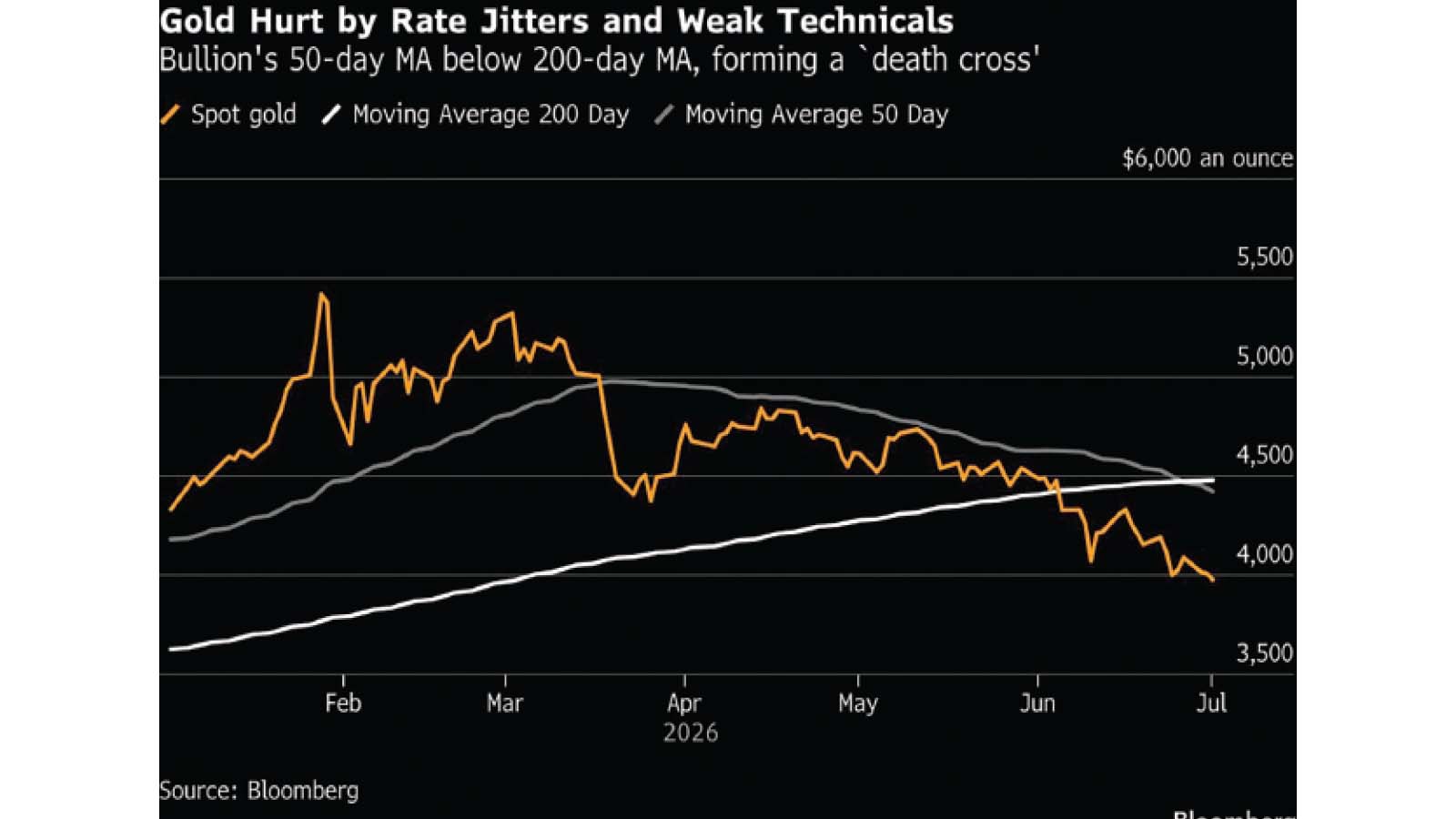
International gold prices have retreated by about 15 percent to around US$4 250 an ounce as at Wednesday last week, after surging to record highs of above US$5 000 earlier this year, driven by heightened geopolitical tensions, aggressive central bank purchases and robust safe-haven demand.
The correction has largely been attributed to easing geopolitical uncertainty, profit-taking by investors following the historic rally and expectations of a more stable global interest rate environment.
The retreat, however, is beginning to ripple through Zimbabwe’s financial markets, where gold-backed investment products, mining companies and fiscal revenues have become increasingly tied to movements in the international bullion market.
Among the first investments to reflect the shift has been the First Mutual Wealth (FMW) Gold Exchange-Traded Fund (ETF), whose performance has closely mirrored movements in the underlying commodity.
Launched on the Victoria Falls Stock Exchange (VFEX) on May 4, the ETF recorded one of the strongest debuts by any investment product listed on the bourse.
The fund opened at an issue price of US$0,10 before closing its first trading session at US$0,1394, representing a gain of almost 40 percent, as investors rushed to gain exposure to gold through a regulated exchange-traded investment vehicle.
More than 357 000 units changed hands on the opening day, highlighting a strong appetite from both institutional and retail investors seeking protection against inflation, currency volatility and broader macroeconomic risks, while capitalising on record international gold prices.
Investor enthusiasm has moderated as bullion prices have softened.
The ETF fell from US$0,1550 on May 28 to US$0,1440 the following day, before easing further to US$0,1364 on June 8, US$0,1343 on June 25 and US$0,1300 by June 30.
Although the fund remains around 30 percent above its launch price, the recent decline illustrates how quickly investor sentiment can change when the underlying commodity weakens.
Unlike conventional equities, whose valuations are largely driven by earnings prospects and company-specific developments, the FMW Gold ETF derives much of its value from its physical gold holdings, making it particularly sensitive to fluctuations in international bullion prices.
A similar trend has emerged in Zimbabwe’s gold-backed savings instrument, the Mosi-oa-Tunya gold coin, introduced by the Reserve Bank of Zimbabwe (RBZ) as a store of value and hedge against inflation.
RBZ pricing data shows that the value of gold has steadily adjusted lower, in line with developments on international bullion markets, declining from US$4 545,95 on June 1 to US$4 074,85 by June 14, before easing further to US$4 024,45 on June 25 and closing the month at US$4,026,45 on June 30.
The indicative buy price for the other instrument, the digital gold token, eased from 0,1388 on June 1 to 0,1322 by June 15, before declining further to 0,1229 on June 25 and edging marginally higher to 0,1230 by June 30.
Investment analyst Mr Enock Rukarwa said the correction should be seen within the context of gold’s exceptional performance over the past year, noting that prices remain significantly higher than they were 12 months ago.
“Although gold has experienced bearish sentiment over the past month, prices are still trading about 20 percent above where they were a year ago,” he said.
Mr Rukarwa said investors should carefully consider the limited alternatives available within Zimbabwe’s capital markets before exiting gold-linked investments.
“Once you move away from gold-related investment products, there are very few comparable alternatives locally that can preserve value in the same way.”
He noted that internationally, investors had increasingly shifted towards United States Treasury Bills and bonds, as higher interest rates made fixed-income securities more attractive than non-yielding assets such as gold.
That migration, he added, had contributed to the recent weakness in bullion prices.
Nevertheless, Mr Rukarwa believes the current decline is more likely to represent a short-term market adjustment than the beginning of a prolonged downturn.
“The best approach for investors at this stage is to hold. This appears to be a temporary phenomenon rather than a structural change in the outlook for gold,” he said.
He further said continued appreciation of the United States dollar against major currencies had also reduced demand for gold, which typically moves inversely to the greenback.
Economist Mr Walter Mapfumo said the recent correction does little to undermine gold’s long-term investment case.
He said bullion prices remain comfortably above their long-term historical averages, suggesting that both the FMW Gold ETF and the Mosi-oa-Tunya gold coin continue to offer attractive portfolio diversification opportunities for investors focused on preserving wealth over the long term, rather than pursuing short-term speculative gains.
The implications of softer bullion prices are expected to be more pronounced within Zimbabwe’s mining industry, where revenues are directly linked to international gold prices.
Zimbabwe has enjoyed record export earnings over the past year, as producers benefitted from exceptionally strong international prices.
According to RBZ statistics, gold exports generated about US$1,2 billion during the first four months of 2026, more than double the US$579 million realised during the corresponding period last year.
The impressive performance has reinforced gold’s position as Zimbabwe’s single largest foreign currency earner and a critical contributor to economic
growth.
A sustained decline in bullion prices could gradually erode some of those gains, placing pressure on mining revenues, export receipts and fiscal collections.
Another economist, Mr Tinevimbo Shava, said producers that had expanded production during the recent gold boom would increasingly have to rely on operational efficiencies to protect profitability as prices retreat.
“For producers such as Padenga
Holdings, whose mining division has become the group’s principal earnings driver following the transformation of Dallaglio Investments, a sustained decline in gold prices could squeeze operating margins despite continued production growth,” he said.
Mr Shava said, while Padenga had invested heavily in expanding output at its Eureka and Pickstone Peerless mines, the company’s financial performance would ultimately depend not only on the number of ounces produced, but also on realised selling prices.
“Mining profitability is a function of both production volumes and commodity prices,” he said.
“A 10 to 15 percent decline in bullion prices can significantly reduce operating cash flows, unless it is offset by higher production or lower operating costs.”
Mr Shava said the same dynamics were evident at Caledonia Mining Corporation, owner of Blanket Mine in Gwanda, whose earnings have historically shown a close correlation with movements in international gold prices.
Caledonia recently reported that stronger realised gold prices helped cushion the impact of lower production during the first quarter of 2026, underscoring the importance of bullion prices in sustaining profitability.
Analysts say should gold prices continue to soften while production challenges persist, miners could come under increasing pressure during the second half of the year, placing renewed emphasis on cost containment, productivity improvements and operational efficiency.
The implications extend beyond the mining companies themselves, as Zimbabwe’s fiscal position has also become increasingly exposed to fluctuations in international bullion prices, with gold assuming a larger role in export earnings and tax revenues.
The country levies a 5 percent royalty on gold priced between US$1 200 and US$5 000 per ounce.
This follows revisions to the royalty framework that accommodated the unprecedented rally in bullion prices.
Mr Shava said mining royalties had become an increasingly important source of Government revenue, helping finance infrastructure projects and essential public services.
“A decline in export values would, therefore, affect not only mining companies, but also Treasury revenues, particularly if lower prices coincide with rising production costs,” he said.
The possibility of weaker bullion prices featured prominently during discussions at the recent Chamber of Mines of Zimbabwe Annual Mining Conference, where industry executives acknowledged growing volatility in global commodity markets.
Even so, producers maintained that prevailing prices remain sufficiently attractive to justify continued investment in exploration, mine development and capacity expansion.
That view mirrors recent remarks by Mutapa Gold Resources chief executive officer Mr Patrick Maseva-Shayawabaya, who has consistently argued that Zimbabwe should focus on maximising value from its mineral endowment through increased production, beneficiation and stronger institutional oversight.
His assessment reflects a broader recognition within the mining sector that commodity booms are inherently cyclical, and that long-term competitiveness depends on sustained investment, efficiency improvements and value addition, rather than temporary price windfalls.
The recent correction is also expected to influence the operations of Fidelity Gold Refinery, Zimbabwe’s sole authorised gold buyer and exporter.
On June 29, Fidelity’s indicative buying price stood at approximately US$122,70
per gramme for gold with a purity of 90 percent and above, equivalent to about US$3 817 per ounce, reflecting adjustments that are in line with international market movements.
For artisanal and small-scale miners, who account for more than 60 percent of Zimbabwe’s total gold production, sustained price weakness could reduce cash flows and limit reinvestment in equipment, mine development and production expansion, particularly for operators with relatively high extraction costs.
The World Gold Council has similarly maintained a constructive long-term outlook, noting that the recent correction largely reflects profit-taking and improving investor sentiment following an exceptional rally, rather than a fundamental deterioration in demand.