


 Online Reporter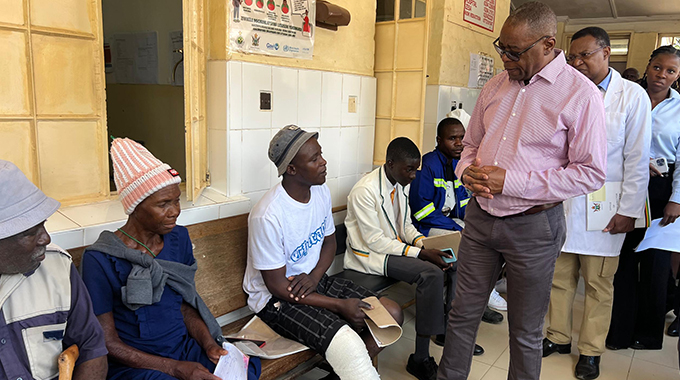
Sukulwenkosi Dube-Matutu, [email protected]
THE Government is pulling together resources to expedite construction of a provincial hospital in Gwanda on a 46 hectare piece of land allocated for the project, which will transform the facility into a major referral centre in the province.
Gwanda Provincial Hospital is currently housed at what was formerly the Gwanda District Hospital and has only 200 beds that cannot handle the huge population that is referred to the institution.
Speaking during a visit to the health facility on Friday, Health and Child Care Minister, Dr Douglas Mombeshora, said limited working space is a common challenge across health facilities that needs to be addressed with urgency as the Government works towards improving health care services.

“I have been touring Matabeleland South this week just to find first-hand information on the situation that is prevailing in our institutions.
“I visited Maphisa District Hospital, Kezi Rural Hospital, Plumtree District Hospital and Lady Stanley Rural Hospital in Bulilima and today I am at Gwanda Provincial Hospital,” he said.
“What has come out today is that this isn’t a real provincial hospital. It was designated to work as a provincial hospital but it’s not adequately staffed, it has three specialists, two theatres, which are serving a multi-purpose function.
“Even the staff levels for the nurses, midwives are very low. The structures are not in good condition as this is a very old hospital,” he said.
Dr Mombeshora said as a starting point dilapidated structures at the hospital will be rehabilitated and a theatre will be constructed. He said construction of a proper provincial hospital has always been in the pipelines and now efforts will be made to ensure that construction works start immediately.
Dr Mombeshora said a 200- bed capacity is far below expectations for a provincial hospital and hinted that a new structure will help incorporate all the essential medical facilities, as well as accommodation for staff.
“That 48 hectare piece of land is more than enough to house all the necessary infrastructure for the provincial hospital if we build going up.
“We have assigned our engineer together with our Director of Finance to start working on modalities to have the provincial hospital constructed,” he said.
“I’m pleased that at this institution they have been able to do their work with limited staff, limited work space. Improving the state of this hospital will also help us to retain our staff as I understand that some who get deployed here leave shortly after starting because of the working conditions.”
The minister conducted a three-day tour of health institutions in the province as part of Government’s boarder strategy to improve health care services in the province.
The tour is part of a national assessment of public health facilities aimed at identifying service delivery gaps, infrastructure needs, staffing levels and equipment shortages as Government intensifies efforts to strengthen the public health system and improve access to quality care.
Dr Mombeshora said the nationwide tour was intended to give him a direct understanding of conditions on the ground and help shape targeted interventions.
He also stressed that although national policies guide the health sector, each province faces its own set of challenges that require tailored responses.
In Matabeleland South he has visited health institutions in Matobo District, Plumtree Town, Bulilima District, Gwanda and Beitbridge District.
He was accompanied by World Health Organisation Representative in Zimbabwe, Dr Desta Tiruneh, and directors in the ministry.
The tour of the Gwanda Provincial Hospital started with an interactive meeting with officials from the hospital and province and other stakeholders. The engagement sought to proffer solutions on how to improve service delivery at the institution.
Gwanda District Hospital medical superintendent, Dr Shadreck Gororo, said some of the challenges faced by the health institution include shortage of staff- both general nurses and specialists, limited working space, shortage of staff accommodation, dilapidated infrastructure, transport constraints, shortage of medicine and surgical supplies among others.
“Infrastructural challenges include but are not limited to ward congestion and infection risks due to limited space. Medical and surgical patients share wards,” he said. “Tuberculosis patients are admitted in the same spaces as general patients. We don’t have a dedicated isolation capacity.”
Dr Gororo said construction of a new provincial hospital may be the long term solution to these structural challenges.
The Gwanda Municipality has allocated 46 hectares of land towards constructing a provincial hospital.
Under the Second Republic, Government has made investment in health infrastructure, human resources and medical supplies a priority, in line with efforts to achieve universal health coverage. Through the devolution agenda pursued by the Second Republic, there has been improvement of rural health facilities, availability of medicines and modernisation of equipment to ensure no community is left behind. — @DubeMatutu.


