

 admin
admin
Senior Business Reporter
GOVERNMENT has been advised against full dollarisation of the economy, but should instead intensify restoration of macroeconomic stability through rebuilding confidence in the use of the local currency.
To achieve this, the Government should consider the adoption of a Currency Board to stabilise the exchange rate.
The recommendations form part of the resolutions from the Zimbabwe Economic Development Conference 2022 (Zedcon22) held in August in Victoria Falls under the theme: “Accelerating Economic Transformation through Evidence Based Policy Making.”
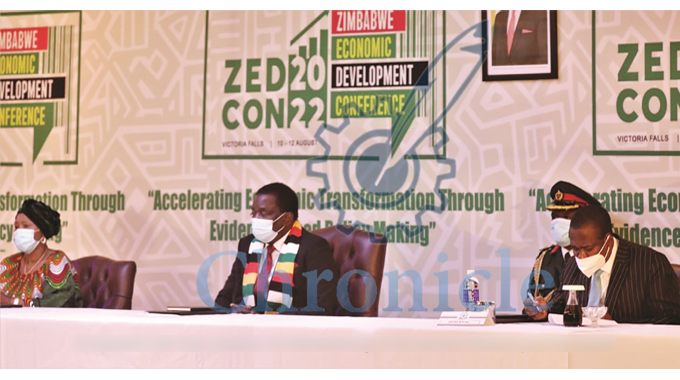
The conference brought together Government, researchers, academics, captains of industry, development partners, civic organisation representatives and policy makers to deliberate on domestic economic developments and policies critical for accelerating the country’s economic transformation agenda.
A post-conference report released last week, recommends several policies that include boosting confidence on the local currency use, lowering taxes and revisiting the progressivity of the taxation system to reduce both tax evasion and avoidance.
“Government was discouraged to adopt full dollarisation, but to restore macroeconomic stability through rebuilding confidence in the local currency.
“To achieve this, the Government was recommended to consider the adoption of a Currency Board to stabilise the exchange rate,” reads part of the report.
Government officials have repeatedly said returning to dollarisation is “not a panacea” to the challenges facing the economy, saying Zimbabweans need to embrace broader use of the local currency and foster market discipline.
There had been renewed lobbying by some private sector players to re-dollarise the economy citing resurgent inflationary pressures.
Zedcon22 also recommended the Government to further tighten monetary and fiscal policy in order to attain exchange rate stability and reduce inflation, including reviewing pricing of Government procurement processes.

In its Mid-term Monetary Policy statement, the Apex Bank put in place additional measures to sustain the prevailing stability momentum.
These include maintained tight monetary policy stance with bank policy rate at 200 percent, which will be reviewed in line with inflation developments, differential statutory reserves extension to foreign currency deposits at 2,5 percent and five percent to support continued safety and soundness of the domestic banking sector, foreign exchange retention maintained at current levels with agricultural sector retaining 75 percent and the tourism sector at 100 percent.
Further, the bank proposed introduction of smaller units of gold coins of a tenth ounce, quarter ounce and half ounce to enhance inclusiveness of the investment instrument.
They are expected to be injected into the market this month.
The report said as part of enhancing demand for local currency, needs to restore a positive real deposit rate to encourage domestic savings and restore confidence towards the banking system.
On economic transformation, the Government was recommended to adopt import substitution strategies with more emphasis placed on value chain addition.
“This can be achieved through the enforcement of local procurement policy and promoting the expansion of venture capital financing,” noted the report.

It added: “As part of economic transformation, the country was recommended to value-add local products from low complexity low ubiquity products to high complexity low ubiquity to enhance the country’s resilience and comparative advantage.”
As part of fiscal reforms, the Government was urged to consider lowering taxes and revisiting the progressivity of the taxation system to reduce both tax evasion and avoidance.
During the 2023 national budget consultations various individuals and business groups appealed to the Government to provide tax relief by lowering or scrapping some taxes.
In its submissions, the Zimbabwe National Chamber of Commerce (ZNCC) said there was need for the Government to provide a tax relief to the sector as the wider economy recovers from the pandemic and tries to navigate the harsh operating environment as a result of the geopolitical environment.
ZNCC said when the two percent Intermediated Money Transfer Tax (IMTT) was introduced, the spirit behind its introduction was to bring into taxation the informal sector which was not being taxed.
It also noted that the four percent IMTT on foreign currency transactions was a disincentive to banking and has resulted in starving the supply of foreign currency liquidity to the formal banking channels.
The Chamber added that given the recent policy announcement that the multi-currency regime will be in effect during the entire duration of the NDS1 the Ministry of Finance and Economic Development should review the IMTT on foreign currency, from 4 percent to 2 percent.



 Blessing Chizhande
 Online Reporter