Online Reporter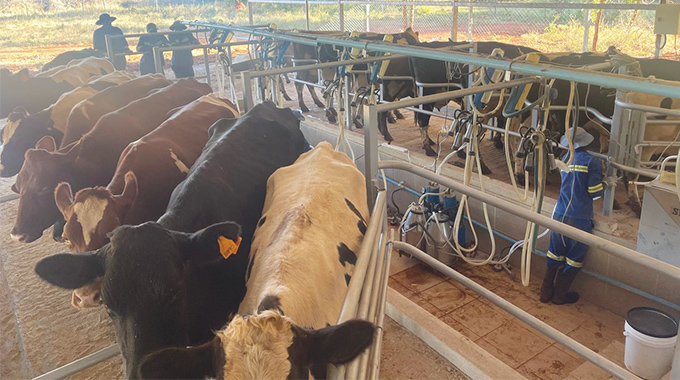
Judith Phiri, [email protected]
THE Ministry of Lands, Agriculture, Fisheries, Water and Rural Development has commended Queens Dairy Farm in Bubi for establishing a complete value chain enterprise, contributing to the country’s drive for dairy import substitution.
This comes at a time when Zimbabwe is actively reducing its dairy import bill by more than 20 percent.
Local milk production increased to 122 million litres in 2025 from 115 million litres in 2024.
Zimbabwe needs 131 million litres of milk for consumption annually.
In an interview after touring Queens Dairy Farm in Bubi District, Matabeleland North Province located 55 kilometres along the Bulawayo-Nkayi Road, Ministry of Lands, Agriculture, Water, Fisheries and Rural Development Deputy Minister, Davis Marapira, on Thursday commended the farm for its milk production, calling for increased support for such initiatives.

“I think you are quite aware that we are producing about 130 million litres for our country, but we are still importing powdered milk and other milk products from South Africa. We have the potential to produce 600 million litres and distribute it into our industry,” he said.
“Protection of such initiatives that are being done here at Queens Dairy Farm can give us growth. This dairy farm has the potential to milk 2 000 cows, so it should be protected because it’s going to create employment.”
He said the dairy farm played a critical role in creating raw materials for industries in multiple provinces and was going to positively contribute to the Gross Domestic Product of Matabeleland Province and the nation.
Deputy Minister Marapira said the Government, through the leadership of President Mnangagwa, had a straightforward policy which should be followed.
“Dairy farms are not included in our resettlement programme and also farmers who do pedigrees, the seed for our cattle, which also include dairy cattle. These have to be protected because they play an important role. They are key to our drive of import substitution so that we reduce milk imports.”
The dairy farm owner, Mr Francesco Marconati, currently has a herd of close to 800 dairy cattle and a milk parlour producing more than 600 litres a day.
“I intend to expand the herd to more than 2 000 dairy cattle to become a leading producer and processor of milk in the region,” he said.
The dairy farm represents a significant step in supporting Zimbabwe’s National Development Strategy 2 (NDS2) as the project aligns with national priorities on food and nutrition security, job creation, rural industrialisation and value addition.
Matabeleland North has long faced a shortage of dairy infrastructure, with no milk processing plant in the province.
This gap has resulted in high transportation costs for farmers who must send raw milk to facilities in Ruwa, Kwekwe or even neighbouring countries, ultimately driving up retail prices and making milk a premium commodity.
Queen’s Dairy is tackling this challenge head-on through the construction of a modern on-site milk processing plant currently underway that will produce pasteurised milk, cheese, yoghurt and other dairy products.
The facility will be owned 60 percent by Eagle Italian Shoes, the project’s primary investor and 40 percent by local farmers, based on their supply volumes.