Sikhumbuzo Moyo [email protected]
VICE-PRESIDENT Dr Kembo Mohadi has reaffirmed the Government’s zero-tolerance policy on child labour, saying the exploitation of children is a stain on the nation’s conscience and a major impediment to sustainable development.
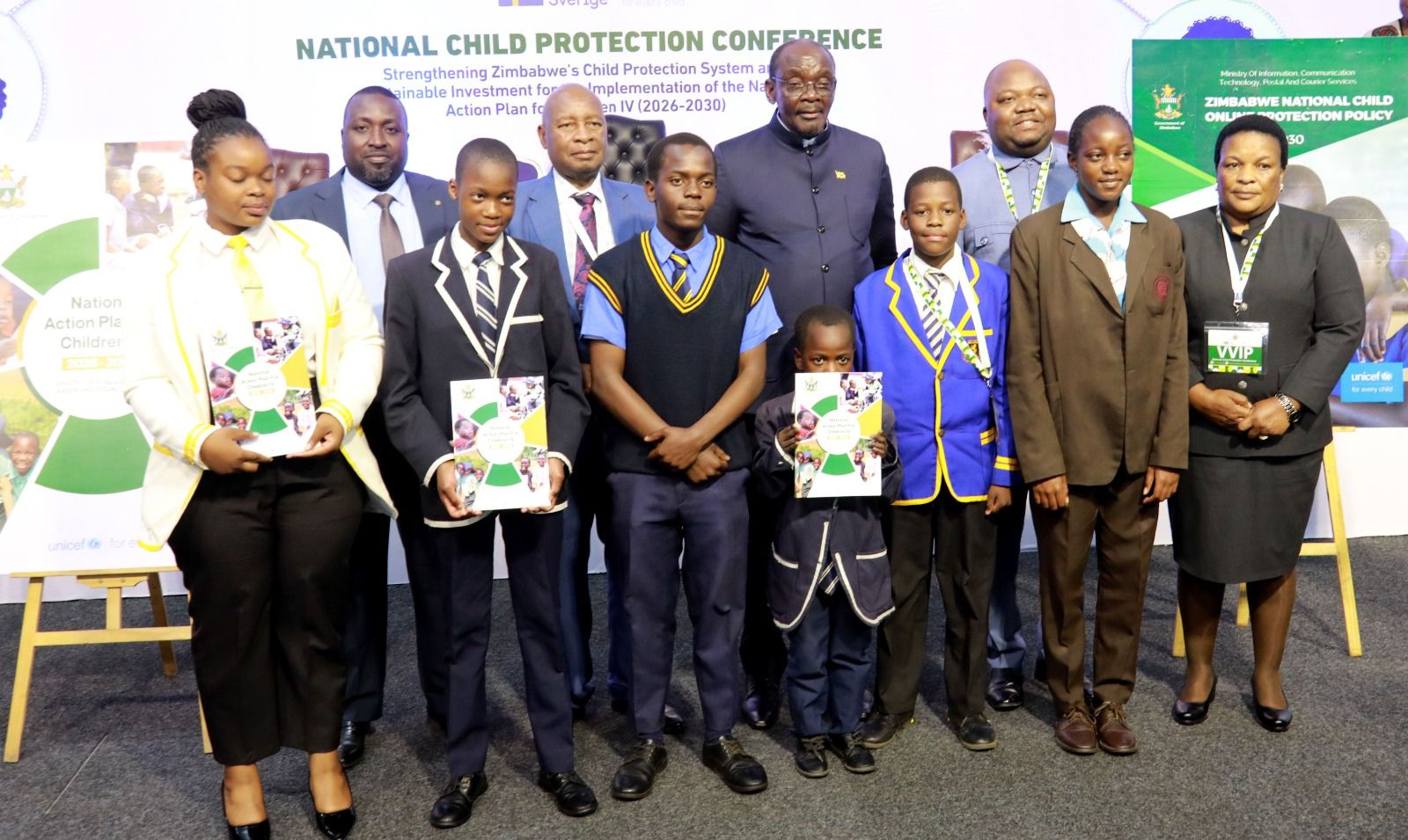
Speaking while officially launching the National Action Plan for Children IV (2026-2030) and the National Child Online Protection Policy in Bulawayo on Friday, the Vice-President said the Second Republic was strengthening legislation, enforcement mechanisms and institutional frameworks to eradicate child labour and protect the rights of every child.
The launch of the two policy frameworks aligns with the Government’s efforts to safeguard children from abuse, exploitation, child marriages, adolescent pregnancies, online violence and other emerging threats in line with the country’s Vision 2030 development agenda and international obligations.
“For far too long, the sight of children in hazardous working conditions, particularly in the informal sectors, has been a stain on our conscience and a barrier to our development,” said VP Mohadi.
He said the National Action Plan for Children IV provides a practical roadmap, backed by adequate resources and accountability mechanisms, to ensure children are protected and able to realise their full potential.
“It reaffirms that childhood is a time for learning, play and growth, not for labour that steals their health, education and dignity. We are united in the resolve that no child in Zimbabwe shall be left behind or forced to bear the economic burdens of adulthood before they are ready,” said VP Mohadi.
He said Government had intensified the fight against child labour through institutional reforms aimed at strengthening compliance with labour laws.
VP Mohadi said the Labour Administration Department had been revitalised through the establishment of a fully-fledged Labour Inspectorate Department responsible for enforcing labour legislation and promoting decent work standards.
The Vice-President also highlighted recent amendments to labour laws that significantly increased penalties for offenders.
“The amendment of labour legislation to increase penalties for perpetrators of child labour from two years to 10 years’ imprisonment represents a significant policy shift towards deterring and combating child labour,” he said.
VP Mohadi said Government had also developed a National Child Labour Framework and established a national hazardous work list to strengthen prevention and enforcement efforts.
“These measures signal the beginning of a new era where every Zimbabwean child is protected, educated and empowered to reach their full potential,” said VP Mohadi.
The Vice-President acknowledged calls made during the High-Level Policy Dialogue on Child Protection Financing for increased investment in child protection programmes.
He assured delegates that Government would urgently consider recommendations on child-friendly budgeting and enhanced financing for prevention and response programmes.
“The deliberations have not fallen on deaf ears but will be considered with the urgency they deserve. Recommendations from the various panel discussions will be followed up with relevant stakeholders to ensure that the discussions translate into meaningful action,” he said.
VP Mohadi urged Government institutions, the private sector, development partners and civil society organisations to strengthen partnerships in protecting children, particularly at a time when external donor funding has declined.
“At a time when donor support has dwindled, it is up to us as a nation to look inward and invest in our children by strengthening public sector financing and fostering partnerships with development partners and the private sector,” he said.
VP Mohadi said the National Action Plan for Children IV incorporates evidence-based interventions to tackle child labour, online violence, commercial sexual exploitation and other emerging threats facing children.
The framework is complemented by the Multi-Sectoral Prevention and Response Strategy for Adolescent Pregnancy, which seeks to address vulnerabilities affecting young people.
Expressing confidence in the newly launched policies, VP Mohadi said they would provide an adaptive and comprehensive framework capable of responding to both current and emerging child protection challenges.
“I am confident that these policies will serve as an urgent, comprehensive and adaptable framework to address the evolving needs of children in Zimbabwe. They will also help address shortcomings identified in previous plans while broadening interventions to mitigate risks facing children,” he said.
VP Mohadi stressed that success would be judged not by policy documents but by measurable improvements in children’s lives.
“The success of this National Action Plan will not be measured by the commitments we make today, but by the transformation we witness tomorrow — empty mine shafts, deserted streets, safe fields and classrooms filled with children pursuing their education and dreams,” said VP Mohadi.
He emphasised that legislation alone would not eliminate child labour and other forms of exploitation, calling for a whole-of-government and whole-of-society approach involving communities, traditional leaders, religious organisations, civil society, development partners and the private sector.
VP Mohadi said Government would continue setting measurable targets, publishing progress reports and mobilising resources to ensure transparency, accountability and effective implementation of child protection programmes as the country advances towards Vision 2030, whose central objective is to build an empowered upper-middle-income society that leaves no child and no place behind.