

 Chronicle Editor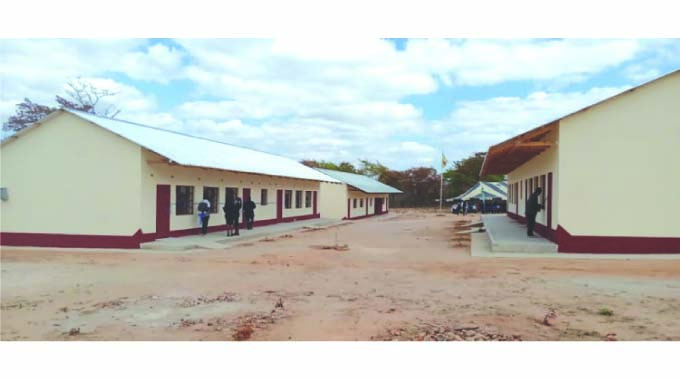
Patrick Chitumba, Midlands Bureau Chief
THE Government’s engagement and re-engagement drive is achieving the desired results after the Japanese embassy partnered the Chirumhanzu community to construct a new secondary school in the district.
Most children had to walk about 25 kilometres to Nhema Secondary School, which was the nearest institution.
Some dropped out of school while a number got pregnant through interactions along the way.
The two classroom blocks at Tokwe 4 Secondary School were built in a record three months giving the institution a major facelift which matches modern standards.
A solar-powered water system was also installed at the school with the community providing labour and bricks, while the Japanese embassy financed the project through the Local Initiatives and Development Agency (LID) to the tune of US$90 000.
Established in 2004 as a satellite school operating at the nearby Mwire Primary School, Tokwe 4 Secondary School now boasts an enrolment of 150 students.
The development was welcomed by the community members who commended the Second Republic for the engagement and re engagement programmes that are bearing fruits.
An elated Chief Chirumanzu said investment in sound education was one of the achievements under the Second Republic.
“Education is the pillar of any development and such investment is very welcome. This resettlement is in the middle of some farms and most people were shunning education. I am happy that this milestone will mean that my subjects will start valuing education and as such we will make informed decisions in developing this area,” he said.
A villager, Mrs Martha Nyoni, said the development will result in more children going to school.
“We used to face great challenges in this area as children had to walk all the way to Nhema which is a very long distance away to access secondary educational facilities. Some ended up not going to school because of the long distance. The distances were long and the results were not impressive at all,” she said.
Mr Agrippa Mawere said the school development was life-changing.
“Our children would face all sorts of problems in travelling to school. Some would even be raped as they had to cross several bushy areas and rivers. Some would indulge in early marriages as they faced a bleak future. This is indeed a life-changing experience,” he said.
Mr Mawere said villagers can also access clean water at the school.
“It’s refreshing to note that we can now easily fetch water without hassle. On top of that our children are accessing schools at their doorsteps. It’s a great milestone for people from this area,” he said.
The Japanese embassy and LID pledged to continue strengthening the mutual relations existing between Tokyo and Harare.
Japanese Ambassador to Zimbabwe Satoshi Tanaka said he was excited by cordial relations between Zimbabwe and his country.
“I am very excited by the cordial relations we have with the people of Zimbabwe. We renewed this only last week when Tokyo reaffirmed her position to assist the African continent on various development areas including education and health,” he said.
The ambassador said the Covid-19 pandemic had forced tourists from Japan to cancel trips to the country.
“I hope Covid-19 cases will continue to go down so that more Japanese people can visit this beautiful country,” he said.
Mr Pascal Manyangaidze, LID executive director, said the organisation will construct teachers’ accommodation at the school.
He said LID was development-oriented and was willing to make notable changes in education and other sectors in the district.
“We are very happy that we are playing our part in the development of our country. We are saying we will be on the ground to ensure that we build the teachers’ quarters and electrify this school,” said Mr Manyangaidze.
He said LID is there to complement President Mnangagwa’s philosophy that brick by brick, the country is built by its own people.
“We are the people who can work together and build our country brick by brick and it’s possible. Community members assisted in moulding bricks and looking for raw materials and that shows that unity and harmony will result in us building a Zimbabwe we want,” he said.
Mr Abiot Maronge, Midlands Province Secretary for Provincial Affairs and Devolution said the Government will continue to collaborate with development partners as the country journeys towards an upper middle-income society by 2030.
“This development is taking place in the backdrop of a robust engagement and re-engagement drive launched by President Mnangagwa. The deliberate move to re-integrate Zimbabwe into the global village has yielded massive social and economic benefits one of which we are all here to witness today,” he said.


 Blessing Chizhande
 Online Reporter