Online Reporter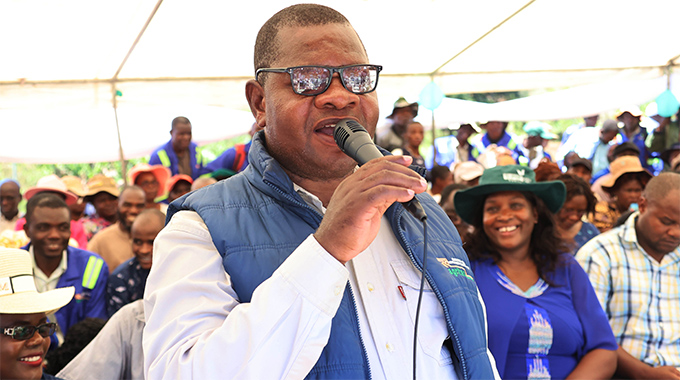
Samuel Kadungure
News Editor
GOVERNMENT has unveiled grand plans to support three million beneficiaries under the Pfumvudza programme during the 2025/26 summer cropping season. Priority will be given to households that have prepared their planting basins, gathered mulch, and contributed a bucket of maize to the Grain Market Board (GMB) as a token of appreciation for last season’s assistance.
Permanent Secretary in the Ministry of Lands, Agriculture, Water, Fisheries and Rural Development, Professor Obert Jiri, disclosed this in an interview with The Manica Post last Friday on the sidelines of the Makoni South Zonal Agriculture Show at Denzwa Primary School. Professor Jiri also emphasised the importance of farmers, particularly those without irrigation facilities, to plant crops suitable for their agro-ecological zones to mitigate the impact of climate change.
He advocated the growing of traditional grains in dryregions, citing their ready market demand due to their dietary and nutritional value. Though Professor Jiri could not be drawn into sharing statistics pending Cabinet approval next week to mark the beginning of distribution of inputs ahead of the 2025/26 season, The Manica Post understands that about 459 000 beneficiaries in Manicaland are expected to benefit, and produce a provincial target of 1 355 970 plots (84 613 hectares).
Distribution of inputs is expected to strictly adhere to established protocols to ensure transparency and accountability, and reach the intended beneficiaries. Early distribution of inputs follows hot on the heels of the meteorological forecast that predicted a good rainfall season with normal to above-normal rains.
“To qualify for assistance, households must demonstrate their commitment to the programme by preparing their planting basins, gathering mulch, and contributing two gallons of grain to the GMB as a gesture of gratitude to President Mnangagwa,” explained Professor Jiri, adding that Pfumvudza was adopted since the 2020-2021 season as a measure to ensure household food security. It is a crucial component of Government’s efforts to promote agricultural productivity, food security and rural development to ultimately contribute to the country’s economic growth.
“We are transitioning into summer, and our winter wheat, which we had a record of 122 566 hectares, is now ready for harvesting.
We are essentially looking after it, focusing on quelea bird control and irrigation management before harvest. We are also preparing for summer, and the summer season plan is ready for distribution to all provinces. We forecast a better season than last year, targeting bigger and better yields in 2026. It awaits Cabinet approval.
“We are planning Pfumvudza with three million beneficiaries in mind. Those who do not want to plant and cannot meet the criteria should be denied access to Pfumvudza inputs. This includes parents, their grown-up children, and other dependants under their household care.Everyone who fulfils the conditions should benefit.
“Pfumvudza is not just a programme for free inputs but aims to mitigate the impact of climate change and deliver good yields. Those who follow its principles will see results. Buhera farmers in particular must undergo a mindset transformation and adopt this concept. We asked every beneficiary to contribute two gallons of maize to thank the President for this programme. Next year, we should increase this contribution, in line with the Biblical principle of ‘givers get’. As climate change takes
its toll, we must adapt and change our farming methods. This is why Government is emphasising Pfumvudza. Those who do not adapt will struggle. Farmers in hot and dry areas must adapt and grow traditional grains like millets, rapoko,sorghum, cowpeas, groundnuts, and round nuts. Failure to do so will result in poor harvests and hunger. There is a ready market for these traditional grains at the GMB and there is no need to worry. Traditional grains constitute a recommended diet and should be consumed for their health benefits and medicinal properties. They are naturally bio-fortified,” he said. He also announced that the country has broken records in tobacco, maize, and wheat production, urging farmers to maintain the momentum and aim even higher next season.
“We want to prove to the world that hunger has no place in this country. The former white commercial farmers should know that black farmers can do even better than them,” he said.
Professor Jiri also revealed that Government is working on a programme to rehabilitate dip tanks in the province to enable cattle to be dipped regularly, protecting them against January Disease. He also assured farmers that teak grease and pour-on dipping chemicals will continue to be distributed.
“There are many non-functional dip tanks in the province, and our team is on the ground rehabilitating them. We will ensure that they are operational and provide tick grease and pour-on chemicals to farmers to prevent the spread of January Disease, which is already affecting Buhera District. We do not need JD to spread to other parts of the province,” he said.
To enhance agricultural extension services, Professor Jiri announced that Government will soon install Starlink, a satellite-based internet service, and provide new motorbikes for extension officers. This will strengthen their capacity and mobility, enabling them to reach every corner of their jurisdictions.