Chronicle Editor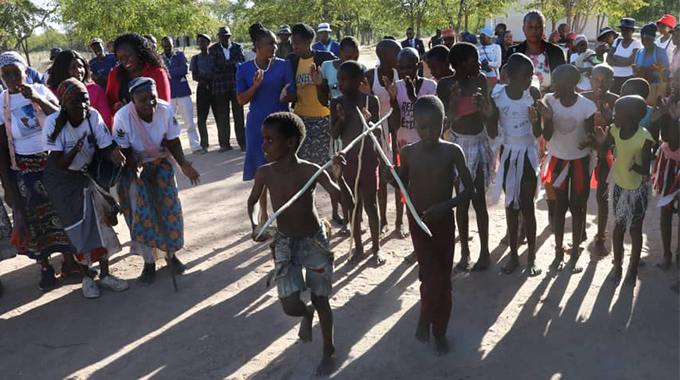
Sikhumbuzo Moyo, [email protected]
MR Madlela Maphosa (76), a respected figure with wisdom etched in the lines of his weathered face, stood tall as the village head of Mtshina Line, a predominately San Community in Tsholotsho District, Matabeleland North Province.
Being a descendant of the first people to settle in the area, Mr Maphosa is a steward of his people’s heritage.
For decades, he had witnessed the struggles and aspirations of his community, yearning for opportunities to uplift their spirits and pave the path towards a brighter future.
Then, like a beacon of light piercing through the veil of uncertainty, came the dawn of a new era with the Second Republic led by President Mnangagwa. With unwavering commitment and a vision for inclusive development that leaves no one and no place behind, the Government embarked on a transformative journey to empower the formally marginalised San community by constructing two schools in the village.
For Mr Maphosa and his community, this was more than just the construction of schools. It was a testament to their resilience, a celebration of their heritage and a proclamation of their worth.

With each brick laid and each lesson learnt the spirit of the San community soared, casting aside the shadows of marginalisation and embracing the promise of a tomorrow filled with endless possibilities.
The schools have become, not only centres of learning but also beacons of hope. Empowered by education, the San community have embarked on a journey of self-discovery and empowerment, reclaiming their narrative and shaping their destiny with newfound confidence and pride.
As the years unfolded, Mr Maphosa would look upon the schools with a sense of profound satisfaction, knowing that the crowning moment of his 76 years of existence was not merely a fleeting triumph, but a legacy etched in the annals of the history of the San community.
“Even if God decides to take me now, I will go a happy man. For many years, we have been treated as uneducated second-class citizens. This was not our making, but a colonial legacy, which saw us being marginalised and our schools lacked the basic infrastructure,” said Mr Maphosa.
He commended President Mnangagwa for taking a bold step towards championing equal participation of all Zimbabweans in national development, including previously marginalised communities, under its broad-based empowerment programmes.
“We could not believe it when we heard that a new school would be constructed right on our doorstep village. For us, it is a dream come true and we may not be educated ourselves, but one thing for sure is that the San community will never be the same again,” said Mr Maphosa.
In line with the Government’s philosophy that no one and no place should be left behind in national development, President Mnangagwa’s administration has also facilitated the recruitment of members of the San community into the country’s security services.
In 2022, 20 youths, comprising eleven males and nine females from the San community in Tsholotsho District, wrote their own piece of history when they became the first group to graduate as the Zimbabwe Prisons and Correctional Services (ZPCS) officers during the 150th recruit correctional officers’ pass-out parade at Ntabazinduna Prison Training School. A villager, Mr Vele Maphosa, said their culture and tradition, which faced possible extinction will now be preserved through the new curriculum.
“We were a people whose culture and tradition faced extinction. Even if some of our people attended school, they were not taught in their language, which is no longer going to be the case as our children will be taught in Tjwao,” he said.
Within seven years, the Second Republic and its development partners Plan International, constructed Mtshina Primary School which was commissioned in 2022 and Mtshina Secondary School, which is yet to be commissioned.
Before the latest development, local children walked long distances to Sikente Secondary School in the neighbouring village.
Mtshina Primary School is also a Zimbabwe Schools Examination Council (Zimsec) examination centre.
Last year, 24 pioneer candidates, six of whom were from the San community, sat for the Zimsec exams. Primary and Secondary Education Minister Torerai Moyo on Wednesday toured the school
The school head, Mr Gift Moyo said they scored a 25 percent pass rate. He assured the minister that there was room for improvement this year after the Government equipped the school with enough reading material and human resources. The school has a staff complement of 12 teachers and an enrolment of 410 learners.
Minister Moyo said the Government was committed to improving the lives of the San community through the provision of quality education as enshrined in the new Heritage-based curriculum.
He said the new curriculum mandates that Early Childhood Development (ECD) learners should be taught in their mother tongue.
“Government will vigorously head hunt, as part of manpower development, teachers from the San community who are going to train at the United College of Education so that they teach the Tjwao language,” said Minister Moyo.
In Zimbabwe, the community is found on the outskirts of Bulilima District in Matabeleland South province and in Tsholotsho District. Resultantly, they have lived under the dominion of the Kalanga and Ndebele tribes for the past century.
Before the Second Republic’s interventions, the San people lived in their own world, far removed from the rest of the country. Most of them did not have birth certificates or identity documents resulting in them lacking access to many services, including health and voting.
A majority of them could not access school and as a result, could not secure formal jobs, but only menial ones. In 2021, President Mnangagwa sent a team of ministers to meet the San people to hear their concerns and how they wanted them to be resolved.
Shortly after that, officials were deployed to Tsholotsho to issue birth certificates and other identity documents, and over 5 000 benefitted.


 Online Reporter