Chronicle Editor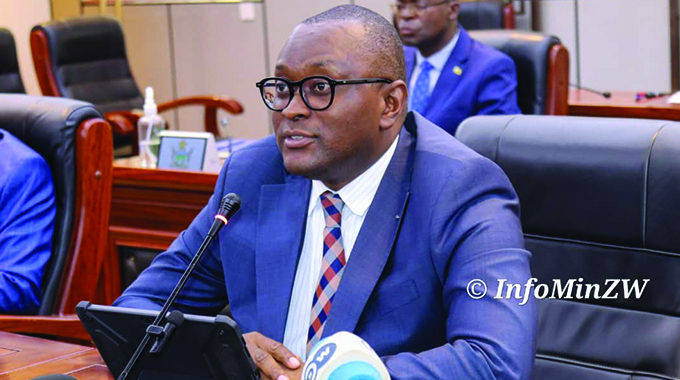
Sikhumbuzo Moyo, [email protected]
GOVERNMENT has announced that the History of Zimbabwe will become a compulsory subject on the education curriculum while national shrines and cultural heritage sites will be included throughout the syllabus to ensure sustained transformation.
The Continuous Assessment Learning Area (CALA) will also be denoted as a school-based project with an emphasis on learners carrying out the practical aspect at school as the future of the country is increasingly shaped by science and technology.
In his post-Cabinet briefing yesterday, Information, Publicity and Broadcasting Services Minister Dr Jenfan Muswere said the National Pledge will be also accorded special emphasis to entrench patriotism, loyalty, and respect while the examination framework will be reviewed to cater for, not just the academically gifted learners, but also for the technical and vocational-oriented learners.
“With a view to ensuring sustained transformation, the History of Zimbabwe will become a compulsory subject on the curriculum. National shrines and cultural heritage sites will be included throughout the curriculum, and the National Pledge will be accorded special emphasis to entrench patriotism, loyalty and respect and thereby inculcate the proper mindset,” he said.
“Products of the education system should know that Zimbabwe comes first. The national e-learning strategy will be enhanced. Diasporans who are also part of the initiative will continue to support the programme, which has already commenced in Chipinge, Chivi and Beitbridge districts.”
Dr Muswere said the Cabinet approved the Heritage-Based Education 2024-2030, which was presented by the Minister of Higher and Tertiary Education, Innovation, Science and Technology Development, Professor Amon Murwira who chairs the Cabinet Committee on Human Capital Development, Skills Development and Application.
He said the Heritage-Based Education 2024-2030 Curriculum Framework is expected to transform the education system to produce citizens with relevant skills, applied knowledge, values, and dispositions that are key to national development.
The minister said the primary and secondary education system is being designed to mould productive learners who will cherish and practise the Zimbabwean philosophical orientation of Unhu/Ubuntu.
“The proposed curriculum will embrace heritage as a basis for learning and infusing technology, and shall be implemented from ECD up to Upper Secondary School level,” he said.
“The pathways, whose learning areas are provided for in the framework, are Science, Technology, Engineering and Mathematics (STEM); Visual and Performing Arts; Humanities, especially the history of Zimbabwe; Technical/ Vocational Education and Training (TVET); and Commercials.”
Dr Muswere said the Heritage-Based Education will be anchored on programmes/learning areas infrastructure; staffing infrastructure; physical and digital infrastructure; legal and regulatory infrastructure; and financial infrastructure.
“Pertinent issues in the learning programmes infrastructure include rationalisation of learning areas; and strengthening the school-based Continuous Assessment. At the infant level (ECD A to Grade 2), learning areas are being reduced from the previous eleven to six. The reduction will also apply at Junior Level (Grades 3 to 7),” he said.
At the secondary school level, the core and compulsory learning areas are being reduced from seven to five. An inclusive and integrated approach will be used to cater for learners with special needs, including through the provision of assistive devices.
“It is envisaged that the identification of pathways will be implemented early when enrolling learners for secondary education, to cater for differences in talent and ability,” said Dr Muswere.
Learners at the secondary school level will study at least three electives from the following categories: the sciences; languages; humanities; commercials; technical and vocational; and physical education and arts.
“The review of the assessment modalities and tools will entail the rationalisation of CALA activities now denoted as school-based projects which emphasise on the learner being observed carrying out the practical aspect at school,” said Dr Muswere.
“The future of the country will increasingly be shaped by science and technology, hence the bias in the education system to foster critical thinking, innovation, creativity, problem-solving and programming.
“As the learners enrol for secondary school level, they are then categorised according to their areas of proficiency.”
Dr Muswere said central to the delivery of quality learning is the capacitation of teachers since the heritage-based curriculum requires a different approach. He said focus will be placed on in-service teacher training and coaching, using locally available resources.
“The inquiry-based teaching approaches and methods pillar aims to transform teaching practices from the traditional rote learning, lecture and drill to more learner-centred approaches where pupils have space to develop their creativity, to develop and express their ideas, to collaborate with one another, to learn by doing and thereby experience holistic development,” he said.
Dr Muswere said personnel qualified in technical and vocational programmes will be considered for employment as teachers in relevant learning areas.
“This is expected to increase the absorption of post O-Level students in tertiary education institutions in the country and form the foundation of start-ups for enterprising learners. Suitable and appropriate physical and digital infrastructure will be provided,” he said.
“Closely related will be the provision of adequate and appropriate infrastructure including classrooms; workshops; laboratories; internet connectivity; technical equipment and teachers’ houses; to achieve the intended goals.”
Dr Muswere said the workshops and laboratories shall be tailor-made according to the unique geographical needs and locally available resources which learners can observe, manipulate and explore during their learning processes.
“Access to electricity, either from the national grid or renewable sources of energy will be a priority for every school. This is to bridge the gap between the rural and urban schools. The focus will be more on learning by doing,” he said.
“To actualise the aims of our education system, a review of the legal and regulations infrastructure will be undertaken. This shall include the alignment of the Heritage-Based Education Curriculum with Section 13 of the Constitution of Zimbabwe which states that ‘The State and all institutions and agencies of Government at every level must endeavour to facilitate rapid and equitable development.”
The minister said policies and regulations will be implemented to ensure that no place or individual is left behind as the curriculum is implemented.
“There will also be continuous harmonisation of the Primary and Secondary Education Curriculum with the Higher Education Curriculum,” he said.


 Online Reporter