Chronicle Editor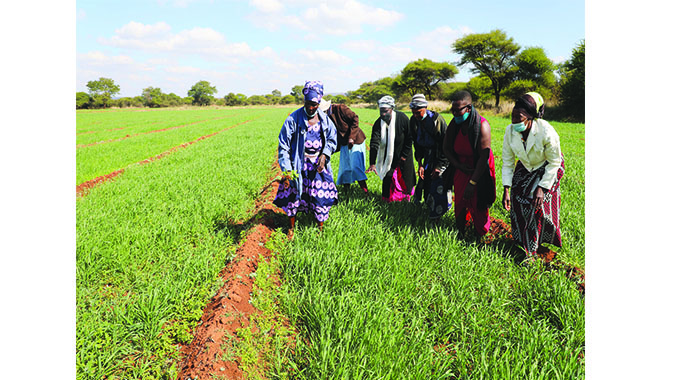
Sukulwenkosi Dube-Matutu, Chronicle Reporter
GOVERNMENT under the Second Republic has made significant progress in revatilising irrigation schemes to ensure food security a report has revealed.
Functional irrigation schemes in the country jumped from 25 percent last year to 50 percent this year.
According to the Zimbabwe Vulnerability Assessment Committee (ZimVac) 2022 Rural Livelihoods Assessment
Report, out of 397 irrigation schemes that were sampled across the country, 202 were functional while 82 were non functional and 113 were partially functional.
Masvingo had the highest number of functional irrigation schemes with 45. The province had 12 non functional and 12 partially functional irrigation schemes. Followed by Manicaland with 43 functional irrigation schemes, two non functional and 20 non functional irrigation schemes.
Matabeleland South had 23 functional, 12 non functional and 22 partially functional irrigation schemes.
Matabeleland North had 17 functional, four non functional and six non functional irrigation schemes
The ZimVac 2021 Rural Livelihoods Assessment Report shows that out of 603 irrigation schemes, 148 were functional while 273 were non functional and 182 were partially functional.
The main reason for non functionality of irrigation schemes was identified as break down of pumping units followed by the need for rehabilitation and maintenance of in field works. Other problems include challenges in power supply and lack of capital.
Government working with various partners is rehabilitating irrigation schemes that have been lying idle across the country and establishing new ones in order to improve food and nutrition security and ensure attainment of Vision 2030.
Government is targeting to rehabilitate and develop 350 000 hectares of land by 2025 across the country to safeguard the country against the negative effects of climate change and ensure food security.
“Government is committed to irrigation development as the long-term solution to achieving sustainable and climate resilient agriculture. Through the Ministry of Lands, Agriculture, Fisheries, Water and Rural Development, Government has come up with an Accelerated Irrigation Rehabilitation and Development Plan (AIRDP) to accelerate irrigation rehabilitation and development.”
“The Ministry is targeting to increase cropping area under irrigation from 116 000 ha to 350 000 ha by 2025. There are 450 smallholder irrigation schemes out of which 50 percent (225 schemes) require rehabilitation. A total of 92 schemes will be rehabilitated in 2022. The Ministry is also targeting the introduction of irrigation scheme business managers to manage the schemes as business cases,” reads the report.
Under the Second Republic, Government is prioritising the revival of the agricultural sector through the development of irrigation schemes to alleviate food insecurity and poverty particularly in rural communities.
A number of irrigation schemes that had been lying idle have been revived while some that were being underutilised have been capacitated and expanded.
Government has also rolled out various agricultural schemes meant to transform subsistence agriculture at household level into commercial agriculture.
Managers have also been deployed to irrigations schemes across the country to maximise production thereby ensuring food security and nutrition.
The intervention from Government and its partners has seen a number of irrigation schemes in Matabeleland South being revived while new ones have been established.
Matabeleland South acting provincial agricultural director rural development services, Mr Mkhunjulelwa Ndlovu said irrigation schemes were fast developing in the province following intervention from Government and various partners. He said this will go a long way in ensuring food security in the province.
“We have a number of irrigation schemes that have been rehabilitated in the province under various programmes. Examples include Sebasa, Tshikwalakwala, Guyu-Chelesa, Silaltshane among others which were revatilised under the SIRP programme. We also have Mtshabezi Irrigation Scheme which was established after Government released funds,” he said.
“There are some irrigation schemes in the province which were underutilised but their production levels have been boosted following intervention from various partners. Examples include Artherstone Irrigation Scheme and Moza Irrigation Scheme. The farmers are also concentrating on operating their schemes as businesses and growing cash crops,” he said. — @DubeMatutu



 Online Reporter