


 peter
peter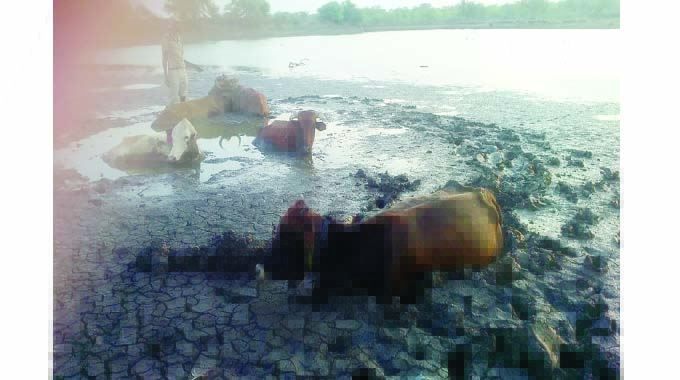
Judith Phiri, Business Reporter
THE Government has quickly responded to distress calls by livestock farmers in Matobo District, Matabeleland South province, who are at risk of losing their investments due to drought by drilling 10 boreholes as well as sending dam scooping equipment to desilt dams and augment provision of water.
The intervention comes after a story in this publication last week highlighted the livestock situation in Gohole Village, Kezi where villagers were rescuing cattle stuck in the mud in the Hozalenditshi Dam. The animals were trying to get closer to the little remaining water in the dam.
It has since emerged that a number of districts in the Matabeleland region were facing a similar predicament. Ministry of Lands, Agriculture, Fisheries, Water and Rural Development Permanent Secretary, Professor Obert Jiri, said the Government was alive to the challenges and was ready to assist farmers.
“Yes, we have heard about cattle that were stuck in the mud in the drier region of Matabeleland. The pictures that came out in the media largely showed cattle stuck. And because they were static pictures, you would see as if the cattle were dead, but those were just cattle stuck in the mud as they were trying to access water in a receding dam. The cattle were rescued, they are alive and well. So we have gone there to remove the mud and made sure that the water is accessible. We have also sent our teams to drill boreholes in the district, at least 10 drilling rigs are down there to ensure that there is enough water in the particular ward for the people and their livestock.”

He said while they were drilling boreholes to ensure there was access to water, farmers were encouraged to take care of their livestock and monitor their movements. Prof Jiri said they have also availed hay bales and smart technologies to ensure the bales are of good quality. He said the challenges were temporary as the water situation and pastures were going to improve with the onset of the delayed rainy season.
“However, we are not stopping as the Government in assisting those communities that are affected. We will ensure both the people and livestock have access to water,” he said.
Prof Jiri added that the long-term solution was in the pipeline and has been outlined by President Mnangagwa when he said the Government was going to move in and drill 35 000 boreholes in 35 000 villages across the country from where they were going to set 35 000 nutritional gardens to support food security and nutrition in the country’s communities.
The drought is a result of a projected El Niño phenomenon affecting Southern Africa with forecasts indicating that Zimbabwe is likely to experience normal to below-normal rainfall in the 2023/2024 cropping season.
The phenomenon, which is not new to Zimbabwe and the region, usually causes delayed and erratic rains, thus, adversely affecting crops and livestock. The drought has affected the water table causing watering points to dry up in the face of excessively hot weather conditions.

Mr Thabani Ndlovu from Ekuthuleni Village, Gwezha Ward 3 in Matobo District, said Government intervention was a welcome development as water was now a challenge in the area.
“Most water bodies here have dried up and water is not only a challenge to livestock but to villagers as well. Some of us have resorted to unprotected water sources, while some have to travel long distances to access water.”
Matabeleland South acting provincial director for Agricultural Rural Development and Advisory Services (Ardas), Mr Mkhunjulelwa Ndlovu urged farmers to implement strategies aimed at safeguarding their livestock in the face of excessively hot weather conditions. These include closely supervising the livestock and pen feeding to reduce distances travelled by animals.
“Farmers are advised to drive their animals for watering. Animals remain a community asset that demand attention from the entire farming households. If stuck in the mud everyone is responsible to save life, while use of borehole watering points is ideal,” he said.
In Zimbabwe, livestock play an integral part for communities, as a source of income for two-thirds of rural households, while contributing significantly to inclusive growth of the agriculture sector and the economy as well as food and nutrition security, according to agriculture experts.



 Blessing Chizhande
 Online Reporter