

 Online Reporter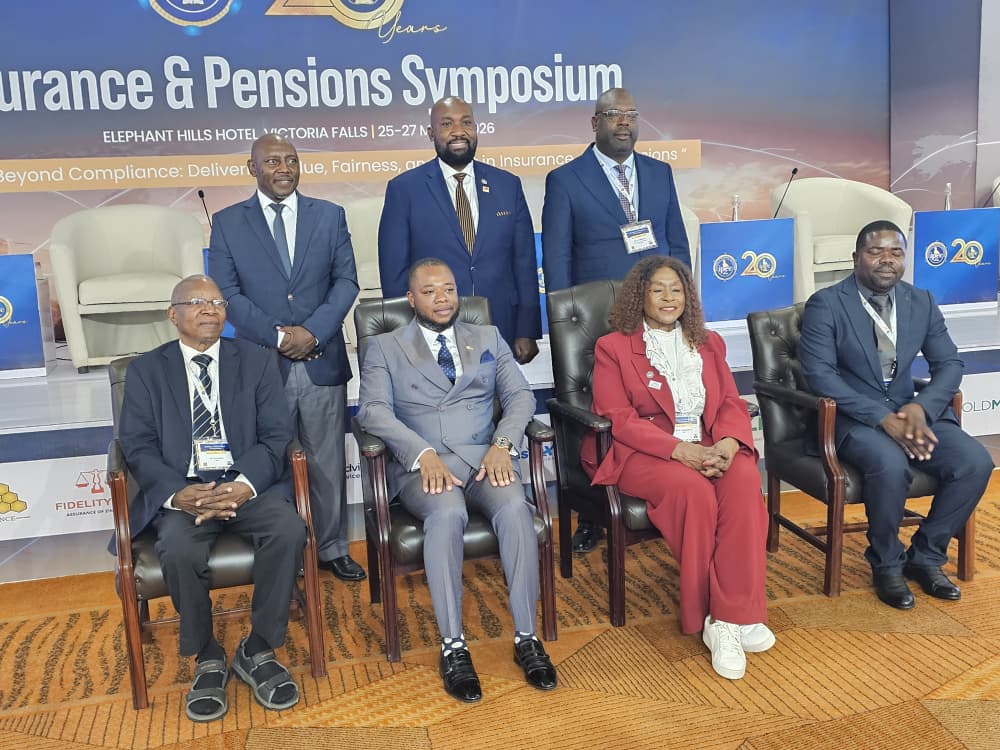
Business Reporter
The Government of Zimbabwe does not view the insurance and pensions industry as merely another industry but as a strategic partner in national development, Deputy Minister of Finance, Economic Development and Investment Promotion, Kudakwashe Mnangagwa, has said.
Speaking at the Insurance and Pensions Symposium organised by the Insurance and Pensions Commission in Victoria Falls, the Deputy Minister delivered a wide-ranging address covering the monocurrency transition, pre-2009 compensation, and the sector’s role in achieving Vision 2030.
On the monocurrency transition, the Deputy Minister stated that Government is acutely aware that the currency shift carries specific and material implications for long-term financial contracts.
“Insurance policies and pension fund obligations are, by their very nature, inter-temporal contracts. They are entered into today and honoured over years, sometimes decades,” he said. “Any disruption to the currency framework can, if not managed carefully, erode the real value of these obligations and undermine policyholder and pension member confidence.”
He gave Government’s firm commitment that the transition “will not disrupt the insurance and pensions industry,” adding that Government is “mindful of the lessons of history” and determined not to repeat past mistakes.
On pre-2009 compensation, he described the loss of life savings during hyperinflation as “one of the most painful chapters in the financial history of Zimbabwe.”
“That loss was not merely financial,” he said. “It was a loss of trust in institutions, in financial products, and in the long-term value of saving itself. No amount of regulatory reform, no amount of product innovation, and no amount of marketing will restore public confidence in long-term savings if the wounds of the past remain unaddressed.”
He reaffirmed Government’s commitment to finalising the compensation exercise, acknowledging the persistent advocacy of IPEC Commissioner Dr Grace Muradzikwa. “We will make sure that we do right by our pensioners,” he said.
On industry engagement, he urged stakeholders to submit white papers outlining their positions. “This is not a consultation for appearances sake,” he emphasised. “This is Government recognising that the technical expertise in this room is indispensable to getting this right.”
On insurance as a development tool, he described insurance as “the invisible foundation upon which a productive, dynamic economy is built.”
He noted that pension funds, when fully developed, have “the potential to mobilise tens of billions of dollars in investable assets” to fund infrastructure and support small to medium enterprises.
As he drew his remarks to a close, the Deputy Minister urged delegates to “engage deeply, speak boldly, and produce recommendations that are worthy of the moment,” adding that the work of the symposium matters “not merely to the industry but to the millions of Zimbabweans whose financial security is ultimately at stake.”


