Chronicle Editor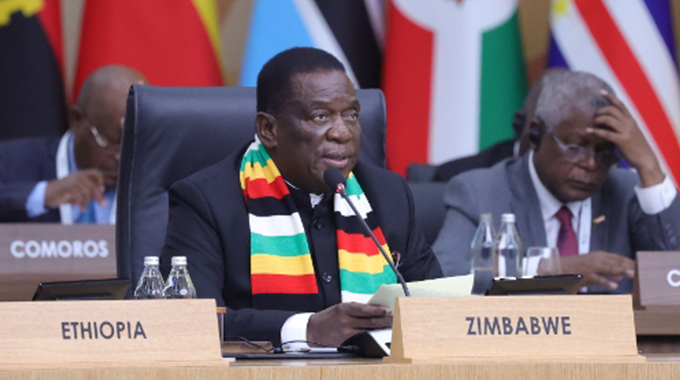
Hebert Zharare in SeouL, South Korea
PRESIDENT Mnangagwa has challenged Zimbabweans in the diaspora to channel their investments into the productive sectors of the economy, assuring them Government is in the process of clearing all bottlenecks that are stifling the flow of capital from locals based abroad.
The President revealed this on Wednesday night while addressing close to 40 Zimbabweans who are part of the 120 either working or studying in South Korea. So hearty were the engagements that the parties poured their hearts out, expressing what they were able to do to contribute towards national economic development.
Finance, Economic Development and Investment Promotion Minister, Professor Mthuli Ncube, Foreign Affairs and International Trade Minister, Ambassador Frederick Shava, Lands, Agriculture, Fisheries, Water and Rural Development Minister, Dr Anxious Masuka, Environment, Climate and Wildlife Minister, Dr Sithembiso Nyoni, Zimbabwe’s Ambassador to South Korea, Ambassador Stewart Nyakotyo, Information Communication Technologies Minister Tatenda Mavetera and senior Government officials attended the engagement.
President Mnangagwa and his delegation were in the Asian country attending the hugely successful inaugural South Korea-Africa summit held on June 4 and 5 at the Korea International Exhibition Centre, just 24 kilometres out of the capital, Seoul.
“I now challenge our diaspora community to diversify their investments into productive sectors. Those keen to invest back home are assured that we have made deliberate efforts to streamline bottlenecks and challenges being faced.
“The ease of doing business environment will be continuously improved not just for foreign investors, but for local Zimbabwean investors and businesses as well,” said President Mnangagwa.
To ensure seamless implementation of programmes by Zimbabweans abroad, President Mnangagwa said the national diaspora taskforce and diplomatic missions were soliciting for views and inputs for the review of the Zimbabwe Diaspora Policy so that it is aligned to the National Development Strategy.
“We look forward to your input based on your unique experiences to ensure that the policy aligns with the present realities and aspirations of our people in the Diaspora,” he said.
Over the years, diaspora remittances have been gaining traction in the economy and official figures show they are now among major sources of foreign currency for the country.
“May I highlight that diaspora contributions through financial remittances have played a significant role in the resuscitation and stabilisation of our economy. Remittances are now the second largest source of foreign currency inflows into the country after mining. Financial remittances for the year 2024, are on course to surpass the U$1,8 billion received in 2023.
“This saw an increase of 18 percent in remittances during the first quarter of 2024, amounting to US$494 million compared with US$420 million received during the same period in 2023.
“To the Diaspora community, I say well done, congratulations, makorokoto, amhlophe, your collective efforts are going a long way towards the development of our beloved motherland Zimbabwe,” President Mnangagwa said.
He said the Second Republic was on course to realise sustainable development and the attainment of an upper middle-income economy by 2030 and in that regard, the Government was conscious of the role the diaspora community played through mutually beneficial partnerships and investments.
The President said Government was ready to harness the experience and expertise from Zimbabweans based in other countries which spanned across all sectors of the economy in an effort to leap frog skills transfer and the modernisation and industrialisation of Zimbabwe.
“Particularly you here in the Republic of South Korea have been exposed to robust and well-developed science, technologies and innovation ecosystems. Your experience and knowledge acquired in this respect should be eventually channelled back home,” he said.
Turning to agriculture, President Mnangagwa said the sector was the most important one not only because it was the mainstay of the economy, but because it provided food for other sectors.
He said the land reform programme was a done deal adding that those who are interested in the sector could go into joint ventures with those who were allocated farms or venture into other areas such as those along the agriculture value chain like food processing.
Despite the El Nino-induced drought, the President said Zimbabwe continued to experience unprecedented increases in agriculture production and productivity throughout all categories of the sub-sectors, adding that Pfumvunza/Intwasa had been a great success.
“To further mitigate the negative impact of climate change, we are building dams in all eight provinces and drilling boreholes as well as setting up agriculture village business units in all our country’s 35 000 villages. Similar facilities are being set up in schools and within vocational training centres.
“On the broader economic front, efforts by Government to maintain a stable macro-economic environment, entrench national pride and identity as well as reduce exchange rate volatility, have seen the introduction of a new structured currency, the Zimbabwe Gold (ZiG). All of us must continue to support our own local currency,” he said.
The President said the mining sector had grown from a US$2.7 billion dollar sector in 2017 to the current US$12 billion, and the country continued to pursue a policy of beneficiation to drive maximum value from the country’s minerals.
“Our primary and secondary school levels are also being channelled along the science, technology and innovation pathways. This is how developed countries realised their present modernity, we are on the right course.
“On the international relations front, we say, Zimbabwe is a friend to all and an enemy to none. We continue to implement a policy of engagement and re-engagement with all countries within the comity of nations who wish to collaborate with us based on respect and mutually beneficial relations,” he said.
“Nyika inovakwa nevene vayo, Ilizwe lakhiwa ngabanikazi balo” is the philosophy that should always guide us as a nation and as the descendants of the Great Munhumutapa, no matter where we may find ourselves”.
Since the advent of the Second Republic, the President has taken it upon himself to always engage with citizens and nationals on the sidelines of any of his international engagements.
“In doing so, we remain guided by our common and shared desire to see our country prosper and fellow citizens realising a higher quality of life.
‘You are therefore encouraged to openly share your views and to come forward and play your part, individually and collectively as we build the ‘Zimbabwe we want and an empowered upper middle income society by 2030.”
During a question and answer session, the Zimbabweans based in South Korea wanted to know how they could participate in the lithium revolution, the artificial intelligence sector, property development, e-learning, among other sectors.


 Online Reporter