Chronicle Editor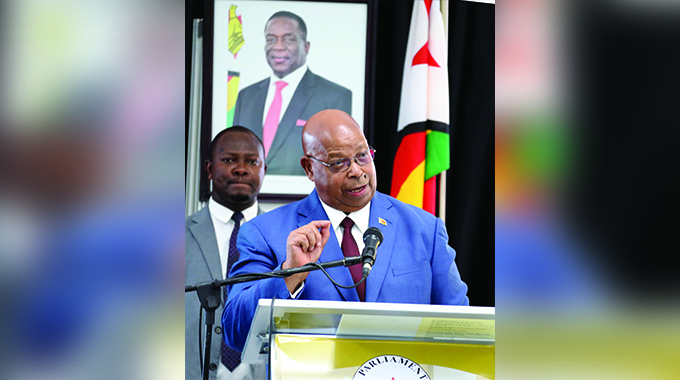
Peter Matika [email protected]
Government has resolved to implement climate change adaptation and mitigation actions across all sectors, including the implementation of the National Climate Change Adaptation Plan (NAP) by mainstreaming climate change in development planning and budgeting processes.
As part of measures to mitigate climate challenges in the country, the Government will also use Artificial Intelligence (AI) to predict future climatic changes to mitigate drought related challenges that may affect the country’s harvest, therefore affecting the economy.
Speaker of Parliament Advocate Jacob Mudenda, said, during the Pre-Budget Seminar for the 2025 National Budget being held in Bulawayo parliamentarians must require that the current budgetary processes account for the opportunities presented by the seminal concept of climate responsive budgeting.
“The ultimate objective is to align public finance with Government commitments and priorities related to climate change adaptation measures. In this regard, the 2025 budget should embrace the application of emerging digital technologies, particularly the deployment of Artificial Intelligence (AI) for predictive data analytics in a digital economy,” said Adv Mudenda.
He said no budget can achieve effective implementation if the revenue tax base is constricted.
Adv Mudenda said the budget strategy underscores the criticality for domestic resource mobilization as it is essential for fiscal consolidation in underwriting the economic reform agenda as well as supporting the implementation of NDS1 programmes and projects.
He said it is parliament’s constitutional and patriotic role to demand that the revenue authorities draw inspiration from Mexico and India whose economies are characterized by high levels of informality but have managed to effectively mobilize revenue for economic development from the informal sector.
“Mexico has one of the largest informal economies in Latin America with nearly 60 percent of the workforce operating informally. Consequently, Mexico introduced a simplified tax regime and invested heavily in digital platforms designed specifically for small businesses and informal workers which makes it easier for them to comply with tax obligations to the State,” said Adv Mudenda.
He said India’s informal economy has more than 80 percent of the workforce operating informally.
“Despite this, India has made significant progress in tax collection, particularly through the introduction of the Goods and Services Tax (GST) and a digital platform which has made it easier for the informal businesses to comply with tax regulations.”
“Let us emulate such taxation initiatives in order to boost our revenues, against a background where the 2025 Budget Strategy Paper has estimated a total revenue of ZiG103 billion which is 17, 8 percent of the GDP, against a total expenditure of ZiG111, 7 billion, equivalent to 19, 4 percent of the GDP, resulting in a deficit of 1, 5 percent of the GDP Adv Mudenda said”
However, he said the motivating factor lies in national self-belief that the country’s citisens are their own economic liberators.
“As we craft the 2025 national budget, it is imperative that we place women and youth at the centre of our economic strategies. The women and youth dividend can only be harnessed if Zimbabwe invests in their education, skills development and entrepreneurship. Accordingly, all banks that have been set up for women and youth should be comprehensively capitalised through the 2025 budget,” said Adv Mudenda.
He mentioned that liberation war veteran’s welfare deserves a significant budget allocation in the 2025 budget in recognition of their contribution to the country’s independence.
Adv Mudenda emphasised that parliament is obligated to comply with the provisions of the constitution.
“…especially as read together with Standing Order No. 21 (a) of the National Assembly which stipulates that; “Parliament must monitor and oversee expenditure by the State and all Commissions and institutions and agencies of government at every level… to ensure that all revenue is accounted for. All expenditure has been properly incurred, and any limits and conditions on appropriation have been observed.”
“In this regard, I must recognize and commend all line ministries for their significant progress in submitting monthly and quarterly Budget Performance Reports to Parliament,” said Adv Mudenda.
He went on to commend respective committees for the evident improvement in roles relating to the prudential management of the public purse.
“However, it is noted that some Select Committees still find these responsibilities too daunting and onerous. The Liaison and Coordinating Committee is, therefore, called upon to decisively assert its authority to ensure improved performance by these few Select Committees. If at all, let all Government entities receive clean and unqualified audits from the Auditor General from now on,” said Adv Mudenda.



 Online Reporter