admin
admin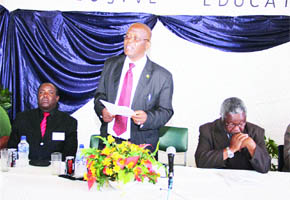
“All colleges should have inclusive orientation so as to produce versatile teachers that can teach any class and suit the needs of individual students.”
Mr Dewa said the Government had set aside some funding for the colleges to rehabilitate their infrastructure to suit the needs of different disabilities.
He, however, could not give specific figures on how much had been set aside for the project.
Mr Dewa urged colleges to be flexible by adopting the modern Information and Communication Technologies (ICTs) in order to enhance increased access to education and allow learners to unlock and share information on different issues.
He also called on lecturers and teachers in schools to develop positive attitudes in order to develop the potential in learners at all levels.
Mr Dewa said the changes in teacher training were in line with the international and regional conventions on education, to which Zimbabwe is a signatory.
These include the Jomtien Declaration on Education for All (1999), the Salamanca Framework of Action on Special Needs Education (1994), the 2006 United Nations Convention on the Rights of Persons With Disabilities and the Sadc Protocol on Education and Training).
These treaties require member states to provide enabling structures, systems and learning methodologies that meet all the learners’ needs irrespective of race, colour or creed.
The University of Zimbabwe (UZ)’s Department of Teacher Education chairperson, Dr Sheasby Matiure, who is also attending the workshop, said SNE had been sidelined for a long time.
He said UZ, as a quality assurance institution, would support the colleges in coming up with the requisite curriculum, developing skilled manpower and the implementation of the programme.
Former UCE lecturer who is now the coordinator of VVOB, a SNE development partner, Mrs Beatrice Musindo, said 70 percent of the country’s population lived with some form of disability.
“Contrary to what many people think, disability goes beyond visual, hearing or lingual impairment. In fact more than 70 percent of the people have some form of difficulties that affect learning. These could be emotional, physical or psychological problems,” said Mrs Musindo.
“The new approach would ensure teachers appreciate different needs of a child, enhance versatility and ensure that all children learn in an inclusive environment where they are respected and recognised.”
She commended the Government for adopting the resolution to mainstream SNE, saying the development would enhance improved education standards.
Mrs Musindo said the new approach should also cater for the empowerment of the girl child.
UCE principal Mr Sipho Moyo said there was a need to incorporate SNE in the Early Childhood Development (ECD) programme in order to achieve the desired impact.
He also appealed to development partners to assist the Government in procuring specialist equipment and in developing the relevant expertise for the new programme.
There are 15 teacher-training colleges in Zimbabwe, 11 for primary education and four for secondary training colleges, which include Hillside, Mutare, Belvedere Technical and Gweru Polytechnic.
The workshop ends on Saturday and is being attended by vice principals from all the 15 teacher training colleges, heads of departments and lecturers.



 Online Reporter