Chronicle Editor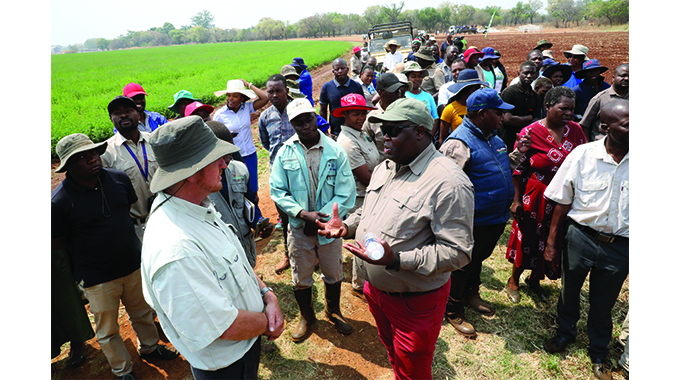
Rutendo Nyeve, Sunday News Reporter
THE Government has called on farmers in low rainfall and rain fed areas to have a bias towards small grain traditional crops to mitigate the effects of the forecasted El Nino while it is putting together various irrigation interventions to ensure continued food security.
The call comes as preparations for the 202324 summer cropping season are at an advanced stage with provinces having started receiving inputs. El Nino is a climate pattern that describes an unusually warmer season with little rainfall.
Despite the prediction of below average rainfall in most parts of the country, registration of farmers is almost complete and farmer reorientation and staff training is ongoing in most provinces while distribution of farming inputs has begun in earnest.

Permanent Secretary in the Ministry of Lands, Agriculture, Fisheries and Water and Rural Development Dr John Basera said cognisant of the 2023/24 seasonal outlook report, his team was working to come up with appropriate early actions and various initiatives to ensure food security.
“A below normal rainfall season is projected and is likely to hit the sector hard. As we reflect long and hard on this, we are expected to come up with appropriate early actions, early responses through customised agriculture extension messaging and implementing robust migiratory measures. Our reflections should culminate into the following key touch points; our AMA: Adaptation, Mitigation, Action. As Zimbabwe Agriculture Team, we are expected to spring into action and deploy the ‘going for growth’ initiatives as we gear for the 2023/24 season,” said Dr Basera.

He said the Ministry was deploying eight key initiatives which include accelerated irrigation rehabilitation through a quick fix irrigation programme, religious adoption of Pfumvudza/Intwasa tenets and promoting on-farm feed formulations with climate smart fodder options.
“Every available irrigable square inch of land should be cultivated to maize while promoting and intensifying in-field water and moisture harvesting. Every drop counts and must be conserved. We have to improve season preparedness through early inputs distribution informed by agro-ecological potential matching. A bias towards growing of traditional/ small grains is required. A healthy animal or crop stands a ‘bad season’ better, hence adoption of GAPs (Good Agricultural Practices) is encouraged at all times as well as increasing vigilance in protecting veld. Mulching is essential, do not burn it, mulch it,” said Dr Basera.
One of the provinces predicated to be most affected by the effects of El Nino is Matabeleland South where the Agritex Provincial Director Mr Mkhunjulelwa Ndlovu said they were raring to go, pinning their hopes on climate proofing agriculture as well as agro-ecological matching.
“We are preparing our farmers to grow drought tolerant crops. These are traditional crops like sorghum, finger millet, rapoko and soya beans. Basically we are doing agro-ecological matching because of the rainfall distribution and intensity. We will have pockets within the province where farmers will be tempted to grow maize, we cannot tell them to stop but our message is for them to go for small grains. We are also encouraging them to do the climate proofing through the use of Intwasa/Pfumvudza as well as utilizing irrigation schemes to those who have access to them.

“In terms of inputs distribution, currently we have received fertiliser and we are waiting for the seeds which might come very soon. Farmer registration is almost complete while farmer reorientation and staff training is ongoing. We are really geared for the season. The Meteorological Services Department is also disseminating climate data. Irrigation rehabilitation is also underway where we are changing the usual systems into climate smart systems. The use of centre pivots and sprinklers that can save water,” said Mr Ndlovu.
The 2023/24 summer cropping season comes at a time when the Meteorological Services Department (MSD) has predicted erratic and low rainfall patterns this year because of El Nino conditions which are expected to affect Southern Africa as a result of climate change.
To cushion the situation where Zimbabwe and other Southern African nations are faced with the realities of climate change, Government is putting together various initiatives to ensure the country does not lose the gains made so far in the agriculture sector. Government has thus come up with robust mitigatory measures under adaptation, mitigation and action which include strengthening the adoption of climate-proof agriculture methods such as Intwasa/Pfumvudza as well as intensifying agro-ecological matching to guarantee a good harvest.–@nyeve14



 Online Reporter