Chronicle Editor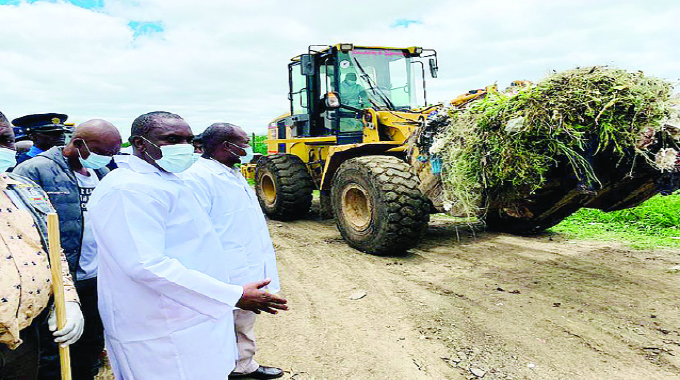
Patrick Chitumba, [email protected]
GOVERNMENT has warned local authorities in the Midlands province against recruiting casual workers through councillors saying the trend leads to inefficiency and partisan workforce that affects the quality-of-service delivery.
Minister of State for Midlands Provincial Affairs and Devolution, Cde Owen Ncube, who was officiating at the launch of the “Enhanced clean-up programme” in urban areas and growth points at Mtapa fresh produce market in yesterday said the Government does not condone nepotism or any form of corruption.
Mtapa market is home to more than 3 000 vendors who have made the place their home since 2021 when they were relocated from the Central Business District during the Covid-19 pandemic.
Town clerks and other officials from urban and rural councils in Midlands province attended the launch programme, which comes at a time when the province and the country at large is grappling with the cholera outbreak.
Poor service delivery, inadequate hygiene and inefficient waste management in urban areas have primarily fuelled the spread of cholera.
“My office will not tolerate the practice of recruiting casual labourers through elected officials especially in some urban local authorities as it creates an inefficient and partisan workforce that compromises quality service delivery,” said Minister Ncube.
He said regulations governing the hiring of employees through the Ministry of Public Service, Labour and Social Development should be adhered to and that firm corrective action will be taken against errant local authorities who fail to comply.
Minister Ncube urged local authorities to work closely with the Environmental Management Agency (EMA) and all stakeholders in the implementation of the enhanced clean-up programme.
“Local authorities should ensure that they provide and adhere to daily and weekly waste collections schedules, establish waste sorting, bailing and collection sites in every suburb and growth points, establish waste management committees at all food and vegetable markets, vending sites, growth points and any other major business centres and promote waste recycling to drive economic development,” he said.
The enhanced clean-up programme for urban areas and growth points in Midlands province emanates from the Government’s directive to local authorities to improve waste management in all areas under their jurisdiction.
Moreover, the recently launched “We are equal” Campaign and “Zero Waste Movement” in Maputo, Mozambique attended the First Lady Amai Auxillia Mnangagwa and other first ladies from Kenya, Nigeria, Malawi and Botswana as well as high level representatives from Eswatini and Rwanda, propelled the urgency of rolling out enhanced waste management in Africa and Zimbabwe and the Midlands province has seized the initiative, Minister Ncube.
He, however, acknowledged that local authorities were having challenges in waste management, which has resulted in widespread illegal dumping in undesignated areas as is the case with Mtapa market where public health safety has become a cause for concern justifying intervention by Central Government.
“Accordingly, following the highly successful launch of Operation Chenesa Harare by the Minister of Local Government and Public Works, Midlands province is implementing the initiative starting with City of Gweru and the programme will be cascaded to all districts guided by the ‘Smart City’ concept, which is in line with an upper middle-income society by 2030 as envisioned by President Mnangagwa,” said Cde Ncube.
Meanwhile, the minister said his office has created a strong partnership with the corporate world and the City of Gweru to enhance waste management.
He said such partnerships were essential given that waste management has significantly deteriorated in the past two decades in most urban centres, growth points, towns and cities.
“Moreover, economic recovery and growth under the New Dispensation triggered increased per capita consumption and an increase in the amount of waste generated and disposed into the environment,” said Minister Ncube.
“Focus is also on rehabilitation of road networks and water reticulation. All potholes in town and high-density suburbs should be attended to as a matter of urgency and cascade drug and substance abuse elimination programmes to community levels as the scourge has threatened the physical and mental health of our youths and some adults.”
The minister also challenged captains of industry among other organisations to take the enhanced waste management programme as an opportunity to exercise their corporate social responsibility role by mobilising resources to assist in resolving waste management issues.



 Online Reporter